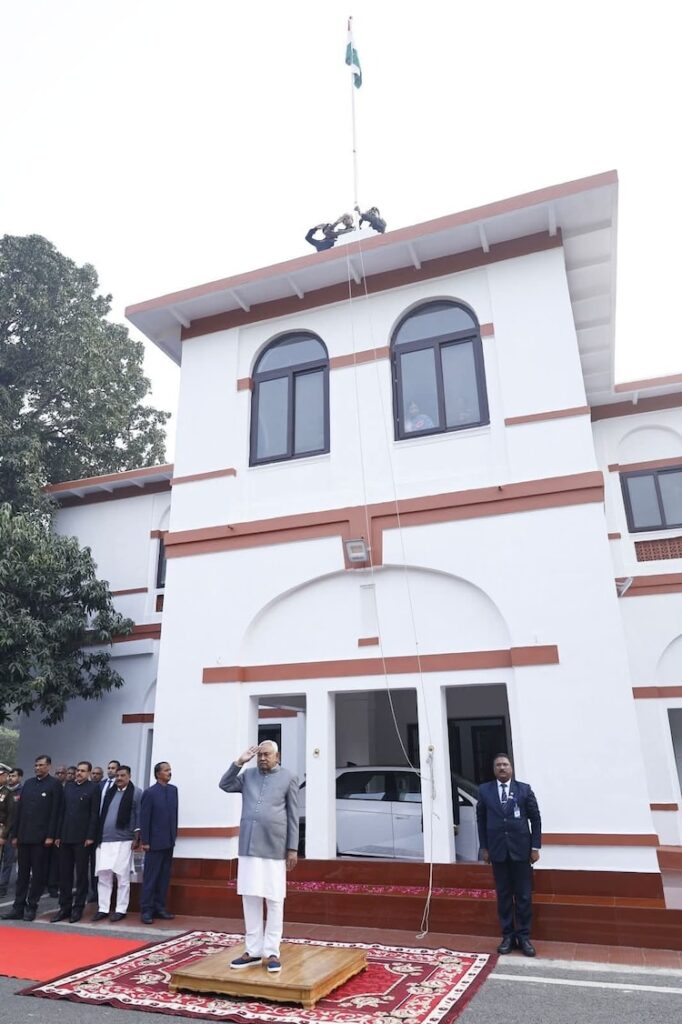
The relocation of Nitish Kumar from 1 Anne Marg to 7 Circular Road—though a distance of a mere 100 meters—is far from a routine move. Occurring as he assumes his role as a Rajya Sabha MP and prepares to vacate the Chief Minister’s office, this transition carries profound political and administrative weight, signalling a definitive shift in Bihar’s power dynamics.
In Bihar, 1 Anne Marg holds the significance of being the most powerful address as it is the official residence of the Chief Minister. It is considered that the state administration runs from this bungalow, with the Chief Minister being involved in every decision-making.

Hence, moving out of this residence clearly indicates that the centre of power is shifting.
CHANGE IN POWER AND ROLE
During his stay at 1 Anne Marg, for more than two decades, Kumar functioned as the head of the Bihar state, with all top Bihar bureaucrats (IAS, IPS officers) reporting to him. From framing policies to taking major administrative actions, every decision involved his direct supervision.
Shifting to 7, Circular Road, after the resignation as the Bihar CM, will reduce Kumar’s role to a national and legislative one rather than an executive one. He will participate in debates, the law-making procedure, and the quotidian affairs of national politics; however, he will not hold the authority to control the everyday administration of Bihar.

This means that his direct administrative authority has been reduced significantly, even if his political importance remains the same.
ROOMS AND INFRASTRUCTURE: 1, ANNE MARG VS 7, CIRCULAR ROAD
1, Anne Marg bungalow is a sprawling property spread over approximately 6 acres of land. It is a high-security government residence.
The residence is spread across a very large campus and includes dozens of rooms, including residential suites, multiple office chambers, large meeting halls, and dedicated spaces for staff, security, and visitors.
It is designed to function both as a home and as a full administrative headquarters. A specific structure exists where the Janata Darbar used to be held till 2015.
On the other hand, 7 Circular Road is a smaller government bungalow. It is also known as the official residence/ camp office of Bihar Chief Minister Nitish Kumar. The 6 VIP rooms in this bungalow are mainly meant for residential use, along with limited office space for personal staff. It does not have the large conference halls or administrative infrastructure required for running the state government.
It is clear that 1, Anne Marg, is larger and plays a more complex role than 7, Circular Road.
Kumar, for the first time, shifted to 7, Circular Road in 2014 after he quit as Bihar CM and handed over the post to Jitan Ram Manjhi for about a year. In 2015, when Kumar returned to power with the help of his arch-rival, RJD, he came back at 1, Anne Marg, but retained 7, Circular Road. That was the time when the opposition leaders questioned him about holding two bungalows, both formally allotted in the name of the Chief Secretary.
SALARY DIFFERENCE: CHIEF MINISTER VS RAJYA SABHA MP
One of the most important changes in this transition is related to salary and financial benefits.
As Chief Minister of Bihar, Nitish Kumar receives a salary that is estimated in the range of Rs 2-2.5 lakh per month, along with several allowances and fully state-funded facilities such as residence, staff, transport, and security. His total financial gain significantly exceeds his base salary, as the government subsidises the majority of his primary expenses.
After becoming a Rajya Sabha MP, Kumar’s salary structure will witness a sea change. A Member of Parliament in the Rajya Sabha gets a basic salary of Rs 1,24,000 per month.
In addition to this, the MP receives allowances such as constituency allowance, office expenses, and daily allowance during Parliament sessions. Adding all these, Kumar’s monthly earnings can go up to around Rs 2.8 lakh. However, this estimate is dependent on a few key factors, like attendance and official work.
The fundamental distinction lies in the institutional framework of each role: as Chief Minister, the state provides direct control and funding for nearly all requirements, whereas an MP operates within a more rigid, rule-based system. Consequently, while the financial figures may appear comparable on paper, the Chief Minister’s position commands significantly greater autonomy, flexibility, and executive power.
FACILITIES AND PRIVILEGES
As Chief Minister, Nitish Kumar benefits from comprehensive state support, including a dedicated cadre of officers, full office infrastructure, and the capacity to convene high-level meetings at will. His official residence is a fully equipped administrative hub, capable of hosting everything from public grievance hearings to formal cabinet sessions.
Upon his move to 7 Circular Road, these facilities will be notably scaled back. The bungalow serves primarily as a private residence, with a marked reduction in staff and official engagements. While his status as a Rajya Sabha MP and former Chief Minister ensures a high level of privilege, the administrative resources available to him will be significantly less than those afforded to a sitting head of government.
SECURITY CHANGES
The transition also involves a significant shift in security protocols. At 1 Anne Marg, the protection is maintained at the highest level, characterised by multiple defensive layers, a massive security detail, and stringent access controls.
While 7 Circular Road will still be heavily guarded, given Kumar’s status as a senior leader, the scale is naturally reduced compared to the chief ministerial headquarters.
Security arrangements there will be dictated by his evolving threat perception; notably, the state government has already moved to accord him Z-plus security in anticipation of his departure from office, ensuring a high-level protective umbrella remains in place even after his resignation.
POLITICAL INDICATIONS
With Kumar’s movement to 7, Circular Road, a larger political shift is expected in Bihar.
A new cabinet will form with a new Chief Minister. Sources indicate that Samrat Chowdhury is expected to succeed Kumar in the upcoming time.
A change in the dynamics of the ruling NDA coalition is also expected.
Nitish Kumar’s relocation from 1 Anne Marg to 7 Circular Road hence marks a defining shift in his political trajectory. Moving from the epicentre of state authority, where he wielded absolute administrative control and enjoyed expansive executive privileges, his transition to the Rajya Sabha signals a pivot toward a legislative role with a distinct salary structure and diminished administrative reach.
While he remains a formidable political presence, this transition underscores a clear reality: the core of executive power in Bihar remains anchored to the residence at 1 Anne Marg.
– Ends
Tune In