3 min readNew DelhiMar 11, 2026 04:49 PM IST
The Tribes Art Fest 2026 brings together over 75 tribal artists, more than 1,000 artworks and 30 art traditions under one roof. Inaugurated on March 2 at Travancore Palace by Union Minister of Tribal Affairs Jual Oram, the festival organised by the Ministry of Tribal Affairs alongside FICCI and National Gallery of Modern Art (NGMA) runs till March 13. It is one of the largest concentrated showcases of India’s tribal visual culture, featuring traditions such as Warli, Gond, Bhil, Dokra, Sohrai, Saura, Bodo and Koya and more.
In his inaugural address, Oram framed the exhibition as both archive and opportunity. “From traditional forms to modern art, painting has evolved over centuries. The Ministry takes pride in promoting and preserving tribal art at risk of extinction while advancing tribal development,” he said.

Assam-based Kingson Swargiary, 41, stated, “Through my work, I wanted to show how our community lives in harmony with nature.” In his canvas, trees, tiger, flowers anchor the frame; hills, rivers and female figures emerge around them. He begins without preliminary layers. “I first create a layout of the entire idea in my mind based on the sounds and environment. I don’t use extra layers; I start directly with colours and balance them within the space,” he said. In another work, he revisits wrestling, a practice he notes is central to his community – the Boro (Bodo) community – as it is in Haryana, rendering it in a style he describes as “somewhat traditional”.
If Swargiary’s work circles harmony, V Naveen’s returns to labour and ritual. The 33-year-old Koya artist from the Godavari Belt of Telangana, works largely in brownish-red paint, which is symbolic of the colour that was once extracted from forest stone and red soil. “My ancestors used red colour, white colour; that’s why we are using red and white only,” he says, though he now paints with acrylic on canvas.
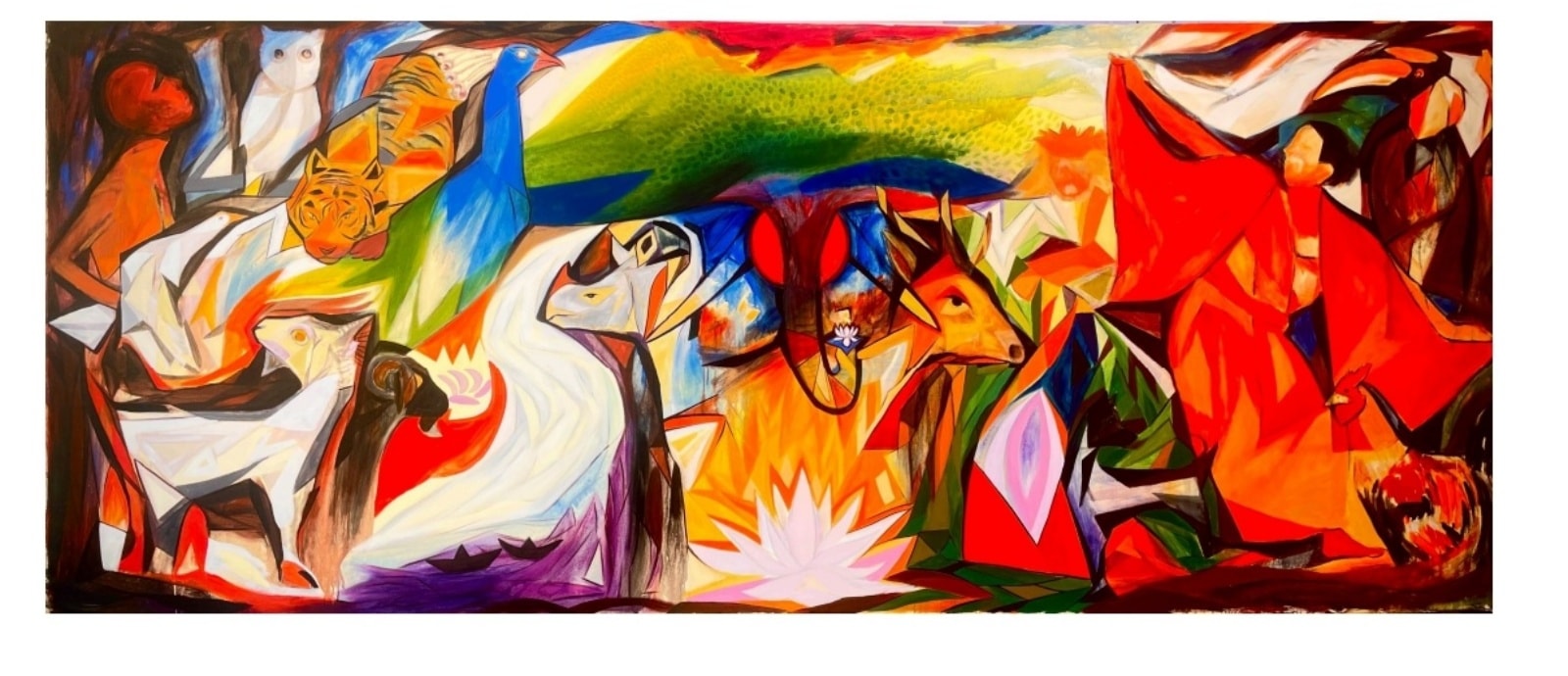 Artwork of Kingson Swargiary, a Boro artist based in Assam showcasing how their community lives in harmony with nature (Photo: PR handout)
His imagery records everyday endurance: a woman tying her baby to herself as she steps out because there is no one else to take care of the baby at home; wooden pounding tools once used to husk rice before mills existed; gatherings during the festivals. Mahua flowers appear frequently — collected, fermented and offered to local deities. “It reflects our connection to nature,” he says of the compositions, which he describes as schematic in style.
Beyond the exhibition, TAF includes panel discussions on themes such as Tribal Art Revival & Sustainable Futures, Tribal Art in Contemporary Spaces, and Livelihoods and Market Linkages. A participatory installation called Project Khum, “khum” meaning flower in Kokborok, the language of Tripura, sees tribal women artists collectively building a shared artwork.
© IE Online Media Services Pvt Ltd