Preliminary Examination: Indian Polity and Governance – Constitution, Political System, Panchayati Raj, Public Policy, Rights Issues
Mains Examination: General Studies-II: Constitution of India —historical underpinnings, evolution, features, amendments, significant provisions and basic structure.
What’s the ongoing story: Saying that the right to menstrual health is a part of the right to life under Article 21 of the Constitution, the Supreme Court on Friday directed all States and Union Territories to put in place Menstrual Hygiene Management (MHM) measures, including gender-segregated toilets and free sanitary napkins, in all government as well as private schools.
Key Points to Ponder:
— How has the scope of Article 21 expanded in recent times?
— What is Article 21?
— Enumerate certain Fundamental Rights that are part of Article 21
— What is the Right to Education Act?
Story continues below this ad
— What is the impact of lack of MHM on female child education?
— What are the types of writs in India?
— What is mandamus?
— What is the role and function of the National Commission for Protection of Child Rights (NCPCR) and the State Commission for Protection of Child Rights (SCPCR)?
Key Takeaways:
— Issuing a slew of directions, the bench of Justices J B Pardiwala and R Mahadevan asked the Centre, States and UTs to ensure compliance within three months.
— Citing provisions of the Right to Education Act, the court also warned of stringent consequences for non-compliance, including the de-recognition of private schools and holding state governments directly accountable for failures in public institutions.
Story continues below this ad
— The absence of MHM measures “does not merely disrupt a girl child’s presence in school,” it said. “It impairs her access to opportunities both during schooling and later in life. The absence of MHM measures at school would lead to recurrent absenteeism, which would result in gap in learning…”
— “Access to safe, effective and affordable menstrual hygiene management measures helps a girl child attain the highest standard of sexual and reproductive health. The right to healthy reproductive life embraces the right to access education and information about sexual health,” the bench said.
— It directed that all the existing and newly constructed toilets in schools should be designed, constructed and maintained so as to ensure privacy and accessibility, including by catering to the needs of children with disabilities and “all school toilets shall be equipped with functional hand-washing facilities, with soap and water available at all times.”
— The schools should provide “oxo-biodegradable sanitary napkins manufactured in compliance with the ASTM D-6954 standards free of cost,” it said.
Story continues below this ad
— Referring to the Schedule to the Right to Education Act, which says that school buildings shall have “barrier-free access” and “separate toilets for boys and girls”, the bench said Section 19 of the Act states that no school shall be recognised until it fulfills the norms laid down in the Schedule.
— The bench also directed district education officers (DEO) “to conduct periodic inspections, preferably once in a year, of school infrastructure, particularly with regard to toilet and washing facilities, availability of menstrual absorbents, sanitary waste disposal mechanisms and training/ awareness measures undertaken by the concerned school.”
— To spread awareness and provide training about menstrual health and puberty, the bench asked the National Council of Educational Research and Training (NCERT) and the State Council of Educational Research and Training (SCERT) to “incorporate gender-responsive curricula, more particularly, on menstruation, puberty and other related health concerns (PCOS, PCOD, etc.), with a view to break stigma and taboo associated with menstrual health and hygiene.”
— It also asked the National Commission for Protection of Child Rights (NCPCR), or, as the case may be, the State Commission for Protection of Child Rights (SCPCR), “to oversee the implementation” of its directions.
Do You Know:
Story continues below this ad
— The court issued a continuing mandamus — a judicial order through which it keeps a matter pending to monitor compliance — directing the Centre and states to ensure free sanitary napkins and functional toilets in all schools.
— Both the High Courts and the Supreme Court can be approached for violation or enactment of fundamental rights through five kinds of writs:
* Habeas corpus (related to personal liberty in cases of illegal detentions and wrongful arrests)
* Mandamus — directing public officials, governments, courts to perform a statutory duty;
Story continues below this ad
* Quo warranto — to show by what warrant is a person holding public office;
* Prohibition — directing judicial or quasi-judicial authorities to stop proceedings which it has no jurisdiction for; and
* Certiorari — re-examination of an order given by judicial, quasi-judicial or administrative authorities.
— The RTE Act guarantees free elementary education for children of ages 6-14. Government schools are required to provide free education to all enrolled children; aided schools must provide free seats proportionate to the aid they receive.
Other Important Articles Covering the same topic:
Story continues below this ad
📍Explained: The Right to Education Act and minority educational institutions
📍Why Supreme Court made menstrual hygiene a fundamental right and what schools must provide
Previous year UPSC Prelims Question Covering similar theme:
(1) With reference to the writs, issued by the Courts in India, consider the following statements: (UPSC CSE 2022)
1. Mandamus will not lie against a private organisation unless it is entrusted with a public duty.
Story continues below this ad
2. Mandamus will not lie against a Company even though it may be a Government Company
3. Any public minded person can, be a petitioner to move the Court to obtain the writ of Quo Warranto.
Which of the statements given above are correct?
(a) 1 and 2 only
(b) 2 and 3 only
(c) 1 and 3 only
(d) 1, 2 and 3
Previous year UPSC Mains Question Covering similar theme:
“Though women in post-Independent India have excelled in various fields, the social attitude towards women and feminist movement has been patriarchal.” Apart from women education and women empowerment schemes, what interventions can help change this milieu? (UPSC CSE 2021)
EU deal goes beyond trade… can lift manufacturing: Goyal
Syllabus:
Preliminary Examination: Current events of national and international importance
Mains Examination: General Studies-II, III: Bilateral, regional and global groupings and agreements involving India and/or affecting India’s interests, Effects of liberalisation on the economy.
What’s the ongoing story: INDIA IS looking at ramping up its manufacturing with technology know-how and investments from European countries that go well beyond just trade, said Union Commerce and Industry Minister Piyush Goyal, after having wrapped up the negotiations for a Free Trade Agreement with the European Union.
Key Points to Ponder:
— What is FTA?
— What are the advantages of the recently signed India-EU trade deal?
— What is the rule based order?
— What is multilateralism?
— What are the key takeaways of the India-EU Summit?
— What is the significance of the India-EU FTA in the current geopolitical context?
— Know about the major trade agreements signed by India in the recent times
— What are the concerns related to WTO’s Appellate Body?
Key Takeaways:
— In an interview with The Indian Express, Goyal said, “The fact is that this (the deal) is much more than just trade. It is a strategic and defence partnership… Then there is financial integration. Going forward, a mobility partnership, and they (the European Union) have said we would like to do an Investment Protection Agreement.”
— Referring to the significant step-up in defence spending by European nations — pushed by a Washington reshaping the transatlantic alliance — Goyal said that this presented a major opportunity for India.
— In addition to this, the EU is helping India in its decarbonisation efforts, the Commerce and Industry Minister said. “A joint fund of Euro 500 million has already been announced. This is just the beginning.”
— In terms of automobiles, none of the small automobiles which are sold in India, which is about 90 per cent of the market, are impacted, Goyal said. “The cars (market) that we have opened and given a quota in a graded (manner) are in the luxury bracket,” he added.
— Goyal said to take advantage of the opportunities that the FTA with the EU presents, Indian industry has to create capacities.
From the Editorial page: India-EU FTA restores trust in rules-based trade order’
— Harsh Pati Singhania writes: The conclusion of the India-EU FTA marks a pivotal moment in the trajectory of global commerce. More than a bilateral accord, it is a reaffirmation of the relevance of a rules-based trade order at a time when international trade faces unprecedented strain.
— The FTA demonstrates that constructive engagement and adherence to international norms remain not only possible but indispensable. It serves as a template for how nations can negotiate complex trade deals while upholding the integrity of the global trading system.
— The agreement underscores the capacity of two major economies — together accounting for about 25 per cent of global GDP, one-third of global trade and a combined market of 2 billion people — to reach a consensus while respecting domestic sensitivities.
— India’s agricultural red lines were safeguarded, while the EU maintained its stance on CBAM. The numbers tell their own story.
— Bilateral merchandise trade stood at $136.54 billion in 2024-25, with India exporting $75.85 billion to the EU. The FTA is expected to unlock $75 billion in fresh exports, including $33 billion in labour-intensive sectors.
— Similarly, the tariff cuts offered by India will save €4 billion per year in duties on EU products. The FTA is a reminder that trade must be anchored in rules, ensuring stability for businesses, workers, and consumers alike.
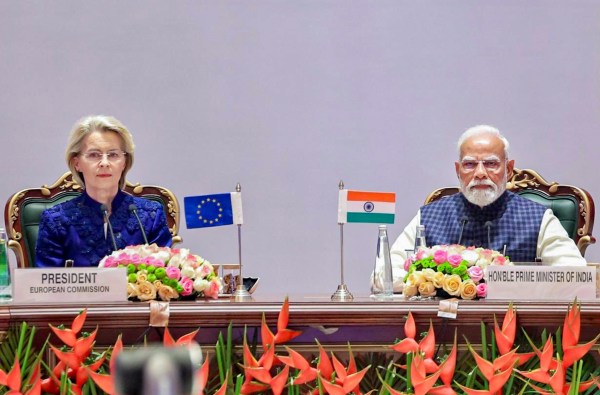
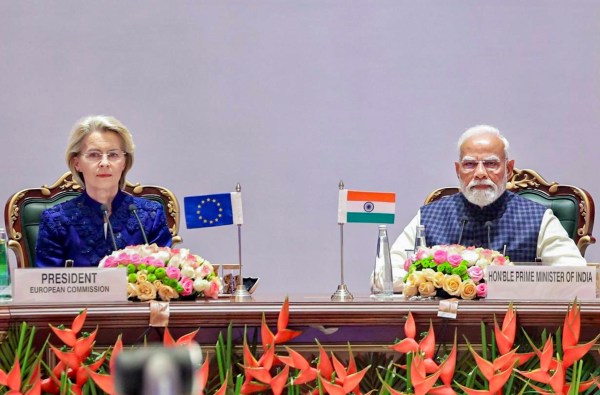 In this image posted on Jan. 27, 2026, Prime Minister Narendra Modi and European Commission President Ursula von der Leyen during the India-EU Business Forum, in New Delhi. (@MEAIndia/X via PTI Photo)
— The agreement also arrives at a critical juncture for the WTO, ahead of the upcoming 14th Ministerial Conference (MC14) in March. The EU has reiterated that WTO reforms should be based on predictability, fairness and flexibility.
— With the paralysis of the WTO’s Appellate Body undermining the credibility of dispute settlement, the FTA serves as a reminder that bilateral and regional accords can reinforce the principles of predictability and fairness even as multilateral reform remains urgent.
From the Ideas Page: Signing of FTAs is a start. Their success will be judged by gains in global market
— Shoumitro Chatterjee writes: India has recently concluded major trade agreements with the EU, the UK, and Australia, reversing a period of more inward-looking trade policy. The EU and the UK together account for about 30 per cent of global imports of low-skill manufacturing products such as apparel, footwear, and assembled electronics
— Free trade agreements with these markets give Indian exporters zero-duty access to a $3.5 trillion market, creating a strong platform for export growth. How large the gains are will depend on how these agreements are implemented and reinforced in practice.
— For years, competitors enjoyed preferential access that India lacked. Bangladesh exported apparel to Europe at zero duty. Vietnam has had an EU FTA since 2020. Indian exporters faced tariffs of 10-12 per cent in apparel and up to 17 per cent in footwear — margins that often decide who wins an order. That disadvantage is now gone.
— These agreements also change how global firms view India. By signalling policy stability, they make long-term investment decisions more viable for companies seeking alternatives to China.
— Bangladesh, Vietnam, and Indonesia export close to their potential, while China is a large outlier. India, by contrast, exports about 18 percentage points less than its potential — equivalent to roughly $160 billion in annual export headroom. Signing an FTA is an important first step.
— Converting these agreements into sustained export gains will require action on four fronts that sit outside the FTA text.
— The first challenge is standards… The larger problem, however, is that non-compliance by even one exporter can damage an entire industry’s reputation. India has experienced this repeatedly… Government can support compliance through testing infrastructure and technical assistance.
— The second challenge is complexity.India’s trade regime remains unnecessarily complicated. Complexity raises compliance costs and creates scope for discretion… The UK schedule has three categories: Zero duty, excluded, or quota-based access. India’s has more than 20… This complexity invites disputes…. Either way, complexity damages credibility.
— Third, FTAs open export markets but do not ensure access to the best inputs and machine. That depends on the MFN tariff regime.
— Fourth, India has a record of undermining its own trade agreements after signing them. Phased commitments create time for domestic lobbies to seek protection through other instruments.
— Several domestic reforms are moving in the right direction —simplifying labour codes, rationalising GST rates, expanding solar infrastructure, and setting up a deregulation commission to name a few. But one constraint looms large: High input costs, chiefly power and credit.
— The success of India’s FTAs will not be judged by signing ceremonies but by a single metric: Gains in global market share. The opportunity is large.
Do You Know:
— The international order based on the rules enshrined in the United Nations Charter of 1945 is referred to as the rules-based international order. It was established to overcome the gravest consequences of traditional power politics, evident in the devastation of the Second World War, and is based on principles like sovereignty, self-determination, multilateralism, and international law.
— Initially known as the liberal international order, the rules-based international order institutionalised a system of rules, laws, and norms, with international organisations like the United Nations, the World Bank, the World Trade Organization, and the International Monetary Fund providing a framework for interaction among states.
Other Important Articles Covering the same topic:
📍Beyond Trending: What is rules-based international order?
📍India and EU seal the deal: Trade, Mobility, Security—and major takeaways
Previous year UPSC Prelims Question Covering similar theme:
(2) Consider the following statements: (UPSC CSE 2023)
The ‘Stability and Growth Pact’ of the European Union is a treaty that:
1. limits the levels of the budgetary deficit of the countries of the European Union
2. makes the countries of the European Union to share their infrastructure facilities
3. enables the countries of the European Union to share their technologies
How many of the above statements are correct
(a) Only one
(b) Only two
(c) All three
(d) None
Previous year UPSC Mains Question Covering similar theme:
The expansion and strengthening of NATO and a stronger US-Europe strategic partnership works well for India. What is your opinion about this statement? Give reasons and examples to support your answer. ( UPSC CSE 2023)
THE EDITORIAL PAGE
India’s next manufacturing leap will be about what it produces
Syllabus:
Preliminary Examination: Current events of national and international importance
Mains Examination: General Studies-III: Indian Economy and issues relating to planning, mobilisation of resources, growth, development and employment.
What’s the ongoing story: Chanchal Sarkar, Mira Sethi, V Anantha Nageswaran wrote: India’s manufacturing sector has regained momentum at a time when global production networks are being reconfigured amidst geopolitical uncertainties. Supply chains are diversifying, firms are seeking alternatives to single-country dependence, and industrial policy has returned to the centre of economic strategy worldwide.
Key Points to Ponder:
— What is the status of India’s manufacturing sector?
— What is the significance of the manufacturing sector in the growth of the economy?
— What does the Economic Survey 2025-26 say about India’s manufacturing sector?
— What are the major manufacturing policies of the government?
— What are industrial clusters?
— What is the status of the logistics sector in India?
— What are the initiatives taken for the improvement of logistics and connectivity?
— What is the National Manufacturing Mission?
Key Takeaways:
— Against this backdrop, India’s manufacturing revival has created a strong foundation for the next phase of industrial growth. As the Economic Survey highlights, sustaining this momentum will depend on strengthening competitiveness and augmenting manufacturing capabilities by integrating into the global value chain.
— Over time, India’s manufacturing policy has increasingly focused on lowering entry barriers through targeted incentives, infrastructure investment, and improving ease of doing business. These efforts have helped attract investment and strengthen business confidence.
— The task ahead is to complement existing schemes with stronger ecosystems and move from capacity creation towards deeper capability building.
— The next phase of industrialisation must prioritise strategically important and technology-intensive sectors, while scaling up traditional manufacturing, even if this entails higher experimentation and more tolerance for firm-level failures.
— India’s manufacturing profile is beginning to move up the value chain, with gains visible in sectors that combine higher technology content, value addition, and export potential.
— In electronics, for instance, production has expanded roughly six-fold, and exports have grown nearly eight-fold in the last 11 years.
— Similarly, India’s pharmaceutical industry is among the world’s largest by volume, supplying over half of global vaccine demand and a significant share of generic medicines. These sectors combine scale, technology intensity, and tradability.
— India needs to intensify its approach to industrial clusters, particularly by addressing issues of scale. While clusters remain an important organising principle, many are too small or fragmented to deliver meaningful productivity and capability gains.
— The next generation of industrial clusters is likely to be anchored increasingly in Tier-2 and Tier-3 cities. They offer several advantages, including more affordable land and real estate, lower operating and wage costs, large labour pools, improved infrastructure, and better liveability compared to congested metros.
— Competitiveness also depends critically on the quality of infrastructure and logistics that connect firms to markets. India has made steady progress on this front. Logistics costs have been declining and were estimated at around 7.97 per cent of GDP in FY 2023–24, broadly comparable with global benchmarks.
— Initiatives such as PM Gati Shakti and the National Logistics Policy, combined with an accelerated pace of highway construction, are improving connectivity and coordination across transport modes. There is scope to further reduce logistics costs by rebalancing the freight mix.
— Quality Control Orders can also play a constructive role in strengthening manufacturing competitiveness, particularly in strategic and safety-critical sectors by progressively aligning with the international standards. By enforcing minimum quality and standards compliance, they can incentivise domestic firms to upgrade capabilities and build credibility in global markets.
— MSMEs are the backbone of India’s manufacturing ecosystem, contributing significantly to employment, output, and exports. However, they face a finance gap. Recent gains in formalisation, improved access to finance, and deeper supply-chain integration have strengthened their role in industrial growth.
— While regulatory reforms have improved formal ease-of-doing-business conditions, manufacturing firms respond most strongly to speed, predictability, and consistency.
— India’s next manufacturing leap will be defined not just by how much it produces, but by what it produces and how strategically indispensable it becomes.
— The proposed National Manufacturing Mission offers a platform to align reforms, skilling, infrastructure and innovation under a long-term industrial strategy.
Do You Know:
— In the Union Budget 2025, the Finance Minister announced National Manufacturing Mission for small, medium, large industries.
— The mission’s mandate will include five focus areas – ease and cost of doing business, upskilling for in-demand jobs, MSMEs, availability of technology, and quality products.
— Under the mission, clean tech manufacturing will be supported to improve domestic value addition in solar PV cells, electric vehicle (EV) and grid-scale batteries, electrolyzers, wind turbines, and high voltage transmission equipment.
— The mission will also help counter China’s dominance in the clean tech space, where it controls 80 per cent of the world’s battery manufacturing capacity and produces roughly 80 per cent of the main components used in solar cells.
Other Important Articles Covering the same topic:
📍Union Budget 2025: National Manufacturing Mission for small, medium, large industries soon
📍Budget 2026: How to power Make in India’s next phase
Previous year UPSC Mains Question Covering similar theme:
The Gati-Shakti Yojana needs meticulous coordination between the government and the private sector to achieve the goal of connectivity. Discuss. (UPSC CSE 2022)
EXPLAINED
Budget 2026: The 3 big macro worries for India
Syllabus:
Preliminary Examination: Current events of national and international importance
Mains Examination: General Studies-III: Government Budgeting.
What’s the ongoing story: On Sunday (February 1), Finance Minister Nirmala Sitharaman will rise to present the Budget for the next financial year that spans from April 2026 to March 2027.
Key Points to Ponder:
— What is the purpose of the Budget?
— What is the fiscal deficit?
— What is GDP?
— How is it calculated?
— What is the difference between real GDP and nominal GDP?
— What is corporate tax?
— What is tax buoyancy?
Key Takeaways:
— The Budget provides three main details:
*One, what the government expects the growth rate of the economy to be in the next year, and how much the government will spend on different schemes and departments.
*Two, how much revenue will the government raise from different sources, be it tax (like income tax or corporate tax) and non-tax (such as dividends from its public sector undertakings or money from the sale of its assets like spectrum).
* Three, the money that the government is forced to borrow to meet the gap between its stated expenses and its expected revenues. This is technically called the fiscal deficit
— There are many issues one can point to, but at the macroeconomic level, there are three main concerns:
— Weak GDP growth: This may sound odd since all stories about India’s economic growth (measured by Gross Domestic Product or GDP) have been resoundingly upbeat. However, most reports that present India as the fastest-growing major economy are talking about “real” GDP growth. When it comes to the making of the Union Budget, what matters more is “nominal” GDP and its growth rate.
— To be sure, what we count first is the nominal GDP — that is, the total value of all goods and services in today’s prices. To arrive at “real” GDP, we take away the effect of prices so that we get to know how we “really” grew, like how many more apples, trucks and shirts, etc., we produced this year as against the last.
— There is a reason why nominal GDP matters more: Because it is the observed value and forms the starting point for all Budget calculations. For instance, if a government wants to know how much it will earn in tax revenues in the next financial year, it has to know the size of the nominal GDP before it can apply a tax rate and arrive at its tax revenues.
— Suppose the government assumes that the nominal GDP of India will grow by Rs 100, and as a result, with a tax rate 15%, it will get an additional Rs 15 in the coming year to spend. But if, for some reason, the nominal GDP grows only by Rs 50, then the total additional money in the government’s hands will be Rs 7.50.
— Weak tax buoyancy: In the example above, where at a 15% tax rate, the government expected an additional Rs 15, the assumed tax buoyancy is 1. A tax buoyancy of 1 would mean that if the GDP goes up by 10%, then the tax collections also go up by 10%.
— But what if this assumption does not come through? What if, apart from nominal GDP going up by only Rs 50 and not Rs 100, the tax buoyancy was also not 1 but 0.5? In such a scenario, the total additional tax revenues with the government will be only Rs 3.75. That is a sharp drop from the original estimate of Rs 15.
— Weak private corporate investments: If there is one consistent policy goal of the incumbent government, then it is to boost the private sector’s involvement in the economy. It follows from PM Modi’s view of “Minimum Government” where the role of the government in the running of the economy should be curtailed, and efforts should be made to incentivise the private sector to take the primary role of producing goods and services and, in the process, creating jobs and prosperity.
— This policy push has been particularly clear since 2019, when FM Sitharaman introduced a sharp cut in corporate tax rates to incentivise private firms to increase their investments in the economy.
— The idea was to bring down the costs of doing business for the private sector. This was further followed by direct subsidies to private firms in the form of the Production Linked Incentive (PLI) scheme.
— However, notwithstanding all these changes and the high growth rates of the economy, data shows that private corporate investment has fallen from the pre-pandemic period (2019).
— What should the FM do in this Budget to boost growth, and what new incentives can the FM unveil to lure the private sector to invest more boldly?
Do You Know:
— The Union Budget (technically called the Annual Financial Statement under Article 112 of the Constitution of India) lays out an account of the government’s financial health. It tells the citizens not only how much money the government raised last year, where it spent it, and how much it had to borrow to meet the gap, but also gives an estimate of what it expects to earn in the next financial year (in the present case, the current financial year), how much and where it plans to spend it, and how much it would likely have to borrow to bridge the gap. The Revenue and the Capital sections together, make the Union Budget.
— Fiscal Deficit is the difference between the Revenue Receipts plus Non-debt Capital Receipts (NDCR) and the total expenditure. In other words, fiscal deficit is “reflective of the total borrowing requirements of Government”.
Other Important Articles Covering the same topic:
📍Union Budget 2025 : Key highlights for UPSC and other competitive exams
Previous year UPSC Prelims Question Covering similar theme:
(3) Suppose the revenue expenditure is ₹80,000 crores and the revenue receipts of the Government are ₹60,000 crores. The Government budget also shows borrowings of ₹10,000 crores and interest payments of ₹6,000 crores. Which of the following statements are correct? (UPSC CSE 2025)
I. Revenue deficit is ₹20,000 crores.
II. Fiscal deficit is ₹10,000 crores.
III. Primary deficit is ₹4,000 crores.
Select the correct answer using the code given below.
(a) I and II only
(b) II and III only
(c) I and III only
(d) I, II and III
Previous year UPSC Mains Question Covering similar theme:
Distinguish between Capital Budget and Revenue Budget. Explain the components of both these Budgets. (UPSC CSE 2021)
Why Economic Survey has raised India’s potential growth rate
Syllabus:
Preliminary Examination: Current events of national and international importance.
Mains Examination: General Studies-III: Indian Economy and issues relating to planning, mobilisation of resources, growth, development and employment.
What’s the ongoing story: At a time when India’s economic growth rate (often measured in terms of GDP) is being hotly debated, the latest Economic Survey (led by Chief Economic Advisor V Anantha Nageswaran) has “reassessed” and upped India’s “potential” economic growth rate from 6.5% to 7%.
Key Points to Ponder:
— What is the forecast of the Economic Survey on India’s GDP?
— What is total factor productivity (TFP)?
— What is a Production Linked Incentive (PLI)?
— What are the key highlights of the Economic survey?
— What are the suggestions made by the Economic survey on public transport system?
Key Takeaways:
— A country’s potential economic growth rate is different from the better-known annual growth rate. While the Gross Domestic Product growth rate is the rate at which an economy grows in a particular year, the “potential” GDP growth rate tells how fast that economy can grow without triggering unwanted levels of inflation.
— Typically, if demand for goods and services expands too fast — what a GDP growth rate essentially is — it results in prices rising too fast for comfort. That’s because supply cannot keep up with demand.
— It follows that to raise a country’s GDP growth rate in a sustainable manner, the government must attempt to raise the potential growth rate. The potential growth rate, in turn, depends on three main factors.
— One, the capital stock in the economy. This refers to all the physical assets in the country — roads, bridges and machinery etc. — that can generate growth.
— Two, the labour input. This refers not just to the number of people but also their capacity, their skills.
— Three, total factor productivity (TFP). This refers to the efficiency with which labour and capital are used in an economy.
— The survey specifically notes the reforms “over the past three years” that have enhanced India’s potential. These include manufacturing-oriented initiatives — such as the Production-Linked Incentive (PLI) schemes, FDI liberalisation, and logistics reforms — that have helped boost India’s ability to produce more (read supply).
— On the labour front, the survey finds that “labour law consolidation, reduced regulatory compliance and State-level regulatory reforms have begun to lower frictions in the labour market. At the same time, sustained investments in education, skilling and the apprenticeship ecosystem are strengthening workforce quality and employability.”
From the Economy page: Why Indians fall in line for Metro but become unruly in other transport systems
— Why do Indians behave differently in different public transport systems and common spaces? Why do they fall in line for Metro trains, Mumbai BEST services, airport queues and passports, but push, grab and jump the line for buses and trains?
— The 2025-26 Economic Survey offers five reasons for this “common” behavior:
— First, the system should be clearly designed to reduce ambiguity about what constitutes the “right behaviour”. The transport system should have proper entry and exit lines, barriers, turnstiles, marked queues, platform doors or painted bays.
— Second, commuters expect some kind of enforcement of rules, even if it is light-touch. “In the Metro, the presence of staff, fines and surveillance creates a background ‘shadow of authority’. But crucially, enforcement is consistent and impersonal, unlike in many other public settings, where it is uneven or negotiable.
— Third, the reliability of the service. The Survey says that if trains arrive at a regular intervals and everyone knows that waiting time is a minute or two, there will be little pushing, grabbing or jumping the line.
— Fourth, people learn from other people in a stable system and even fellow passengers object to unruly behavior. “Once people see that others queue, give space, or avoid blocking doors, conformity starts to move toward order rather than disorder.”
— Fifth and last, the Economic Survey calls for creating a dignified public space for people. It says that when such spaces are in dilapidated condition, poorly maintained or captured by vested interests, people do not feel any obligation to care for them. Thus, neglect breeds neglect.
Other Important Articles Covering the same topic:
📍Knowledge Nugget | Economic Survey 2025-26: Key takeaways for your UPSC exam
| ALSO IN NEWS | |
| US museum to return 3 bronze sculptures ‘removed illegally’ from temples in TN | The Smithsonian’s National Museum of Asian Art announced on Friday its plans to return three sculptures to India, following what it calls “rigorous provenance research that documented that the sculptures had been removed illegally from temple settings”.
These bronze sculptures include ‘Shiva Nataraja’ (Chola period, 10th century), ‘Somaskanda’ (Chola period, 12th century), and ‘Saint Sundarar with Paravai’ (Vijayanagar period, 16th century). These were among some of the sacred idols carried in temple processions. |
| India’s cheapest power needs new buyers | Samir Saran writes: For decades, India’s power sector grappled with scarcity and affordability issues even as it undertook complex and ambitious power-sector reforms. Today, we add 40 GW of renewable capacity every year, far more than in most developed economies and cheaper than in most geographies. The task is to organise markets, institutions, and demand. Absorption is becoming a constraint with nearly 42 GW of renewable capacity awarded through auctions yet to find buyer utilities. |
| PRELIMS ANSWER KEY |
| 1. (c) 2. (a) 3. (d) |
Subscribe to our UPSC newsletter. Stay updated with the latest UPSC articles by joining our Telegram channel – IndianExpress UPSC Hub, and follow us on Instagram and X.
🚨 Click Here to read the UPSC Essentials magazine for January 2026. Share your views and suggestions in the comment box or at manas.srivastava@indianexpress.com🚨