This report is from this week’s The Tech Download newsletter. Like what you see? You can subscribe here.
The core
Earnings season has seen endless spending commitments from tech companies as they scramble to build out data center capacity amid the AI boom.
Hyperscalers, including the likes of Amazon, Microsoft, Meta and Alphabet, announced capital expenditure could hit $700 billion on AI this year — that’s more than the GDP of countries like the United Arab Emirates, Singapore and Israel.
Investors have been jittery. Shares plunged last week as more than $1 trillion was wiped from the market caps of Big Tech companies amid concerns over the scale of AI spending and questions over returns.
While there’s been something of a recovery this week, uncertainty over astronomic AI spending continues to make folk nervous.
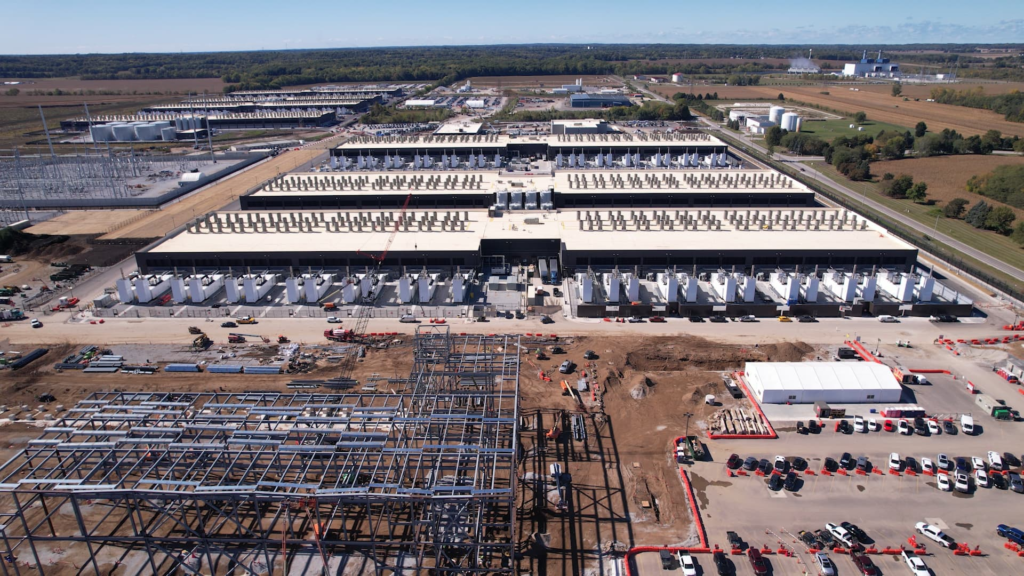
Amazon’s largest AI data center has seven completed buildings, with 30 total buildings planned on 1,200 acres in New Carlisle, Indiana, shown here on October 8, 2025.
Erin Black
The AI bet becomes ‘binary’
“2026 is a 60% aggregate increase in committed capex on the prior year,” said Michael Field, chief equity strategist at Morningstar.
“At a certain point this bet becomes binary: either demand and monetization follows and pays off the spend, or it doesn’t and the businesses fail,” he added. “Investors were comfortable when it was a side bet, but when the whole business is at risk, they are much less comfortable.”
The level of capex from hyperscalers this year will consume almost 100% of cash flow from operations compared with a 10-year average of 40%, according to a note from UBS this week.
The capex isn’t as much of a worry as where the money came from, Bob Savage, head of markets macro strategy at BNY, told me.
“If this increases the net borrowing of mega-caps it takes away from equity holdings,” he said. “Investors are happy to buy debt, as shown by Oracle, but the issue is that it’s reducing free cash flow and puts balance sheets at risk for some.”
Earlier this month Oracle announced plans to raise $45 billion-$50 billion in the 2026 calendar year and Alphabet is planning to raise $20 billion from a U.S. dollar bond sale, people familiar with the matter told CNBC on Monday.
Positive on hyperscaler stock
Despite market wobbles, many analysts are still broadly bullish on hyperscaler stocks.
“The returns for the main data center builders (Amazon, Microsoft and Google) are already positive since they are pre-selling all of their capacity before they even build the data center,” Gil Luria, head of technology research at D.A. Davidson, told me.
He added that more upside is likely coming further down the line. “As [AI] usage grows exponentially and consumers and businesses will be willing to pay more for the value being created, we expect the positive returns to materialize.”
But timelines on recouping huge capex are “very much unknown” right now, Field told me. “The estimated useful life on much of this spend, including data centres and chips, can be as low as 3-5 years, meaning the hyperscalers need to see significant returns on investment before 2030 — providing a very tight timeline.”
Clear timelines around payback periods and “credible” strategies around monetization are needed from hyperscalers to ease concerns, Field said.
Until that happens, he added, investors are likely to continue to balk at further plans to increase capex — which could cause further market jitters in the coming months.
Latest updates
Alphabet is returning to the debt market to fund its AI build-out, after reporting it could shell out $185 billion in capital expenditure this year.
Elon Musk’s xAI lost two co-founders in two days, as researcher Jimmy Ba and Tony Wu announced their exits from the company.
U.S. proposals to move 40% of Taiwan’s semiconductor supply chain to its shores are “impossible,” Taipei’s top tariff trade negotiator said in an interview on Sunday.
Apple had its worst day on the stock market since April on Thursday, after reports surfaced about delays with Siri and as the company’s news app faced regulatory scrutiny.
Anthropic closed a $30 billion funding round at a $380 billion post-money valuation, the company announced on Thursday, in the second largest private tech raise on record.
Chart of the week
With geopolitical tensions between Europe and the U.S. reaching boiling point in recent weeks after Trump refused to rule out using force to acquire Greenland before backtracking, questions around the region’s digital sovereignty — or lack of it — have resurfaced. The data paints a stark picture.