The story so far: Kerala has declared that flooding caused by tidal rise along the extensive coastline of the State, adversely affecting the coastal community and resulting in loss of life and livelihood, can be considered a State-specific disaster. A government order in this regard declared that financial assistance, similar to that provided to victims of natural disasters under State Disaster Response Fund (SDRF), will be given to victims of floods caused by tidal rise. This is the first time in the country that a State has declared tidal flooding a State-specific disaster.
What is tidal flooding affecting Kerala?
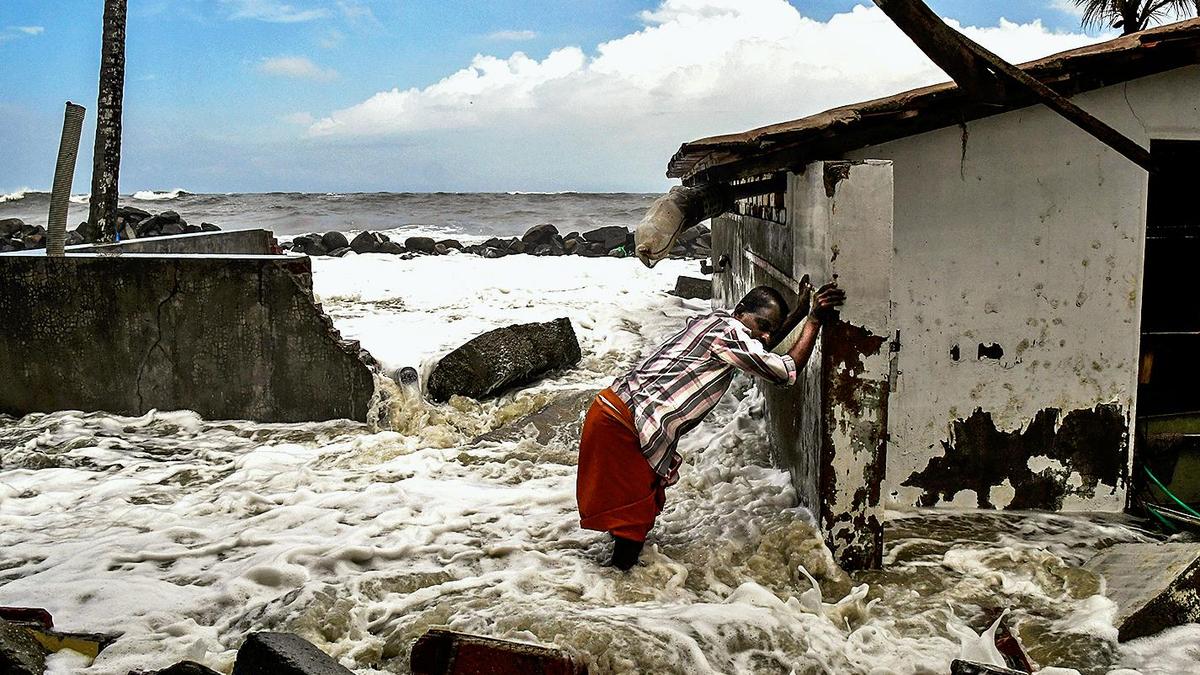
It is a common phenomenon along Kerala’s coastline, where the Arabian Sea level temporarily rises above an identified threshold for a brief period, inundating low-lying coastal areas. Unlike cyclone-induced storm surges, tidal flooding happens twice in a day and is more severe during full or new moons. The issue becomes more complex when coastal storms, triggered by meteorological conditions, coincide with high tides, increasing both the depth and extent of coastal flooding. This type of flooding is particularly a concern in the coastline of nine coastal districts of Kerala, where spring tides can also join to make things worse.

Why has a routine event been declared a State-specific disaster?
Normally, flooding exacerbated by extreme events comes under the State Disaster Response Fund (SDRF) norms. Since tidal rise is a routine natural phenomenon, it is not practicable to declare normal tidal rise a disaster under the SDRF norms, and hence, financial assistance cannot be provided under these. However, Section 2(d) of the Disaster Management Act says that if flooding caused by tidal rise adversely affects a community, resulting in loss of life, livelihood, and living conditions, such a natural phenomenon can be considered a disaster.
What prompted Kerala to declare this, compared to other States?
The land use pattern and the topography of the State are quite different in Kerala compared to other parts of the country. For instance, parts of the coastal plains of Alappuzha, especially in the Kuttanad region, lie below sea level, while the commercial city of Kochi is situated very close to sea level. So, water intruding beyond the ‘high tide line’ (HTL) generally constitutes dangerous sea incursion exceeding the normal high tide range. During high tides, seawater rises and enters residential areas through adjoining rivers, backwaters, and canals. Along the Kerala coast, particularly in areas such as Vypin, Chellanam, Edakochi, and Perumbadappu in the Kochi Corporation, as well as Kumbalanghi panchayat, recurrent tidal flooding due to by seawater ingress occurs frequently.

This causes extensive damage to residential areas and infrastructure. It is a serious natural phenomenon that directly affects the lives of fishermen, coastal agricultural sectors, coastal residents, and small traders. Therefore, based on the HTL, the natural phenomenon termed ‘coastal high-tide flooding/sea incursion’ falls within the scope of the definition of ‘disaster’ under the Disaster Management Act in Kerala.
How serious is the issue?
At least 10% of the population of the State is affected by high-tide flooding. Due to deficiencies in land use, a significant number of houses and structures are located in floodplains or adjacent to rivers and puramboke lands near water bodies. In addition, factors such as excessive siltation and reduced depth of rivers and lakes aggravate coastal flooding in a manner not previously experienced. Unlike rainfall-induced flooding, tidal flooding is a hazard that can occur throughout the year, which further enhances the relevance of declaring it a State-specific disaster.

What are the other State-specific disasters in Kerala?
Apart from nationally notified disasters, Kerala has notified coastal erosion, lightning, strong winds, soil piping, heatwave/sunstroke/sunburn, and human-wildlife conflict as State-specific disasters. The previous one was the shipwreck (MSE Elsa 3) incident off the coast of Kerala. The ship, carrying more than 643 containers, capsized on May 25, 2025 off the Kerala coast. The maritime incident had raised serious environmental concerns, including the potential for oil spills and the drifting of debris, including cargo, along Kerala’s coastline. Considering the potentially serious environmental, social, and economic impact of the shipwreckage, the State government declared the wreckage, in the Arabian Sea, 14.6 nautical miles off the Kerala coast, a State-specific disaster.