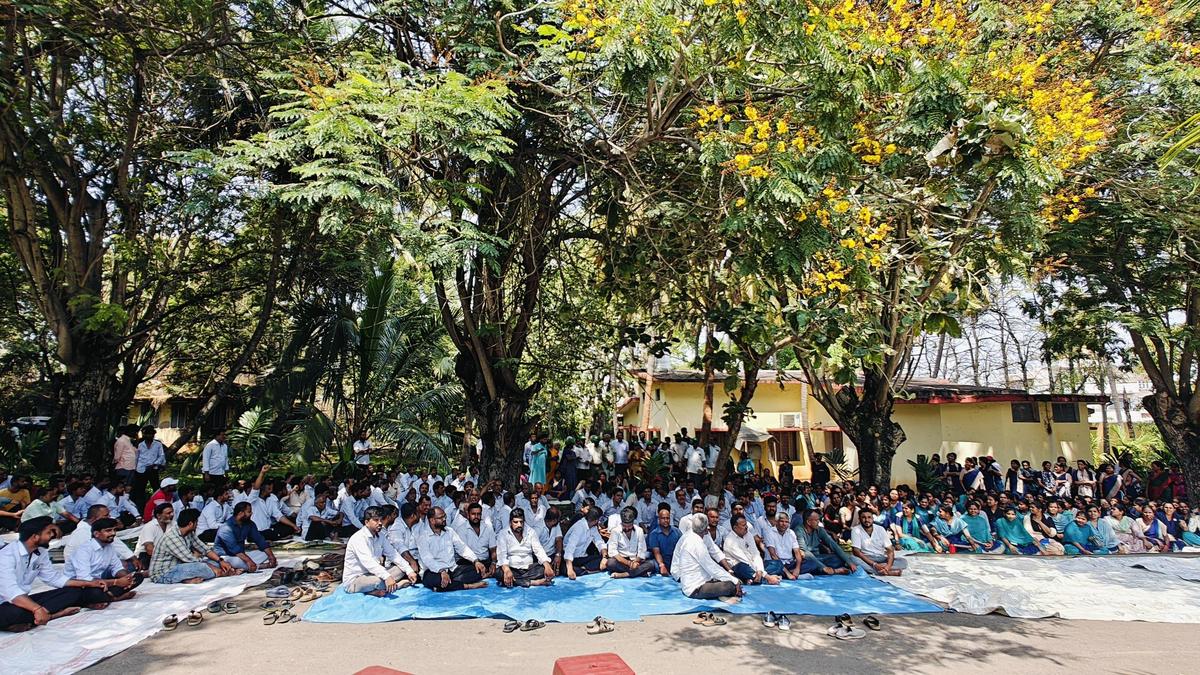
The protest against the proposed construction of a stadium within the KSIC filature factory premises at T. Narsipura, in Mysuru district of Karnataka, intensified on February 25 with employees of KSIC’s weaving units in Mysuru and Channapatna joining the agitation.
Around 700 workers of the Mysuru weaving unit, 150 from Channapatna and nearly 190 from the filature factory stayed away from duty, disrupting operations, and raising concerns over the potential impact on the production of GI-tagged Mysuru silk sarees.
The striking weaving unit employees joined their counterparts at T. Narsipura in a show of solidarity. “Without raw silk from the filature factory, the weaving units in Mysuru and Channapatna cannot function,” a KSIC source said.
Officials indicated that continued disruption could affect the supply of Mysuru silk sarees, which are in high demand.

KSIC, being a major buyer at cocoon markets in Kollegal, Ramanagara and Sidlaghatta, could also trigger a ripple effect, with the strike likely to impact cocoon prices and, in turn, sericulture farmers.
The protest at T. Narsipura also drew environmentalists under the banner of Parisarakkagi Naavu, led by former MLA A.T. Ramaswamy. Environmental activist Parashuramegowda said the group would continue to support the employees until the government of Karnataka drops its plan to build a stadium.
He pointed out that the five-acre filature premises host hundreds of trees, many over a century old, supporting a rich ecosystem of birds, animals, insects and butterflies. “Destroying such biodiversity for a stadium is unjustified,” he said.
Mysuru MP Yaduveer Krishnadatta Chamaraja Wadiyar, who visited the protest site on February 24, said he had written to Chief Minister Siddaramaiah opposing the project. He questioned the rationale of building a stadium within a functioning factory, especially when Mysuru silk sarees — produced from raw silk supplied by the unit — continue to enjoy strong demand.
He also underscored the historical importance of the factory, established in 1912 by Nalwadi Krishnaraja Wadiyar, and called for its preservation.