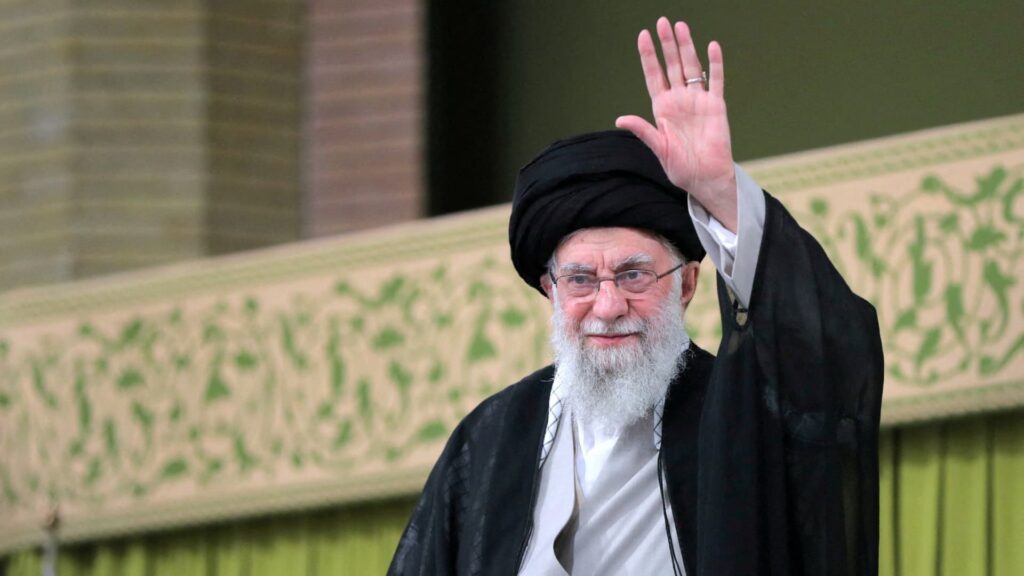
FILE PHOTO: Iran’s Supreme Leader Ayatollah Ali Khamenei waves during a meeting with students in Tehran, Iran, November 2, 2024.
Office Of The Iranian Supreme Leader | Via Reuters
Ayatollah Ali Khamenei’s death following joint U.S.-Israeli airstrikes has thrust Iran’s leadership into the urgent process of selecting a new supreme leader.
Under Iran’s constitution, the supreme leader is appointed by the Assembly of Experts, an 88-member clerical body elected by the public every eight years. Candidates for the Assembly are first vetted by the Guardian Council, tightly controlling who can run.
When the position becomes vacant, the Assembly convenes to deliberate and select a successor. The decision requires a simple majority vote.
In the interim, a provisional three-member leadership council assumes the supreme leader’s duties until a replacement is formally appointed.
On Sunday, local media reported that the temporary council comprises President Masoud Pezeshkian, Judiciary Chief Gholam-Hossein Mohseni-Ejei and Ayatollah Alireza Arafi, who serves as the Guardian Council’s representative.
The council’s authority is strictly transitional, while the Assembly of Experts retains sole constitutional power to choose Iran’s next supreme leader.
On Polymarket, traders are pricing Mohseni-Ejei as the narrow frontrunner at roughly 18%. Other top contenders include Arafi and Iranian cleric Hassan Khomeini.
The “Position abolished” outcome is trading close behind, suggesting that while markets still lean toward an individual successor, there is meaningful speculation around a potential structural change to the office itself.
Here are some key contenders:
Gholam-Hossein Mohseni-Ejei
Iran’s intelligence minister nominee Gholamhossein Mohseni-Ejei listens to a member of parliament’s speech at the Iranian parliament, 21 August 2005.
Atta Kenare | Afp | Getty Images
Mohseni-Ejei has been the Chief Justice of Iran since July 2021, overseeing the country’s judiciary and supervising legal policy across the Islamic Republic.
Before that, he served as prosecutor-general from 2009 to 2014, was first deputy head and spokesperson of the judiciary from 2014 until 2021, and earlier held national security roles, including minister of intelligence from 2005 until 2009.
He has also been a longtime member of the Expediency Discernment Council, a key advisory body to Iran’s leadership, and his career has spanned senior positions in both the judicial and security apparatus.
Hassan Khomeini
Hassan Khomeini, the grandchild of Iran’s late leader Ayatollah Ruhollah Khomeini, looks on while attending the opening ceremony of Hashemi Rafsanjani Hospital.
Nurphoto | Nurphoto | Getty Images
Khomeini is the grandson of Islamic Republic founder Ayatollah Ruhollah Khomeini, could theoretically serve as a bridge between the revolutionary system and reform-minded constituencies, said the Council on Foreign Relations.
CFR suggested that elevating someone like him might help preserve the core structure of the Islamic Republic, ease Iran’s international isolation, and address popular dissatisfaction at home.
Alireza Arafi
Arafi is a senior Iranian cleric and influential figure within the Islamic Republic’s religious and political hierarchy. He has risen through the clerical establishment with a series of key appointments, including director of Iran’s seminaries, Friday Prayer leader in Qom, and member of both the Guardian Council and the Assembly of Experts, the body constitutionally tasked with selecting the supreme leader.
Arafi’s roles in shaping theological education and vetting political candidates have made him a central fixture in Iran’s clerical power structure.
What’s next?
Under Article 111 of Iran’s constitution, the death or incapacity of the supreme leader immediately triggers the formation of a temporary leadership council to exercise his powers until a successor is chosen.
The constitution does not set a strict deadline for the Assembly of Experts to appoint a new leader, but it states that the Assembly must act “in the shortest possible time.”
Analysts cautioned, however, that the formal succession process may be accompanied by intense elite bargaining and broader geopolitical uncertainty.
Amin Saikal, professor emeritus at the University of Western Australia, said that while Mohseni-Ejei may appear a frontrunner, the Assembly of Experts could opt for another member, or even someone from outside it.
“There is going to be a great deal of horse-trading,” he said, adding that “whoever emerges might be a compromise,” he told CNBC.
He added that a hardline successor would likely continue Khamenei’s confrontational posture and security-first policies, while a more moderate figure could seek limited reforms aimed at easing domestic restrictions and improving foreign relations to alleviate sanctions pressure.
Separately, Michael McFaul, a former U.S. ambassador to Russia and professor at Stanford University, noted that historically air campaigns rarely lead to regime overthrow, questioning how current U.S. strikes, which target military assets rather than internal instruments of repression, would translate into the broader regime change Washington has signaled.