UPSC Essentials brings to you its initiative of subject-wise quizzes. These quizzes are designed to help you revise some of the most important topics from the static part of the syllabus. Attempt today’s subject quiz on the Economy to check your progress.
🚨 Click Here to read the UPSC Essentials magazine for February 2026. Share your views and suggestions in the comment box or at manas.srivastava@indianexpress.com🚨
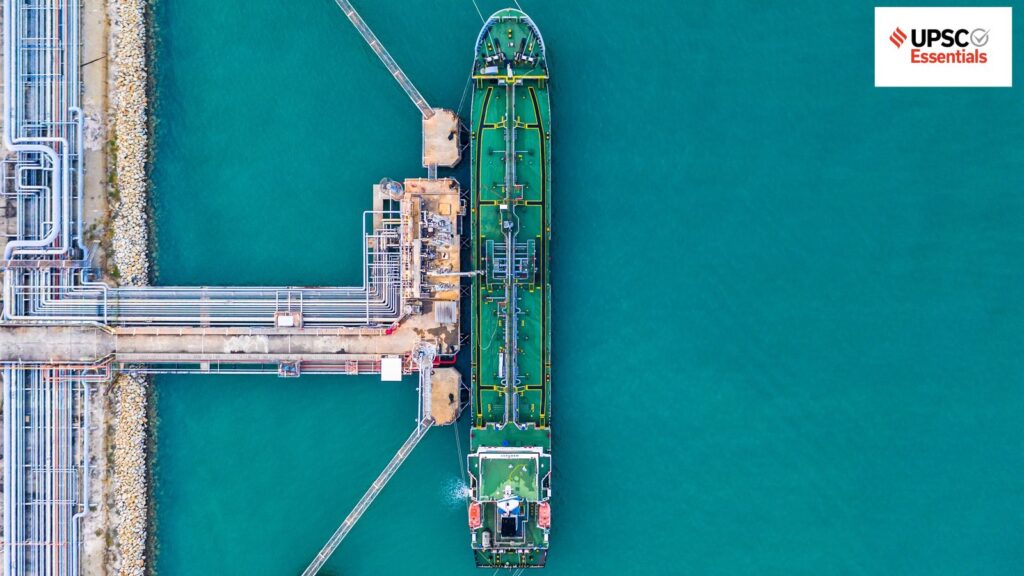
1. India depends on LNG imports to meet about half of its natural gas requirement per day.
2. India depends on the Strait of Malacca for most of its LNG imports.
3. UAE is the largest provider of LNG to India.
How many of the statements given above are correct?
(a) Only one
(b) Only two
(c) All three
(d) None
Relevance: India’s growing dependence on LNG imports highlights concerns related to energy security and diversification of energy sources. UPSC can ask questions linking energy imports, strategic sea routes, and India’s external energy dependence in the Prelims.
Explanation:
— With fuel shipments via the Strait of Hormuz halted for the foreseeable future, thanks to the war in West Asia, and the country’s liquefied natural gas (LNG) reserves in short supply, the government invoked the Essential Commodities Act to divert natural gas to “priority sectors” that are dependent on the fuel.
Story continues below this ad
— India depends on LNG imports to meet about half of its natural gas requirement of around 190 million standard cubic metres per day. Over 50% of these imports are sourced from West Asian countries like Qatar and the UAE. India depends on imports to meet 60% of its LPG requirement, 80% of which is sourced via the Strait of Hormuz. Hence, statement 1 is correct and statement 2 is not correct.
— The largest LNG supplier to India is Qatar. Hence, statement 3 is not correct.
Therefore, option (a) is the correct answer.
QUESTION 2
With reference to the women borrowers in last five years, consider the following statements:
1. Women hold the highest share in gold loans, followed by education loans.
Story continues below this ad
2. Women account for more than half of business loan volumes.
Which of the statements given above is/are correct?
(a) 1 only
(b) 2 only
(c) Both 1 and 2
(d) Neither 1 nor 2
Relevance: Trends in women borrowers and credit access reflect the progress of financial inclusion and women-led entrepreneurship in India. Such developments are relevant for UPSC under inclusive growth, financial inclusion policies, and women’s economic empowerment.
Explanation:
— The credit bureau said the number of women borrowers grew at a compounded annual growth rate (CAGR) of 14.2% between December 2020 and December 2025, reaching 8.9 crore, compared with 8.2% growth among men during the same period.
Story continues below this ad
— Women borrowers also recorded stronger expansion in loan portfolios. Portfolio outstanding for women borrowers rose 23.4% year-on-year (y-o-y) in December 2025, higher than 16.7% seen among male borrowers. Active loans among women increased 14.8% y-o-y — more than double the pace recorded for men.
— Women also continued to exhibit stronger repayment behaviour, with overall delinquency — measured as portfolio at risk (PAR) between 31 and 180 days — at 2.8%, lower than 3.3% for men, the report said.
— Among retail products, women hold the highest share in gold loans (43.5%), followed by education loans (36.7%) and home loans (32.2%). In home loans, women account for 33.2% of originations by value and have a higher average ticket size of Rs 33.9 lakh, compared with Rs 30.7 lakh for men. Hence, statement 1 is correct.
— Further, women account for 50.4% of business loan volumes and 28% of business loan originations by value. Secured business loans to women grew 61.1% y-o-y, while their share in unsecured business loans increased from 23.7% to 26.5% over the past year. Hence, statement 2 is correct.
Therefore, option (c) is the correct answer.
Story continues below this ad
QUESTION 3
The Brownsville refinery was recently in the news due to India’s private sector’s tremendous investment for the project. The refinery is located in:
(a) Qatar
(b) United States
(c) UAE
(d) Iran
Relevance: The Brownsville refinery project at Port of Brownsville highlights the growing global investment footprint of Indian private companies. Such developments are relevant for UPSC as they connect energy security, overseas investment, and India’s role in global energy infrastructure.
Explanation:
— According to Trump, the Brownsville refinery—the first new refinery in the US in five decades—entails a $300-billon deal. The refinery will be built by America First Refining, which plans to break ground on the project in the April-June quarter this year. Diversified conglomerate RIL owns and operates the world’s largest single-location refining complex in Gujarat’s Jamnagar.
Therefore, option (b) is the correct answer.
Story continues below this ad
QUESTION 4
The coins shall be a legal tender in payment when –
1. a coin of any denomination not lower than one rupee, for any sum not exceeding ten thousand rupees
2. a half-rupee coin, for any sum not exceeding ten rupees
3. any other coin, for any sum not exceeding one rupee
Select the correct answer using the codes given below:
(a) 1 only
(b) 1 and 3 only
(c) 2 and 3 only
(d) 1, 2 and 3
Story continues below this ad
Relevance: The provisions relating to legal tender status and limits of coins are defined under the Coinage Act, 2011, which governs minting and circulation of coins in India. UPSC can ask factual questions on economic laws and currency-related provisions in the Prelims.
Explanation:
— As per the Indian Coinage Act, the coins shall be a legal tender in payment or on account, in case of–
(a) a coin of any denomination not lower than one rupee, for any sum not exceeding one thousand rupees; Hence, statement 1 is not correct.
(b) a half-rupee coin, for any sum not exceeding ten rupees; Hence, statement 2 is correct.
Story continues below this ad
(c) any other coin, for any sum not exceeding one rupee. Hence, statement 3 is correct.
Therefore, option (c) is the correct answer.
(Source: rbi.org.in)
QUESTION 5
With reference to the National Accreditation Board for Certification Bodies (NABCB), consider the following statements:
1. There are no NABCB accredited Indian agencies recognised under EU regulations.
2. It does not regulate validation and verification bodies on assessment in line with international standards and guidelines.
Which of the statements given above is/are correct?
(a) 1 only
(b) 2 only
(c) Both 1 and 2
(d) Neither 1 nor 2
Relevance: Carbon Border Adjustment Mechanism of the European Union has major implications for India’s exports such as steel, aluminium, cement and fertilisers, making certification and carbon-verification mechanisms important. Such questions test awareness of institutions related to quality certification and global trade regulations, which can be asked in UPSC Prelims.
Explanation:
— Even as India and the European Union (EU) have agreed to ‘most favoured nation’ (MFN) treatment on the carbon border adjustment mechanism (CBAM) in an effort to get a concession on the EU’s most controversial regulation, the trade deal stops short of recognising independent Indian accreditation bodies that could have given immediate relief to Indian exporters.
— The NABCB is the National Accreditation Board for Certification Bodies that provides accreditation to inspection, certification, validation and verification bodies on assessment of their competence as per the Board’s criteria and in line with international standards and guidelines. Hence, statement 2 is not correct.
— Though there are no National Accreditation Board for Certification Bodies or NABCB-accredited Indian agencies recognised under EU regulations, there are certain validation and verification bodies in India for the EU’s CBAM scheme based on accreditation granted by other accreditation bodies. Hence, statement 1 is correct.
Therefore, option (a) is the correct answer.
Previous Daily Subject-Wise-Quiz
Daily Subject-wise quiz — History, Culture, and Social Issues (Week 148)
Daily subject-wise quiz — Polity and Governance (Week 153)
Daily subject-wise quiz — Science and Technology (Week 153)
Daily subject-wise quiz — Economy (Week 151)
Daily subject-wise quiz — Environment and Geography (Week 152)
Daily subject-wise quiz – International Relations (Week 152)
Subscribe to our UPSC newsletter and stay updated with the news cues from the past week.
Stay updated with the latest UPSC articles by joining our Telegram channel – IndianExpress UPSC Hub, and follow us on Instagram and X.