We are not nutritionists, just enthusiastic snackers who went deep down a pork rind rabbit hole. If you have specific dietary concerns, your doctor or dietitian is always the right call.
Pork rinds live in a strange cultural space. They are the gas station grab, the Southern cookout staple, the snack that generations of Latin American households have loved under the name chicharrones. And yet most people have vaguely assumed they belong in the same category as any other fried junk food.
Turns out, the picture is a lot more interesting than that. Not in a “this candy bar is technically nutritious” way. More in a “the fat in this thing looks remarkably like olive oil” way. We went looking at what pork rinds are actually made of and came back with a handful of facts we genuinely did not expect.
The fat is closer to olive oil than you would think
Here is the fact that stopped us mid-scroll: 43% of the fat in pork rinds is oleic acid. If that name sounds familiar, it is because oleic acid is the same monounsaturated fatty acid that makes olive oil the darling of the Mediterranean diet. According to Wikipedia’s breakdown of pork rind fat composition, most of that unsaturated fat is indeed oleic acid, the same healthy fat found in olive oil.
Another 13% is stearic acid. This is a saturated fat, but one that behaves differently from the saturated fats in, say, a fast food burger. Healthline notes that studies on stearic acid have found it has a neutral effect on cholesterol levels. It does not raise LDL the way other saturated fats can, which is part of why chocolate (also high in stearic acid) has a more nuanced health reputation than its saturated fat content alone would suggest.
One important caveat: pork rinds also contain palmitic acid, a different saturated fat that can raise LDL cholesterol depending on your overall diet. So the fat story is not perfectly rosy, but it is considerably more nuanced than “fried food bad.”
It is also worth noting that saturated fat has a more complicated reputation than it deserves. Current thinking has moved well away from the idea that all saturated fat is harmful. It plays a real role in how the body functions, and the specific saturated fats in pork rinds, particularly stearic acid, are among the least problematic kinds. If you want to go deeper on the broader fat conversation, our post on whether you should be afraid of seed oils covers a lot of this same territory.
The fat breakdown per serving
| Total fat (1 oz serving) | 9 grams |
| Oleic acid (same as olive oil) | 43% of total fat |
| Stearic acid (cholesterol-neutral) | 13% of total fat |
| Carbohydrates | 0 grams |
Source: Wikipedia / USDA
They are a genuinely different animal from regular chips
The chip comparison is almost unfair. According to Men’s Health, a one-ounce serving of pork rinds delivers nine times the protein of potato chips, with less fat, and zero carbohydrates versus chips’ meaningful carb load. That zero-carb profile is not a rounding error. It is why pork rinds became a keto staple: if you need something crunchy and salty and cannot afford the blood sugar spike of a chip, pork rinds are one of the very few snacks that actually delivers on texture without the carbs.
The real catch in the chip comparison is sodium. Healthline reports that a medium-sized single-serving bag can provide close to half your recommended daily sodium intake. If you are watching salt, portion size matters here. Choosing brands with shorter ingredient lists and lower sodium counts helps considerably, and they do exist.
Worth noting too: pork rinds are a highly processed food, and most major health organizations recommend limiting highly processed snacks regardless of their individual fat or protein numbers. That context matters for the full picture. Enjoyed occasionally and paired thoughtfully, they hold up well. Eaten by the bag every day, less so.
“A one-ounce serving of pork rinds has nine times the protein of potato chips and zero carbohydrates.”
The collagen story is real
Pork rinds are made from pig skin, and skin is collagen. Every bag is essentially a crunchy delivery mechanism for the same protein that commands premium prices in powders, supplements, and bone broth. Collagen is what holds skin, joints, and connective tissue together. Your body produces less of it as you age, which is a big reason it has become such a popular ingredient in wellness products.
Because pork rinds are made from pig skin, they are a genuinely good source of collagen. The specific amount varies by brand and preparation method, and there is no established recommended daily value for collagen yet, so it is hard to put a precise number on what a serving delivers. But the collagen is legitimately present. This is not marketing language.
If collagen is something you are already interested in for skin or joint health, our post on collagen and beauty is worth a read alongside this one.
Why the bag says “not a significant source of protein” when it clearly has protein
This is the pork rind paradox. A one-ounce serving can show 17 grams of protein on the label, and right next to it a disclaimer that it is “not a significant source of protein.” It reads like a contradiction. It is not.
The FDA scores protein quality based on amino acid completeness, specifically whether a food contains all nine essential amino acids your body cannot make on its own. A protein source that has all nine in adequate amounts is called a complete protein. Pork rinds are almost entirely collagen protein, and collagen is low in three key essential amino acids: tryptophan, methionine, and histidine. Because the amino acid profile is incomplete, the FDA’s scoring system flags it regardless of how many grams the label shows.
The FDA scores protein quality based on amino acid completeness, specifically whether a food contains all nine essential amino acids your body cannot make on its own. A protein source that has all nine in adequate amounts is called a complete protein. Pork rinds are almost entirely collagen protein, and collagen is low in three key essential amino acids: tryptophan, methionine, and histidine. Because the amino acid profile is incomplete, the FDA’s scoring system flags it regardless of how many grams the label shows.
The gram count is accurate. The usability of those grams for muscle repair and tissue building is limited compared to complete protein sources like eggs, meat, or dairy. WebMD covers the protein quality question in more depth if you want to dig into the science. Our guide to the best sources of lean protein covers complete protein options if you want to build your diet around them.
The ultimate pork rind snack board
Because pork rinds are missing certain amino acids, pairing them with foods that have complementary amino acid profiles fills in the gaps. The good news is that the foods doing the most nutritional work here are exactly the ones that taste best with pork rinds anyway.
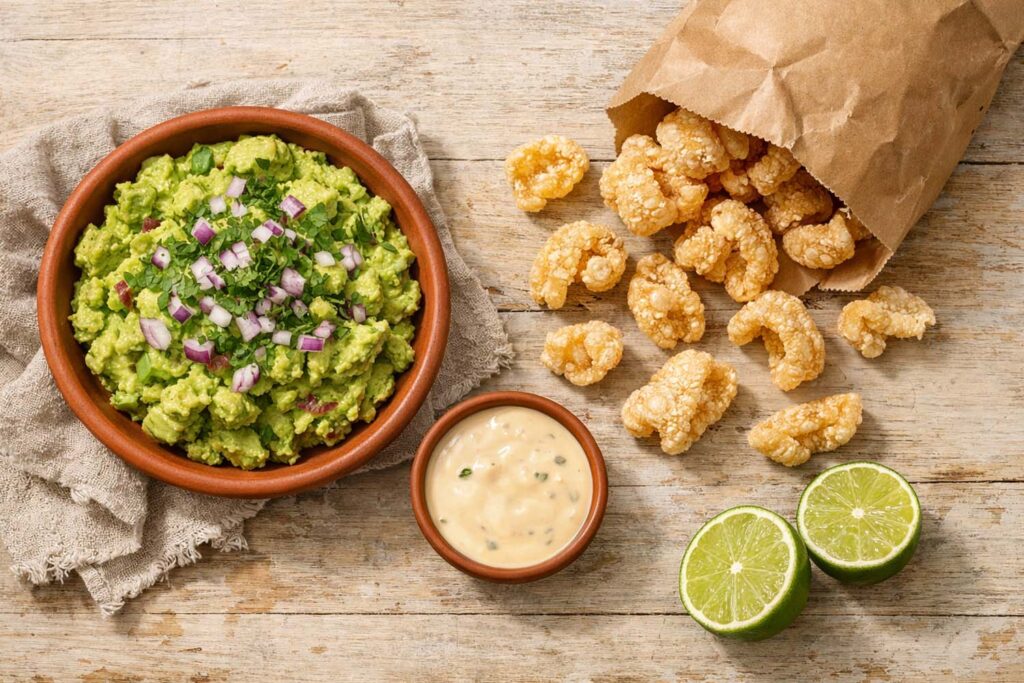
We have been eating them this way for a while now and it has become our go-to: pork rinds with fresh guacamole, pico de gallo, and a homemade fat free mozzarella queso. Melt fat free mozzarella down, stir in fresh pico and a squeeze of lime, and you have a queso that is genuinely better than most restaurant versions. Fat free mozzarella is real dairy — not processed cheese product — so the protein quality is intact and it fills every amino acid gap the pork rinds leave open. Add Greek yogurt with Tajin on the side as a dip and you have covered collagen, complete protein, healthy fats, fiber, lycopene from the tomatoes, and vitamin C from the lime and chili, all in one snack board.
Pork Rind Pairings
🥑
Guacamole
Raw avocado has a complementary amino acid profile to pork rinds, plus fiber, potassium, and healthy fats. The most instinctive pairing turns out to be the most nutritionally logical one too.
Best overall
🍅
Pico de gallo or fresh salsa
Fresh tomato, onion, cilantro, and lime add fiber, lycopene, and vitamin C without adding carbs or sodium worth worrying about. Keeps the whole board feeling fresh and light.
Fresh and bright
🧀
Fat free mozzarella queso
Melt fat free mozz, stir in fresh pico and a squeeze of lime. Real cheese means real complete protein — all nine essential amino acids — filling the gaps pork rinds leave. Better than most restaurant quesos and genuinely lighter.
Complete protein
🥣
Greek yogurt with Tajin
Fat free Greek yogurt is one of the most complete proteins available plus probiotics and calcium. Tajin adds chili lime brightness for almost zero calories. Sounds unexpected, tastes like it was always supposed to be there.
Most surprising dip
Put all four on the table and you have collagen from the rinds, complementary amino acids from the avocado and dairy, complete protein from the mozz and yogurt, fiber and antioxidants from the fresh tomato, and vitamin C from the lime and Tajin. That is a snack board that actually does something. Our avocado recipe collection has plenty more ideas if you want to build out the guac situation further.
And if you want to use them beyond snacking, crushed pork rinds make an excellent carb-free coating for baked chicken or fish. They’re crunchier than breadcrumbs and with more protein per bite.
The bottom line
Pork rinds are not going to replace a salad and they are high in sodium, so portion awareness matters. But for a crunchy zero-carb snack with a fat profile that looks a lot like olive oil, real collagen, and pairings that genuinely round out the nutritional picture, they have been carrying an unfair reputation for a long time.
The gas station stigma did them dirty. Build the right board around them and they become one of the more interesting and satisfying snacks you can put together. Looking for more ideas on smarter snacking? Our guides to quick healthy snacks and stocking your fridge for weight loss are both worth a read.
The fact that the whole board tastes great is almost beside the point at this stage. Almost.
Better Living may earn commissions through affiliate links and may occasionally feature sponsored or partner content. If you make a purchase through our links, we may receive a small commission at no cost to you.