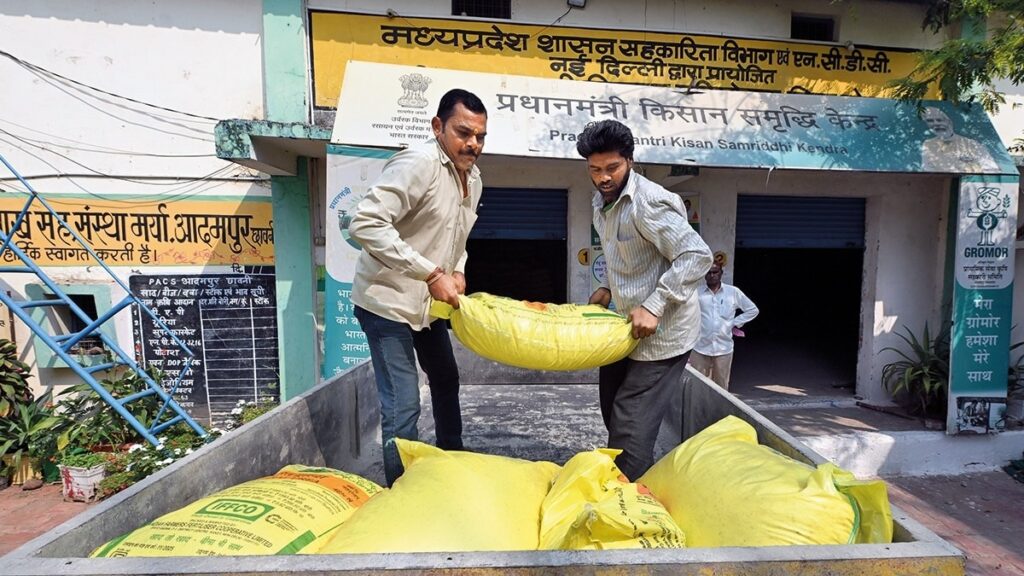
The ongoing conflict involving the US, Israel, and Iran has begun to ripple far beyond the Middle East, disrupting global supply chains and raising concerns for India’s agricultural sector. A key chokepoint, the Strait of Hormuz, has seen restricted movement of merchant vessels, affecting the transportation of crucial inputs like fertilisers and pesticides.
With the Kharif season approaching, the disruption is emerging as a serious threat to farm productivity and food prices in India.
Ground reports from Madhya Pradesh indicate that farmers are already facing shortages and rising costs of essential agricultural inputs. Interactions with farmers, traders, and experts suggest that the situation could worsen if supply chains are not restored quickly.
FRETILISER AND PESTICIDE SHORTAGE
Avatansh Kumar, a farmer from Parichha village in Shivpuri district, says fertiliser and pesticide availability has sharply declined.
“There is a shortage of both fertilisers and pesticides in the market. A single bag of Urea, which is typically sold for Rs 280, is now fetching up to Rs 1,200 on the black market.”
Madhya Pradesh, where nearly 73% of the population is dependent on agriculture, is a major producer of soybeans, pulses, wheat, oilseeds, and horticultural crops. Farmers here rely heavily on timely and affordable access to inputs.
Avatansh explains that one acre requires around four to five bags of Urea. With 35 bighas under cultivation, his input costs have surged significantly.
“I have finished harvesting my wheat crop and am now preparing to sow onions. So far, I have only been able to procure 20 bags.”
Prices of key fertilisers have also spiked. DAP (Diammonium Phosphate), which earlier cost around Rs 1,300 per bag, is now selling between Rs 2,100 and Rs 2,200, adding further pressure on farmers.
DEPENDENCE ON IMPORTS AND SUPPLY CRISIS
India depends heavily on imports to meet its fertiliser demand:
- 20–30% of its Urea needs
- Approximately 30% of its DAP needs
Much of this supply comes from Gulf nations such as Saudi Arabia, Qatar, the UAE, Oman, Bahrain, and Iran, where production is closely tied to natural gas availability. The ongoing geopolitical tensions have increased shipping and fuel costs, disrupting supply lines and limiting availability in domestic markets.
SURGE IN PESTICIDE PRICES
The impact is also visible in pesticide markets. Mayank Meliwar, a dealer in Jhabua, says prices have risen noticeably since the conflict began. “Since the conflict began, pesticide prices have risen by 15–25%”.
Prices of some of the key products:
- Paraquat (1 liter): Rs 225 to Rs 300
- Glyphosate (100 grams): Rs 45 to Rs 55
- Acephate + Imidacloprid: Increase of Rs 50/kg
- Carbendazim + Mancozeb: Up by Rs 100–125
As a result, per-acre input costs for farmers have increased from around Rs 4,000 to between Rs 5,500 and Rs 6,000.
BIGGEST IMPACT ON SMALL FARMERS
Small and marginal farmers are bearing the brunt of the crisis. A farmer from Jhabua said rising costs are making cultivation decisions uncertain.
“I have finished harvesting my wheat and plan to sow watermelons, but the rising costs make the potential profit uncertain”.
Limited landholdings and tighter financial margins leave such farmers especially vulnerable to price shocks.
THREAT TO KHARIF CROPS
The disruption comes at a critical time, as farmers prepare for the Kharif sowing season. In Madhya Pradesh, soybean dominates, covering more than 50% of the cultivated area. Other major crops include paddy, maize, pulses, sorghum (jowar), pearl millet (bajra), cotton, and sesame.
These crops are already dependent on monsoon variability. Rising input costs and shortages now add another layer of uncertainty, potentially affecting both yield and profitability.
TRADERS NOT RECEIVING ADEQUATE STOCK
Supply constraints are also being reported by traders. Vimal Kumar, a fertiliser dealer in Ratlam, says deliveries have dropped sharply.
“We are not receiving adequate fertiliser. While we previously received 4,000–5,000 bags, this time we have received only 500 bags”.
He attributed the disruption to supply shortages as well as operational issues such as glitches in the e-token system.
GOVERNMENT STATISTICS VS GROUND REALITY
Government data suggests that adequate stock is available in Madhya Pradesh:
- Urea: 281,000 metric tons
- DAP: 84,004 metric tons
- NPK: 231,000 metric tons
However, farmers and traders argue that despite these figures, supplies are not reaching markets efficiently, leading to shortages at the ground level.
EXPERTS’ WARNING
Agricultural expert Devinder Sharma cautions that the crisis could deepen in the coming months.
“The crisis has only just begun, and prices are set to rise further. Several production units have already shut down”.
India requires nearly 39 million metric tons of fertiliser for the Kharif season. To address potential shortages, the government is exploring alternative import sources, including Russia, Morocco, Australia, Jordan, Canada, Algeria, and Egypt.
RECOMMENDATIONS FOR NATURAL
Devinder Sharma emphasised the need to reduce dependence on imported inputs by promoting sustainable practices.
“It is imperative to promote natural farming across the country to reduce our dependence on external inputs”.
He cited Andhra Pradesh as an example, where around 800,000 farmers have adopted natural farming over the past decade.
The ongoing Middle East crisis is now beginning to directly impact Indian agriculture and food security. If supply disruptions persist and prices continue to rise, both crop production and food inflation could face serious challenges in the months ahead.
– Ends
Published On:
Apr 1, 2026 00:03 IST
Tune In