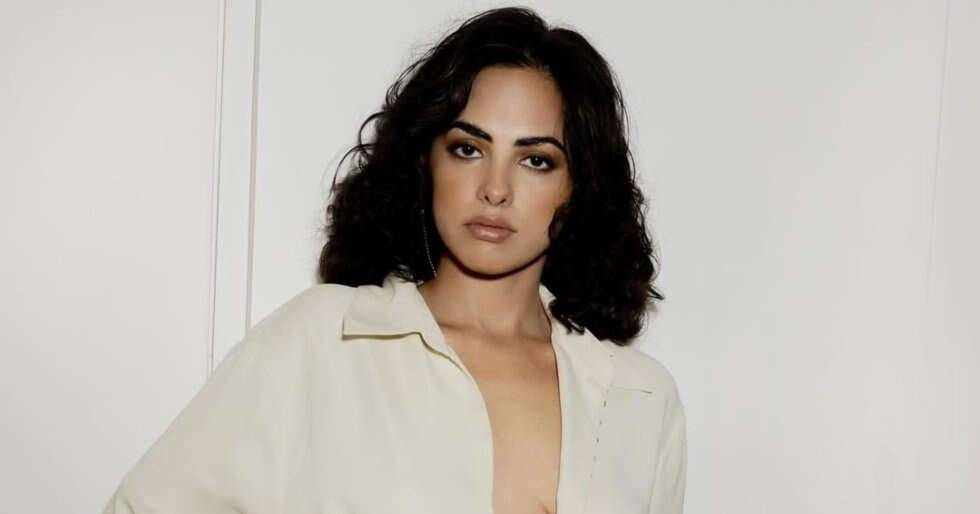
Joyeeta Dutta didn’t take a conventional route into acting. While she always knew performing was her safe space, she began her career in the corporate world, just like any other person, before deciding to follow her instinct and move towards performance full-time. That shift led her to train with Adil Hussain, and eventually to projects like A Suitable Boy and the Monsoon Wedding musical with Mira Nair.
She was most recently seen in The Great Shamsuddin Family, directed by Anusha Rizvi, where she played Latika in an ensemble cast including Kritika Kamra, Shreya Dhanwanthary, Juhi Babbar, Fareeda Jalal and Sheeba Chaddha. In this conversation, Dutta talks about her journey into acting, navigating the industry, questions of representation, and the kind of stories she wants to be part of.
When did you realise your passion for acting?
I always knew I wanted to act. Growing up, performing was my safe space. But that gap between knowing something that you like and being able to pursue it as a livelihood requires quite a bit of reconciliation between the two. Our education system and the structures that we live in condition us to tick certain boxes, so I did all of that, thinking this is correct. But my instinct wanted me to pursue acting. That’s when I met Adil Hussain and trained with him. Through him, I met casting director Dilip Shankar and auditioned for a stage musical called Monsoon Wedding, directed by Mira Nair. I left my corporate job to take up acting full-time.
How did you land The Great Shamsuddin Family?
I have to thank casting director Dilip Shankar. I worked with him previously in A Suitable Boy and the Monsoon Wedding musical. During my audition, I was just told that it’s an ensemble film with amazing actors, and Anusha Rizvi is directing it. From what I was told, they were struggling to find the character of Latika, and it was one of the last characters to be cast. I auditioned for it in the morning, and by night, I got a call that I’ve been locked in.
How has the response been for the film?
My first big victory and joy has been the love that I got from Anusha Rizvi. She was once asked in an interview whether any young actor had created an impact on her, and she mentioned me and my performance. To have that vote of confidence from your director means the world, and to have that connection with her feels like a big gift. After the film, Varun Grover, whom I admire and look up to, sent me a very kind message talking about my performance.
Coming from Assam to the Hindi film industry, have you faced stereotypes or felt an identity shift?
Everyone has their own journey when it comes to navigating structural issues like representation or stereotyping. There are different sections of people, and you have to find your own path within that.
Very often, we believe there are certain rules, but in reality, they’re just constructed, imagined ideas. Even when it comes to being true to yourself, it’s easy to get pulled into that vortex of thinking, “This is what I need to do to be an actor in Indian cinema.” I’ve felt that too. That I needed to look a certain way or speak a certain way. But that’s something I had told myself, and it isn’t true. I don’t think I can play by those rules, because honestly, those rules don’t exist. When it comes to finding truthful narratives, you need to work with people who are from that community. Then the narrative automatically becomes authentic since the gaze is not external.
What kind of support have you received from the people in the industry?
I’ve gotten a lot of support from the people in the industry. There have been seniors in the field, whether it is Tilottama Shome, Adil Hussain or Mira Nair. There are so many people I reach out to for guidance. This is something that people don’t talk about enough in our industry. It’s hard to call it an industry because we are not organised in that sense. There aren’t structures that protect you or nurture you. The concept of mentorship is something that is very vague, and it can be confusing for younger people. Luckily, because I had my background in the corporate world, I was able to reach out to people. It’s not easy to keep running this marathon. There are big moments of unemployment, uncertainty, and this is part of the industry; we can’t complain about it. You navigate it through your support system, mentorship, and I hope that I can do what these people have done for me, so that people will come after.
When you say the industry is not organised, is it only about mentorship and networking, or are there other deep-rooted problems?
An industry, in its true sense, also has certain guarantees and protections for people, which we don’t have in our system yet. Hopefully, we can go towards that direction, whether it comes to health insurance or minimum wage. These could be alien concepts for people, but there are countries that help their artistes. It would be very beautiful if we could have that.
Tell us about working with Mira Nair…
I left the office early in Gurgaon and took the metro to Okhla for my audition. It was my first one, and I remember thinking that no matter what happens, I’ll at least get to be in the same space as her. I walked in, and she had these incredibly powerful eyes that just lock into you. She’s a giver. She makes you feel seen and important, so you begin to feel like you matter. For an actor, especially before an audition, that kind of energy just opens you up. Before we even got to the audition, she spent nearly half an hour just talking to me about my family, my elder sister, why I was working, and whether I should leave my job. She’s deeply curious, genuinely interested in who you are, and that makes you feel cared for. By the time we started the audition, there was already a sense of connection.
Who do you want to work with in the future?
I loved Preeti Panigrahi in Girls Will Be Girls. I also want to work with Tilottama Shome, Shefali Shah, Alia Bhatt and Konkona Sen Sharma, among many others. Out of directors, Vishal Bhardwaj, Anurag Kashyap, Reema Kagti and Shoojit Sircar are some of the people I want to collaborate with. I saw Ram Reddy’s Jugnuma and also loved Sabar Bonda.
Also Read: Haiwaan Exclusive – “Saif Ali Khan’s Character Was The Most Difficult to Write”: Rohan Shankar