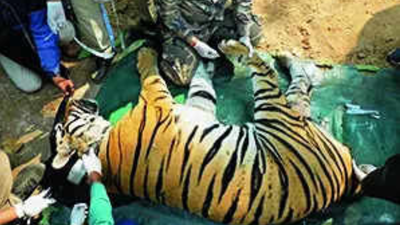
BHOPAL: Satpura’s rewilded tiger, which had been brought back into the wild as part of a conservation effort, died a painful death after multiple attempts were made to kill it, investigators have now found. Officials probing the case said the accused, linked to illegal opium cultivation inside forest land, first tried to poison the tiger by lacing a dead bull with urea. The big cat repeatedly fed on the carcass but survived the initial attempts. When the poisoning did not work, an electric wire trap was laid along the tiger’s movement route. According to investigators, the tiger walked into the live wire around midnight on March 3. The timing of the electrocution has been corroborated through tripping records from a nearby power sub-station, which showed a fault at the same time. Post-mortem findings have confirmed that the tiger suffered both poisoning and electrocution. The case, officials said, is becoming complicated with the illegal opium cultivation and questions over the actual motive behind the killing. Tiger, translocated from Bandhavgarh to Satpura, was released into wild in ’25The tiger, around four-and-a-half years old, had been translocated from Bandhavgarh Tiger Reserve to Satpura Tiger Reserve on December 24, 2024, as part of a rewilding effort. It was released into the wild on January 1, 2025, after being fitted with a satellite radio collar equipped with a drop-off mechanism to track its movement without the need for recapture. The collar stopped transmitting on March 3. Officials handling the system initially believed the signal loss could be due to possible satellite disruption, leading to a delay in field response. The remote drop command for the collar was issued only on March 19. A tracking team from Satpura Tiger Reserve then moved to the Chhatiaam area of Sangakheda Range in Chhindwara based on the last recorded coordinates to recover the collar. Instead of the device, the team first found a decomposed carcass of a bull. With no sign of the tiger, suspicion grew. A joint search was launched with the local forest team, covering nearby forest patches and compartments. What drew attention was that both ears of the animal had been cut off, a deliberate move to remove identification tags and delay tracing the owner. With no immediate records to go by, the team relied on local inputs. A tip-off from a village child helped link the carcass to Udesingh, 50, a resident of Chhatiaam village, which was further confirmed by the village sarpanch. Acting on this lead, officials zeroed in on the suspect. During the initial phase of investigation at the site itself, teams also noticed signs of human activity deeper inside the forest. Acting on these leads, officials trekked for nearly one and a half hours through hilly terrain and found illegal opium cultivation. A total of 6,148 plants weighing 194.5 kg were seized by police. During questioning, the accused, Udesingh, said he had laced the carcass with urea after the tiger killed his bull. Officials said he had also received compensation in 2025 for cattle loss caused by a tiger. Officials have recovered the electric wire and wooden posts used in the trap. The tiger’s collar is suspected to have been destroyed, and one of its claws is missing. Efforts are on to recover both.