Wind and solar generators in India have been given more time to adjust to tighter grid rules as the country’s top electricity regulator has delayed the rollout of stricter deviation norms by a year.
These norms — meant to penalize firms when they produce more or less electricity than promised — will now start in April 2027 instead of April 2026.
Power generators have to declare in advance how much electricity they will supply to the grid. If they generate too much or too little, it can disturb the balance of the power system, forcing grid operators to adjust supply from other sources. The stricter norms aim to reduce these mismatches over time.
Grid operators levy deviation charges — essentially financial penalties — when differences between actual generation and scheduled supply force them to curtail output from other plants to maintain system stability.
For now, renewable energy companies are getting a breather as wind and solar power depend on the weather, making the output harder to predict. While deviation charges still apply to them, they enjoy relaxed norms due to their intermittent nature.
However, in its March 31 order, CERC laid out a phased plan to tighten these norms using a more complex calculation methodology. The order aims at aligning deviation rules for renewable energy (RE) generators with those applicable to conventional generators from 2031 onwards.
As per CERC, these measures are necessary as India rapidly adds more renewable energy to the grid, where even small forecasting errors can have a larger impact on overall grid stability.
Story continues below this ad
However, the implementation of the order remains subject to writ petitions pending before the Delhi High Court. Meanwhile, industry players have cautioned that the tighter norms could dent revenues and further strain the financial viability of projects.
The new rule seeks to reduce the gap between what the electricity generators commit to supply versus what they deliver. Currently, renewable energy accounts for over 50% of India’s installed power capacity, although its share in actual electricity generation remains below 30%.
Grid stability concerns
In its order, the CERC underscored that grid stability concerns have intensified with the rapid scale-up of renewable energy. When wind and solar capacity were relatively small, deviations from schedule did not materially threaten system balance. However, as the scale of renewable injection grows, even moderate forecasting errors can translate into large absolute deviations, which, in turn, affect frequency, reserve deployment and ancillary service requirements, the order read.
“Large unscheduled overinjections or under-injections require balancing through reserves or ancillary services, impose costs on the system and potentially affect frequency stability. If such costs are not internalised by the entities causing deviations, they are ultimately borne by consumers,” it noted.
Different pathways for solar and wind
Story continues below this ad
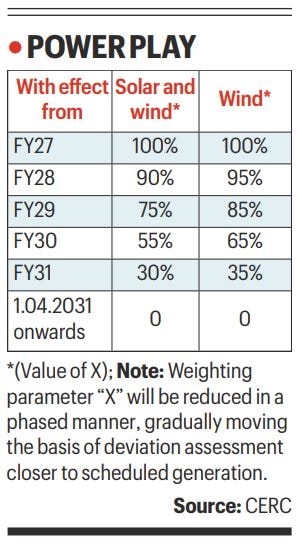
Under new regulation, deviations for wind and solar generators will no longer be assessed solely against available capacity. Instead, the calculation will shift to a blended denominator that factors in both available capacity and scheduled generation.
A key element of this framework is the weighting parameter “X”, which will be reduced in a phased manner over time, gradually moving the basis of deviation assessment closer to scheduled generation.
To enable the transition, the CERC has outlined a phased roadmap, with separate trajectories for solar and wind, reflecting differences in forecasting accuracy.
“Over time, it has been established that Solar-based Projects have greater generation predictability than wind-based projects,” the order read, adding that the allowed margin for error before deviation charges kick in will get smaller from April 1. For solar and hybrid projects, the permissible deviation band will be narrowed from +/- 10% to +/- 5%. For wind projects, it will be reduced to +/- 10% from +/- 15%.