Preliminary Examination: Indian Polity and Governance-Constitution, Political System, Panchayati Raj, Public Policy, Rights Issues, etc.
• General Studies II: Parliament and State legislatures—structure, functioning, conduct of business, powers & privileges and issues
arising out of these.
• General Studies II: Government policies and interventions for development in various sectors and issues arising out of their design and implementation.
What’s the ongoing story: The Union Cabinet on Wednesday cleared the proposed Constitutional amendments to the Nari Shakti Vandan Adhiniyam and a Delimitation Bill to fast-track 33% reservation for women in Lok Sabha and Vidhan Sabhas by using 2011 Census data, sources told The Indian Express.
Key Points to Ponder:
• What are the proposed Constitutional amendments to the Nari Shakti Vandan Adhiniyam?
Story continues below this ad
• What are the proposed Constitutional amendments to the Delimitation Bill?
• What is delimitation?
• Why delimitation is required for the implementation of women reservation?
• How demographic shifts and variations in fertility rates among states influence political representation in India?
• What are the impact of population-based representation on economic development and governance?
Story continues below this ad
• Should economic contribution and governance parameters be considered in delimitation?
• Women’s Reservation in the parliament-How will it be implemented?
• Women’s Reservation in the parliament and in the legislative assembly-what are the key highlights?
• The Women’s Reservation Act also Constitution (106th Amendment) Act, 2023-know in detail
Story continues below this ad
• Why Women’s Reservation Act is likely to face various legal and constitutional challenges?
• What can be the possible legal and constitutional challenges in Women’s Reservation Act?
• What is Article 81 of the Constitution?
Key Takeaways:
• According to sources, there will be multiple Bills to make the long-pending reservation a reality by delinking it from the yet-to-be completed Census exercise and using the 2011 data instead.
• The Delimitation Bill, which is learnt to propose an increase of 50% in the number of seats in the Lok Sabha and state assemblies, was also cleared by Cabinet. A separate Bill will be moved to implement this move in Union Territories.
Story continues below this ad
• In the Lok Sabha, the strength would increase by 50% only by the next general elections in 2029.
• The Bills will be brought to Parliament during the special session convened for later this month. The Parliament’s Budget Session has been adjourned to meet again on April 16, and is expected to sit until April 18 to consider and pass these Bills.
• If the proposal is to be implemented, Constitutional provisions limiting the strength of the Lok Sabha to 550 and the assemblies to 500 also need to be amended. For the Lok Sabha, changes will have to be made to Article 81 and for the Assemblies to Article 170.
• Given the proposal, the strength of the Uttar Pradesh Assembly, for instance, will increase to over 600 from the present 403. A Delimitation Commission is also expected to be set up by June to decide the demarcation of constituencies based on 2011 Census data.
Do You Know:
Story continues below this ad
• Delimitation is a Constitutional mandate, to be carried out after every Census in order to readjust the number of seats in Parliament, and the boundaries of constituencies, based on latest population data. The idea is to ensure that each constituency has roughly the same number of people living in it.
• Up until 1976, after every Indian Census, the seats of Lok Sabha, Rajya Sabha and State legislative Assemblies were re-distributed throughout the country. This happened thrice, based on the Censuses of 1951, 1961, and 1971.
• The 42nd Amendment to the Constitution, passed during the Emergency, froze the total number of Parliamentary and state Assembly seats till the 2001 Census.
• In 2001, the boundaries of constituencies were altered. But the number of seats that each state had in Lok Sabha, as well as the strength of states’ legislative Assemblies, remained the same. This was largely due to opposition from southern states.
Story continues below this ad
• The number of seats each state gets after delimitation will depend upon the base average population that a delimitation commission, as and when constituted, will arrive at.
• In the 1977 Lok Sabha, for instance, every MP in India represented 10.11 lakh people on average. While it is impossible for every constituency to have the same population, it is desirable that the population in each constituency be tightly grouped around this average.
Other Important Articles Covering the same topic:
📍We owe it to nari shakti to come together to advance women’s representation
Previous year UPSC Prelims Question Covering similar theme:
1) How many Delimitation Commissions have been constituted by the Government of India till December 2023? (UPSC CSE, 2024)
a) One
b) Two
c) Three
d) Four
Story continues below this ad
2) With reference to the Delimitation Commission consider the following statements: (UPSC CSE, 2012)
1. The orders of the Delimitation Commission cannot be challenged in a Court of Law.
2. When the orders of the Delimitation Commission are laid before the Lok Sabha or State Legislative Assembly, they cannot effect any modification in the orders.
Which of the statements given above is/are correct?
(a) 1 only
(b) 2 only
(c) Both 1 and 2
(d) Neither 1 nor 2
Previous year UPSC Main Question Covering similar theme:
📍“The reservation of seats for women in the institution of local self-government has had a limited impact on the patriarchal character of the Indian political process”. Comment. (2019)
📍“Empowering women is the key to control population growth”. Discuss. (2019)
India no longer inclined to host COP33 climate meeting in 2028
Preliminary Examination: General issues on Environmental ecology, Bio-diversity and Climate Change – that do not require subject specialization.
Main Examination: General Studies III: Conservation, environmental pollution and degradation, environmental impact assessment.
What’s the ongoing story: India is learnt to be no longer inclined in hosting the COP33 climate meeting in 2028, official sources said on Wednesday. India had not formally bid for the event, but Prime Minister Narendra Modi had made the offer in December 2023, during the COP28 meeting in Dubai.
Key Points to Ponder:
• What is UNFCCC’s Conference of the Parties (COP)?
• How India positioned itself in upcoming COP33?
• Why India no longer inclined to host COP33?
• What is Global Stocktake (GST)?
• What are the major unresolved issue at COP?
Key Takeaways:
• The sources did not spell out the reasons for India’s change of mind, but the rethink had been happening in government circles for the last one year. This, despite the fact that a COP33 cell had been set up under the Climate Change division in the Ministry of Environment, Forests and Climate Change last year to prepare the country for hosting the event.
• There was a growing realisation within the government that as the host and President of the conference, India would be expected to champion and prioritise the global cause on climate change which could sometimes come in conflict with its own national positions on many climate-related issues.
• COP33 is due to carry out a Global Stocktake (GST) of climate actions to assess how the world has progressed on the Paris Agreement target of keeping global rise in temperatures within 1.5 or 2 degree Celsius from pre-industrial times.
Do You Know:
• COP, or Conference of Parties, is the annual meeting of the signatories to the 1994 UN Framework Convention on Climate Change (UNFCCC). It also serves as the meeting of the signatories to the 2015 Paris Agreement, and 1997 Kyoto Protocol. These meetings decide the global course of action on climate change.
• The Global Stocktake is an important mechanism set up under the Paris Agreement, to be carried out at five-year intervals. The first GST was held at COP28 in Dubai in 2023, and the second one is due for COP33. Countries are expected to raise the ambition of their climate action based on this exercise. There is greater scrutiny on the climate actions of the host country which is supposed to act as the global climate leader during its presidency.
Other Important Articles Covering the same topic:
Previous year UPSC Prelims Question Covering similar theme:
3) Consider the following statements: (UPSC CSE, 2025)
Statement I: At the 28th United Nations Climate Change Conference (COP28), India refrained from signing the ‘Declaration on Climate and Health’.
Statement II: The COP28 Declaration on Climate and Health is a binding declaration; and if signed, it becomes mandatory to decarbonize the health sector.
Statement III: If India’s health sector is decarbonized, the resilience of its health-care system may be compromised.
Which one of the following is correct in respect of the above statements?
(a) Both Statement II and Statement III are correct and both of them explain Statement I
(b) Both Statement II and Statement III are correct but only one of them explains Statement I
(c) Only one of the Statements II and III is correct and that explains Statement I
(d) Neither Statement II nor Statement III is correct
Previous year UPSC Main Question Covering similar theme:
📍Describe the major outcomes of the 26th session of the Conference of the Parties (COP) to the United Nations Framework Convention on Climate Change (UNFCCC). What are the commitments made by India in this conference? (2021)
Nation
25 Himalayan Griffon vultures dead in UP
Preliminary Examination: General issues on Environmental ecology, Bio-diversity and Climate Change – that do not require subject specialization.
Main Examination: General Studies III: Conservation, environmental pollution and degradation, environmental impact assessment.
What’s the ongoing story:Around 2 pm on Tuesday, a villager living on the edge of the Dudhwa Tiger Reserve witnessed a rare sight of several Himalayan Griffon vultures circling his field — only to be shocked when the birds suddenly began collapsing.
Key Points to Ponder:
• Know about Himalayan griffon vulture
• What are the special features of the Himalayan griffon vulture?
• What is IUCN status of Himalayan Griffon vultures?
• Why do vultures play an important role in the ecosystem?
• Diclofenac and vultures-connect the dots
• What is Vulture Action Plan 2020-25?
• India is home to many species of vultures-know in detail
Key Takeaways:
• By the time he alerted the forest department and teams reached the spot in Semariya village, in Gola tehsil of Lakhimpur Kheri district, 25 of the raptors were dead. Six were rescued.
• Officials said the area forest officer of Bhira range, range staff and a team, including veterinary officer Dr Hemant Kumar Singh from Bijua, carried out an inspection.
• Preliminary findings, they said, pointed to a suspected case of secondary poisoning. According to officials, rice laced with pesticides or some artificial chemical may have been left in the open, possibly to target stray dogs.
Do You Know:
• The raptor (Gyps himalayensis) is listed as ‘Near Threatened’ on the Red List of the International Union for Conservation of Nature (IUCN). Experts have said the Himalayan Griffon vulture is not an endangered species unlike oriental white-backed, slender-billed and lone-billed vultures.
• Himalayan Griffon vulture are migratory, adults live on higher reaches. They can live upto 40-45 years of age. Their large wingspan helps these vultures soar high in the sky searching for carcasses on the ground. By feeding on the carcasses, vultures prevent diseases from spreading to humans.
Other Important Articles Covering the same topic:
📍Vulture numbers ‘stabilising’, MoEF launches action plan to increase population
Previous year UPSC Prelims Question Covering similar theme:
4) Vultures which used to be very common in the Indian countryside some years ago are rarely seen nowadays. This is attributed to (UPSC CSE, 2012)
(a) the destruction of their nesting sites by new invasive species
(b) a drug used by cattle owners for treating their diseased cattle
(c) scarcity of food available to them
(d) a widespread, persistent and fatal disease among them.
No new clearances for production of refrigerant gases after 2027: Centre
Preliminary Examination: Current events of national and international importance.
Main Examination: General Studies III: Conservation, environmental pollution and degradation, environmental impact assessment.
What’s the ongoing story: In line with its international commitments to gradually phase-down production of planet-warming hydrofluorocarbons (HFCs), the Government has directed all state and Central authorities to stop granting environmental clearances for new or additional HFC production beyond December 31, 2027.
Key Points to Ponder:
• What is hydrofluorocarbons (HFCs)?
• Why India is gradually phasing-down production of planet-warming hydrofluorocarbons (HFCs)?
• What is ozone and ozone layer?
• Human-caused ozone holes-What experts say on this?
• What are the key points of the Montreal Protocol?
• What Montreal Protocol says about Ozone holes?
• What was the Kigali Amendment?
• What is India’s efforts on Ozone holes?
• Why is the Ozone layer important?
• What steps are being taken to repair the ozone layer?
Key Takeaways:
• Those applying before the deadline will need to submit an undertaking guaranteeing that their plant will be fully operational, including commencement of production, on or before December 31, 2027.
• The Environment Ministry directive in this regard was issued on April 1 through office memorandum to State Level Environment Impact Assessment Authorities and Expert Appraisal Committees at Central level.
• The ministry’s memorandum stated that the phase-down targets would be implemented through appropriate regulatory mechanisms, including amendment of the Ozone Depleting Substances Rules, 2000. This will be to align it with the HFC phase-down schedule under the Kigali Amendment, prohibition on setting up of new or expansion of HFC production capacity for controlled application after the freeze date of January 1, 2028, and implementation of appropriate framework permitting HFC production.
Do You Know:
• The 1989 Montreal Protocol is meant to protect the ozone layer of the upper atmosphere. It wasn’t originally an instrument to fight climate change. A set of chemicals, mainly the chlorofluorocarbons or CFCs, which were being used in the air-conditioning and refrigeration industry earlier, were found to be damaging the ozone layer of the upper atmosphere.
• The Montreal Protocol mandated the complete phase-out of CFCs and other ozone-depleting substances (ODS), which it has successfully managed to do in the last three decades.
CFCs were gradually replaced, first by HCFCs, or hydrochlorofluorocarbons, in some cases, and eventually by HFCs which have minimal impact on the ozone layer. The transition from HCFCs to HFCs is still happening, particularly in the developing world.
• India is a party to the landmark Montreal Protocol of 1989 which was brought to tackle ozone depletion through phase-out of CFCs, with a complete ban from 2010. Later in 2021, India ratified the Kigali amendment to the protocol, which adopted a plan to phase-down controlled applications of HFCs that were being used as a replacement for CFCs. This landmark amendment to the protocol was agreed upon in Kigali, Rwanda, in 2016.
• India has agreed to a phase-down schedule from January 1, 2028, onwards, which will see 10 per cent reduction in HFCs by 2032 rising up to 85 per cent by 2047. The Centre said in view of the January 1, 2028, freeze date, it was necessary to put in place a mechanism to regulate and progressively reduce HFC production to meet India’s international commitments. “Accordingly, no additional HFC production capacity should be permitted beyond 31.12.2027,” the memorandum stated.
Other Important Articles Covering the same topic:
📍Explained: What to read in ozone hole size
Previous year UPSC Prelims Question Covering similar theme:
5) Consider the following statements: (UPSC CSE, 2017)
1. Climate and Clean Air Coalition (CCAC) to Reduce Short Lived Climate Pollutants is a unique initiative of G20 group of countries.
2. The CCAC focuses on methane, black carbon and hydrofluorocarbons.
Which of the statements given above is/are correct?
a) 1 only
b) 2 only
c) Both 1 and 2
d) Neither 1 nor 2
Economy
RBI holds repo rate, sees GDP growth slowing to 6.9% in FY27
Preliminary Examination: Economic and Social Development-Sustainable Development, Poverty, Inclusion, Demographics, Social Sector Initiatives, etc.
Mains Examination: General Studies III: Indian Economy and issues relating to planning, mobilization, of resources, growth, development and employment.
What’s the ongoing story: The Reserve Bank of India’s (RBI) Monetary Policy Committee (MPC) Wednesday left the main policy instrument, the repo rate, unchanged at 5.25%.
Key Points to Ponder:
• What are the instruments of monetary policy?
• Why RBI Monetary Policy Committee (MPC) left the repo rate, unchanged at 5.25%?
• What happens to lending rates if repo rate is left steady?
• When is RBI expected to cut repo rate?
• What happens when repo rate is increased?
• Repo rate is the rate at which central bank of a country (in our case Reserve Bank of India) lends money to whom?
• In reverse repo rate is the rate at which the central bank of a country (Reserve Bank of India in case of India) borrows money from whom?
• If Repo Rate is increased or say decreased then it impacts common people?
• Who decides the repo rate and reverse repo rate?
• How repo rate and reverse repo rate are decided?
• What is the difference between repo rate and interest rate?
• If repo rate or reverse repo rate is increased or decreased, then how it impacts savings?
• What Marginal Standing Facility?
Key Takeaways:
• The move underscores a cautious and calculated approach as economic risks resulting from the West Asia conflict have led to heightened
uncertainty for both the inflation and growth outlook despite the US and Iran agreeing to a two-week ceasefire.
• “The ceasefire, to some extent, has been taken into account. The whole implications… we’ll come to know. But the ceasefire has been taken into account in the monetary policy decision,” the central bank Governor Sanjay Malhotra told reporters in a press conference.
• The conflict had led to a sharp rise in crude oil prices and broader energy supply disruptions after Iran closed the Strait of Hormuz. This unleashed fresh price pressures, pushing up input costs, straining supply chains, and raw material shortages across industries.
• While the Strait of Hormuz has been re-opened, questions remain over the status of the energy infrastructure of the Gulf nations.
• The RBI has made some changes to the assumptions that underpin its growth and inflation forecasts.
• Keeping the policy rate unchanged at 5.25% would come as a significant relief for borrowers across various segments of the economy. When the RBI maintains its repo rate, it generally means that lending rates offered by banks and financial institutions are unlikely to rise in the near term. As a result, equated monthly instalments on various loans — homes, vehicles, personal needs, corporate financing or small businesses — are expected to remain stable. Deposit rates are also expected to remain unchanged as of now.
Do You Know:
• Monetary policy essentially deals with the supply and cost (interest rates) of money in an economy. The RBI’s MPC meets every two months to assess the state of monetary activities, and may tweak the repo rate — the interest rate at which the RBI lends to commercial banks — in a manner that reduces price fluctuations in the economy while keeping the inflation rate (the rate at which the general price level in the economy grows) at a reasonable level.
• Repo Rate: The interest rate at which the Reserve Bank provides liquidity under the liquidity adjustment facility (LAF) to all LAF participants against the collateral of government and other approved securities.
• Marginal Standing Facility (MSF) Rate: The penal rate at which banks can borrow, on an overnight basis, from the Reserve Bank by dipping into their Statutory Liquidity Ratio (SLR) portfolio up to a predefined limit (2 per cent). This provides a safety valve against unanticipated liquidity shocks to the banking system. The MSF rate is placed at 25 basis points above the policy repo rate.
• Reverse Repo Rate: The interest rate at which the Reserve Bank absorbs liquidity from banks against the collateral of eligible government securities under the LAF. Following the introduction of SDF, the fixed rate reverse repo operations will be at the discretion of the RBI for purposes specified from time to time.
Other Important Articles Covering the same topic:
📍Monetary Policy: Why RBI will keep rates steady & revise inflation and growth forecasts
Previous year UPSC Prelims Question Covering similar theme:
6) If the RBI decides to adopt an expansionist monetary policy, which of the following would it not do? (UPSC CSE, 2020)
1. Cut and optimize the Statutory Liquidity Ratio
2. Increase the Marginal Standing Facility Rate
3. Cut the Bank Rate and Repo Rate
Select the correct answer using the code given below:
(a) 1 and 2 only
(b) 2 only
(c) 1 and 3 only
(d) 1, 2 and 3
Top 10% rural households own 44% land in India: Study
Preliminary Examination: Current events of national and international importance.
Mains Examination: General Studies II: Land reforms in India.
What’s the ongoing story: Land ownership in rural India is highly concentrated with the top 10% of households owning 44% of total land area even as about 46% of households are landless, according to a working paper released by the Paris-based World Inequality Lab.
Key Points to Ponder:
• What Paris-based World Inequality Lab said in their latest repot?
• What report said on concentration of land ownership?
• Which States exhibit high levels of land concentration?
• What is Gini Coefficient?
• Land inequality in India-know the historical background
• What steps were taken by GOI for equal land distributions?
• What are the limitations of conventional indicators like the Gini Coefficient in assessing inequality in India?
Key Takeaways:
• Large landholders dominate land ownership in many villages with the largest landholder controlling about 12% of village land on an average, while two states — Bihar and Punjab — have the highest share of villages in which a single landlord owns more than half of the available land, the paper titled ‘Land inequality in India: Nature, history, and markets’ said.
• The paper, co-authored by economists Nitin Kumar Bharti, David Blakeslee, and Samreen Malik, said Bihar and Kerala stand out among states for their high levels of land concentration in terms of top 10% or 5% or 1% ownership. Overall, while the top 10% rural households own 44% of total land area, the top 5% and top 1% own 32% and 18% of total land area, respectively, it said.
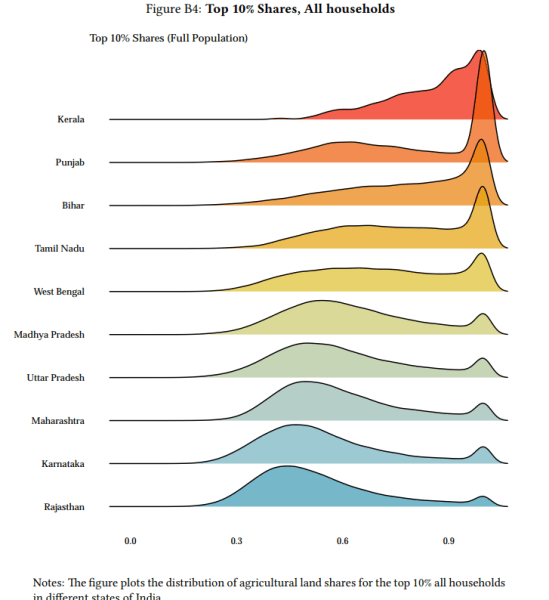
• The paper draws its findings from the Socio-Economic Caste Census conducted in 2011, which covered 650 million individuals from 270,000 villages across ten of the largest states of India — Punjab, Uttar Pradesh, Bihar, Rajasthan, Madhya Pradesh, Maharashtra, Karnataka, Tamil Nadu, Kerala, and West Bengal — accounting for approximately 75% of the rural population.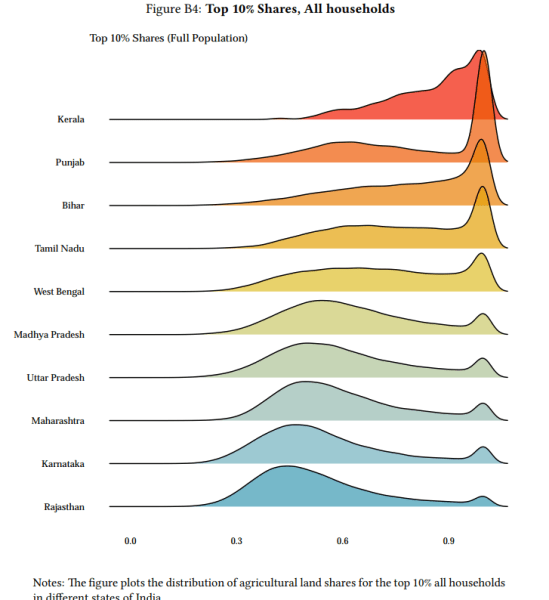
Land inequality among states
Do You Know:
• The share of land owned by the top household ranges from a low of 7.3% in Uttar Pradesh to a high of 20.1% in Bihar, the working paper said. Among the four states where dependency on agriculture is particularly high, Rajasthan (34%) and Uttar Pradesh (39%) have a relatively lower level of landlessness than Madhya Pradesh (51%) and Bihar (59%). Punjab, known for its highly developed commercial agriculture sector, has the highest level of landlessness at 73%, the paper said.
• As per the all-household Gini measure, Kerala has the highest Gini coefficient at 90, followed by Bihar, Punjab, Tamil Nadu and West Bengal, each with a Gini coefficient of around 80. Karnataka and Rajasthan have the lowest Gini coefficient of below 65, the paper stated.
• A lower Gini coefficient indicates a more equal distribution of income or wealth within a population, meaning a smaller gap between the rich and poor. “Excluding landless population reduces the Gini coefficient for all states, and reduces variation across states, indicating that landlessness contributes significantly to the all-household Gini measure,” it said.
Other Important Articles Covering the same topic:
📍Why digitisation is not enough to reform land laws
Previous year UPSC Prelims Question Covering similar theme:
7) With reference to land reforms in independent India, which one of the following statements is correct? (UPSC CSE, 2019)
(a) The ceiling laws were aimed at family holdings and not individual holdings.
(b) The major aim of land reforms was providing agricultural land to all the landless.
(c) It resulted in cultivation of cash crops as a predominant form of cultivation.
(d) Land reforms permitted no exemptions to the ceiling limits.
Explained
Iran’s Hormuz lever to Pakistan’s rising profile: The 5 key takeaways
Preliminary Examination: Current events of national and international importance.
Mains Examination: General Studies II: Effect of policies and politics of developed and developing countries on India’s interests
What’s the ongoing story: US President Donald Trump announced a two-week ceasefire with Iran just about an hour-and-a-half before his 8 pm (5.30 am IST) “deadline” ran out. Iranian Foreign Minister Seyed Abbas Araghchi swiftly agreed to the ceasefire around 40 minutes later.
Key Points to Ponder:
• What are the key takeaways from the two-week “double-sided” ceasefire?
• What this war meant for Washington?
• What this war meant for Iran?
• How Iran gained leverage over the Strait of Hormuz?
• What is the concept of coercive diplomacy in the context of the US-Iran Conflict?
• How is India affected by the Iran War diplomatically and geopolitically?
• “War is God’s way of teaching Americans geography”-decode the quote
Key Takeaways:
• The announcements came after Pakistan Prime Minister Shehbaz Sharif, in a post on X, “requested” both countries to dial down the tensions. And so, 39 days since the war began, the world breathed a sigh of relief as the US President stepped back from the ledge, just hours after threatening to destroy Iran’s energy infrastructure — and its “whole civilization” — if it did not reopen the Strait of Hormuz.
• First, the US President’s brinkmanship was on full display in front of the whole world, as he made announcements laden with threats and expletives.
• While the US does not import oil from the Strait of Hormuz, Iran’s effective closure of the narrow maritime passageway had sent oil prices spiralling for the world — including the US.
• Iran says it has “forced” the US to accept its “10-point plan” which includes the following terms:
—Commitment to non-aggression
—Iran’s control over the Strait of Hormuz
—Acceptance of Iran’s uranium enrichment
—Lifting of all primary sanctions
—Lifting of all secondary sanctions
—Termination of all UN Security Council resolutions
—Termination of all Board of Governors resolutions
—Paying compensation to Iran
—Withdrawal of US combat forces from the region
—Cessation of war on all fronts, including in Lebanon
• The role of Pakistan in the ceasefire has been acknowledged by both sides. This puts Pakistan’s profile as a regional and global peacemaker on the map, and raises its role as a credible mediator.
• The impact on the region has been brutal in the last 39 days. The death toll in the war since February 28 was climbing as it had crossed more than 3,000 so far in the last five-and-half weeks — at least 1,665 killed in Iran, 1,500 killed in Lebanon, 32 killed in the Gulf countries, 20 in Israel, American death toll has been at 13 military personnel.
Do You Know:
• India has been impacted due to the energy crisis that has gripped the economy. The shortage in supply of the oil and gas from the Gulf — India depends on these economies for 60% of its energy needs — has threatened to derail economic growth, pushing it towards a slowdown. While there will be some heartburn in Delhi as Pakistan has stolen the spotlight and has emerged as a peacemaker — External Affairs minister S Jaishankar had referred to them as “dalal” (broker) in his statement at the all-party meeting — but the fact that it has led to a two-week reprieve and a potential pathway towards a truce should be a major development to be welcomed.
• On Wednesday, India, in its first official statement, “welcomed the ceasefire” and expressed hope that it will lead to a “lasting peace”. The Ministry of External Affairs did not mention Pakistan in its statement, whose role has been acknowledged by both the US and Iran.
• The war had also taken a toll on Indian lives, as eight Indians have been killed in the last five-and-half weeks, including three seafarers. While more than 7 lakh Indians had been able to use the flights to come home, including about 1,800 from Iran, the concern in Delhi for the safety of Indians in the Gulf was very high. After all, there are about one crore Indians in the region, and they account for almost 40% of remittances sent to India.
Other Important Articles Covering the same topic:
📍How Tehran and Trump’s roads to ‘victory’ ended at negotiating table
📍Islamabad channel: India must stand for peace, whoever the broker may be
📍Crisis needs a national approach, talk to the Opposition
📍Pause welcome, path ahead forbidding: 5 key minefields amid US-Iran chasm
📍Expert Explains Iran-US ceasefire: What each side was fighting for, and what they have won or lost
|
PRELIMS ANSWER KEY |
|
1.(d) 2.(c) 3.(c) 4.(b) 5.(b) 6.(b) 7.(b) |
For any queries and feedback, contact priya.shukla@indianexpress.com
Subscribe to our UPSC newsletter. Stay updated with the latest UPSC articles by joining our Telegram channel – IndianExpress UPSC Hub, and follow us on Instagram and X.