4 min readNew DelhiApr 10, 2026 07:02 PM IST
India’s real economic growth rate is expected to dip below the crucial 7% mark in the current financial year thanks to the war in Iran, according to a new assessment by the World Bank.
On February 27, the Indian government had updated the way it estimated its economic growth. The most significant change was the use of a new base year (2022-23). It was a long-pending update — the previous base year was 2011-12 — as a growing number of observers had raised questions about the quality of India’s GDP data, especially many who claimed India’s GDP was being overstated.

While the new gross domestic product or GDP was lower in the new data series, a silver lining was the fact that in each of the years in the new GDP data series, the growth rate of India’s real GDP (that is, economic growth after taking away the effect of inflation) was above 7%.
The new series pegged India’s real GDP growth rate at 7.2% for FY24, 7.1% in FY25 and 7.6% in FY26. Commenting on the data, India’s Chief Economic Advisor V Anantha Nageswaran had underscored the importance of the 7% growth rate.
“This is very important because these are the numbers when we talk about achieving Viksit Bharat by 2047. The numbers being talked about are between 7% and 8% in real growth rates.”
The very next day, however, the US and Israel attacked Iran — a war that continued for 39 days before reaching a fragile ceasefire agreement. Over the next few days, top negotiators from the US and Iran will meet in Islamabad and attempt to bring hostilities to an end. But even as things stand, India’s GDP growth rate has been dented enough to dip below the 7% mark according to the World Bank’s latest India Development Update (see table).
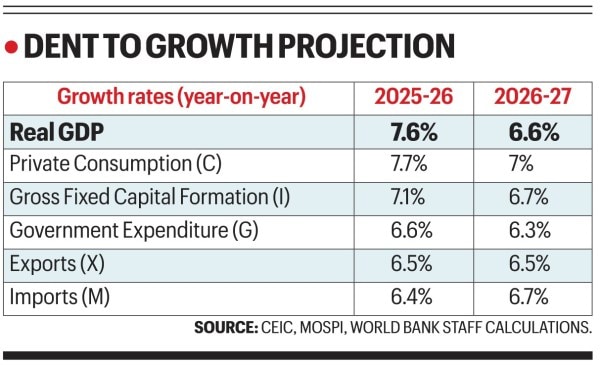
“In the absence of the conflict, GDP growth was projected at 7.2 percent… Growth is now projected at 6.6 percent in FY27, reflecting headwinds from the Middle East conflict — assuming an extended disruption in global energy (oil and gas) supply till end-2026,” states the World Bank.
Story continues below this ad
The World Bank has also provided a detailed breakdown about how different components of India’s growth will be affected. Typically, the GDP of a country is generated by four main engines:
- The expenditures by private individuals for their own consumption (C) — this includes everything from food to cars to train tickets;
- The expenditures made by companies towards their businesses (these are called investments or I in the table)
- The expenditures that the government makes for its daily running e.g. salaries and fuel bills etc.
- The net effect of exports (X) and imports (M); exports bring money into the country and add to the GDP and imports do the opposite.
The equation is GDP = C + I + G + NX (net exports)
The biggest deceleration in the overall GDP is likely to happen via the deceleration in the growth of private consumption, which is also the biggest engine of growth in any year, accounting for almost 55% to 60% of India’s total GDP. In the past couple of years, the government has tried to boost private consumption by providing relief both in direct income tax as well as indirect (GST) tax. But the higher prices in the wake of this war is expected to hit “disposable” incomes.
The growth in “investments” by companies — second biggest engine, contributing almost 30% of total GDP in a year — too are likely to slow down thanks to all the uncertainty prevailing in the markets.
Story continues below this ad
The government’s own expenditure, too, is likely to be constrained because it is already over-stretched on its total borrowings and with oil prices staying elevated, the subsidy bill is likely to rise further.
Last, while exports are expected to continue to grow at the same rate, imports are likely to increase at a faster clip and the net effect is expected to drag down India’s GDP further.
“While India’s strong macroeconomic buffers offer some protection against downside risks, the conflict underscores the importance of energy diversification, prudent fiscal management, and trade diversification,” concludes the Bank.

© The Indian Express Pvt Ltd