

4 min readNew DelhiApr 23, 2026 12:38 PM IST
Delhi High Court news: Over 40 years after he was medically discharged from service in 1979, and almost three decades after his disability pension was discontinued in 1998, a retired Indian Army officer has secured partial relief from the Delhi High Court, which ruled that a disability once declared permanent cannot be downgraded without a fresh medical assessment.
A bench of Justices V Kameswar Rao and Manmeet Pritam Singh was hearing a writ petition filed by the central government challenging the Armed Forces Tribunal (AFT) orders of July 13, 2023, and November 14, 2024, which had restored disability pension to Captain J K Verma, assessed his disability at 20 per cent and granted enhanced benefits by rounding it off to 50 per cent for life.

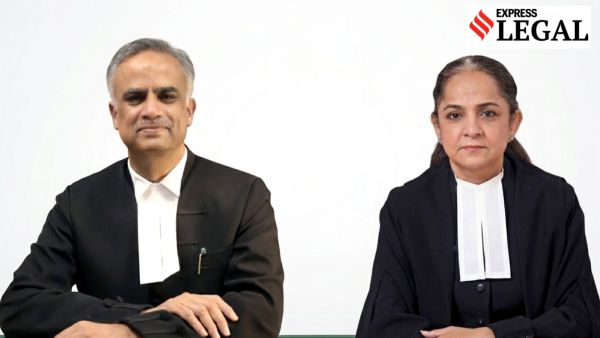 Justices V Kameswar Rao and Manmeet Pritam Singh ordered that the arrears shall be paid by the Centre within 3 months. (Image enhanced using AI)
“Once the disability has been assessed at 20% for life then the same is permanent for life. So, to that extent, the conclusion of the Tribunal cannot be contested,” the Delhi High Court said on April 20, directing the Centre to calculate and issue necessary pension payment orders (PPO) to the retired officer within a period of three months.
The court also ordered that the amount of arrears shall be paid by the Centre within the same period, failing which the officer shall be entitled to interest 6 per cent per annum.
Service history, medical background
Captain J K Verma (Retd) served in the Indian Air Force from June 13, 1967, to July 6, 1973, before joining the Indian Army on May 12, 1974. He was invalided out on May 12, 1979, after being diagnosed with pulmonary tuberculosis attributable to military service.
Initially granted 100 per cent disability pension, his condition was periodically reassessed. By 1993, a re-survey medical board fixed his disability at 20 per cent and declared it permanent, extending pension benefits accordingly.
However, in 1998, the authorities reduced the disability assessment to 11-14 per cent, leading to the discontinuation of his pension as it fell below the eligibility threshold of 20 per cent.
Story continues below this ad
Tribunal ruling, government’s challenge
After years of representations, the officer approached the AFT in 2019. The tribunal, in its orders dated July 13, 2023, and November 14, 2024, restored his disability pension, holding that his disability should be treated as 20 per cent and rounded off to 50 per cent for life, with benefits from the date of discharge.
The Union government challenged this ruling, arguing that a pension is not payable when disability falls below 20 per cent, that medical reassessments justified the reduction, and arrears should not be granted for delayed claims.
The bench delivered the judgment partly upholding orders, while modifying the extent of monetary benefits.
Administrative vs medical authority
The Delhi High Court examined whether authorities could reduce a disability percentage declared permanent without fresh medical evaluation.
Story continues below this ad
The bench found that the reduction in 1998 was carried out without a fresh medical board, making the action unsustainable in law. It emphasised that administrative authorities cannot override medical findings unless supported by a competent medical opinion.
Court’s findings, directions
- The Delhi High Court upheld the tribunal’s conclusion that once disability was assessed at 20 per cent for life in 1993, it could not be reduced without due medical reassessment.
- However, the court disagreed with granting enhanced benefits from the date of discharge.
- Disability pension at 20 per cent was restored from February 23, 1998.
- “Broad-banding” to 50 per cent applicable only from 2014, in line with Supreme Court precedent.
Arrears, compliance
The Delhi High Court directed the government to recalculate pension and issue a revised pension payment order within three months, pay arrears within the same period, and pay 6 per cent interest in case of delay.

© IE Online Media Services Pvt Ltd










Very informative and easy to understand.