For Hershey, much of its 132-year-old history has been built around its iconic sweets, including Reese’s, Almond Joy and its namesake chocolates. But a bigger part of its future growth hinges not just on sugar, but salt.
Hershey has acquired four salty brands since 2017: SkinnyPop popcorn, Pirate’s Booty cheese puffs, Dot’s Homestyle Pretzels and organic snacks brand LesserEvil, which it officially closed in mid-November.
Today, these snacks generate about 10% of Hershey’s more than $11 billion in annual revenue. During its most recent quarter ended Dec 31, Hershey said its salty portfolio generated $357 million in sales, up 28% from the same period a year ago, with part of the increase coming from the addition of LesserEvil.
Executives, however, have even broader ambitions for salty snacks, aiming to grow the business to 20% of its revenue through M&A, innovation, new packaging formats and the addition of more retail locations.
“It’s a big bet. It’s a long-term bet, and it’s a bet that is working, and we want to continue to extend that bet into the future,” Veronica Villasenor, president of Hershey’s salty snacks division, said in an interview. “Our full leadership team at Hershey is committed to salty.”
Villasenor, who has been with Hershey for 23 years, noted the company’s salty brands still have room for expansion despite posting strong growth since they were purchased.
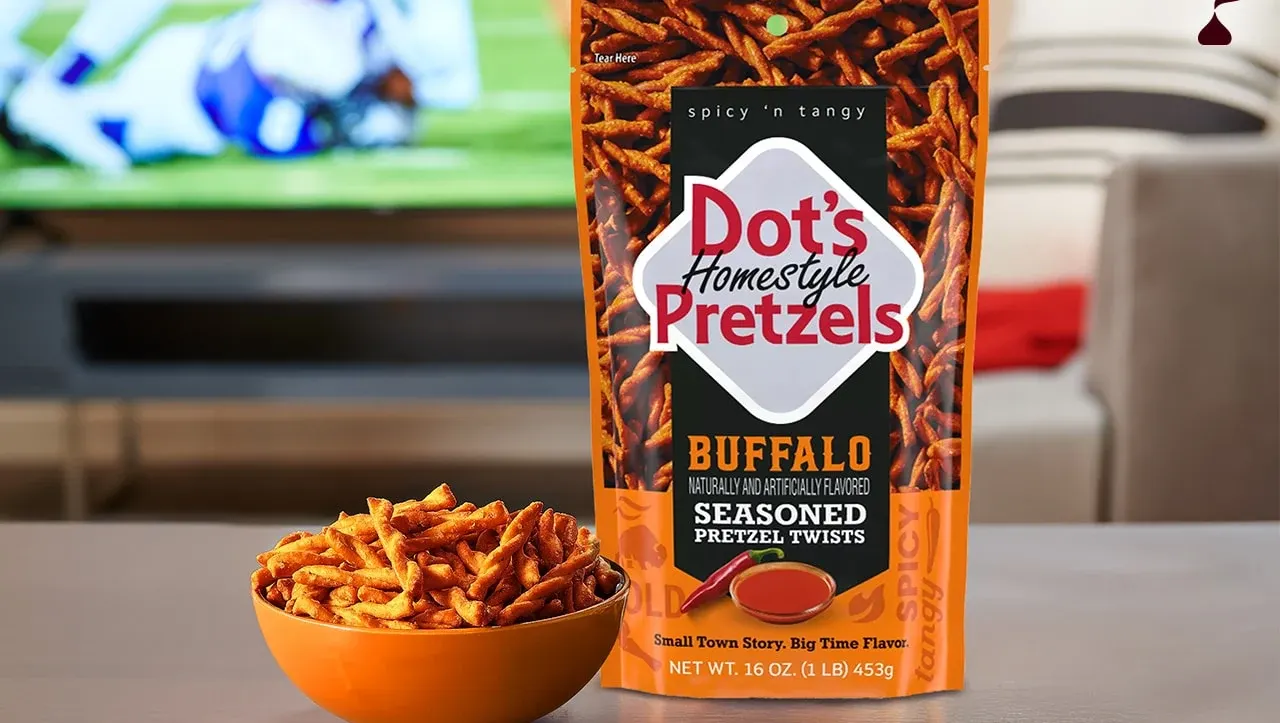
Dot’s, the top-selling pretzel brand by market share, has more than doubled its market share to 22% since Hershey acquired it four years ago.
SkinnyPop has experienced similar success. The leader in ready-to-eat popcorn, SkinnyPop owns about 26% of the market compared to the 20% it owned when Hershey acquired it in late 2017.
Optional Caption
Courtesy of Hershey
Pirate’s Booty has been the only laggard in Hershey’s salty portfolio, with its market share remaining flat since the acquisition seven years ago, despite a slight increase in household penetration and a spike in total points of distribution.
Hershey is putting more resources into growing Pirate’s Booty, the third-largest brand in the $4.5 billion puffs space, this year.
Hershey’s strategy in salty snacks has been to acquire brands that can be scaled and possess a distinctive flavor to help them stand out in the market. The company has avoided entering areas like potato chips that are widely available or dominated by a major player. Hershey also eschews offerings that are not as conducive to innovation or viewed as less permissible snacking options.
In the case of Dot’s, for example, the brand prioritizes an intense flavor profile, with options such as garlic parmesan and honey mustard, that is administered using a proprietary process.
Hershey has also built a salty portfolio that touts better-for-you snacks, such as SkinnyPop or Pirate’s Booty. LesserEvil, which uses ingredients such as coconut oil and avocado oil, also makes popcorn, puffs and rings that are seen as healthier.
“If we’re going to play, we’re going to play to win,” Villasenor said. “We want to be committed to the bet that we’re making.”
For Hershey, a presence in salty snacks allows the company to further benefit from strong snacking demand. Snack food sales increased 4.8% to $156 billion during the past year, according to a SNAC International report released last May, with growth stemming from interest in single-sized portions and healthier offerings.
Hershey’s burgeoning snacks portfolio enables it to connect with certain demographics or people looking for better-for-you foods and unique flavors. SkinnyPop, for example, is popular with women, while LesserEvil resonates more with children and other younger generations.
“We have been very intentional about how we build our salty portfolio,” Villasenor said. These brands “have so much potential and they really complement the total portfolio of the company.”
Erin Lash, a senior director of consumer equity research at Morningstar, called Hershey’s slow and methodical push into salty “a prudent strategy” for the storied company.
“They’ve made very select and targeted acquisitions of up-and-coming or leading brands in niche categories,” Lash said.
She added that Hershey has used innovation and marketing resources to scale brands while tapping into “entrenched retail relationships to be able to expand the distribution of these products into channels and doors where those products on their own didn’t have access.”