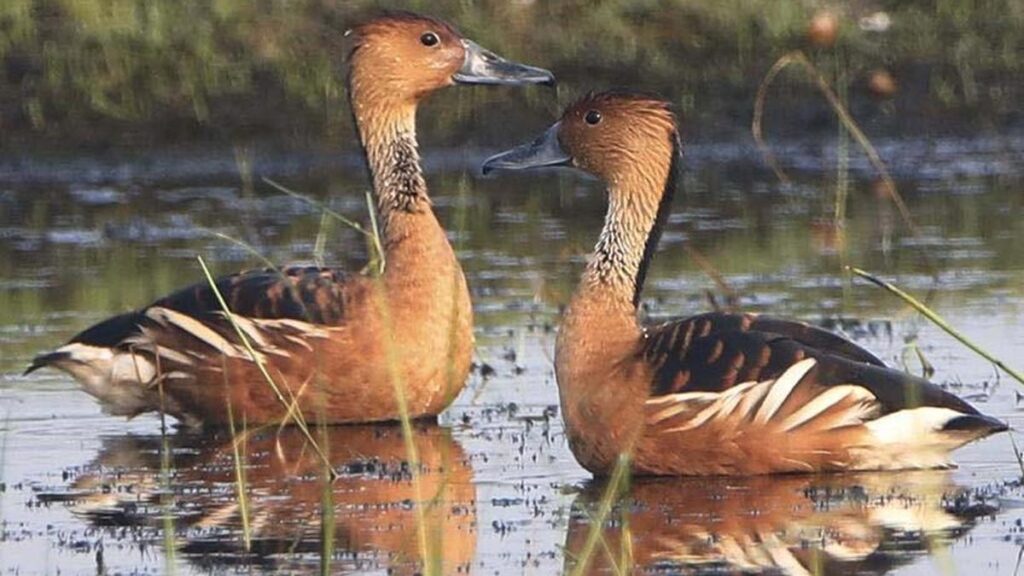
The Tamil Nadu Department of Environment, Climate Change and Forests has invited bids for the construction of the proposed International Bird Centre (IBC) at the Kazhuveli Bird Sanctuary in Villupuram’s Marakkanam.
The IBC will be established under the Tamil Nadu Strengthening Coastal Resilience and the Economy Project (TN-SHORE) at an estimated cost of ₹46.94 crore. The centre is envisaged as a hub for bird conservation awareness through both interior (displays and models) and exterior (wetland mimic area/nature trail) interpretations.
According to official sources, the proposed project will come up at two sites—the Agaram Reserved Forest along the East Coast Road and the Kazhuveli Lake—approximately 7.3 km apart. The focus is on seamlessly integrating the built structures with the surrounding landscape.
At the Agaram forest, the IBC will be developed over an area of 47.46 acres and will include a range of amenities aimed at promoting conservation awareness. These will comprise a Conservation Centre, a Wetland Mimic Area, and research and training facilities.
A key feature of the IBF is its landscape design, conceived as a living canvas that unfolds along the nature trail that allows visitors to immerse themselves in the ecosystem. The landscape plan, proposed by the Auroville Botanical Garden, covers 10.65 acres earmarked for afforestation and 7.41 acres for landscaping. They are expected to support a diverse array of fauna, including insects, reptiles, amphibians and small mammals.
The landscape will include a biodiversity forest, a curated forest, a grassland, and pathways for visitor engagement.
Equipped with a scaled model of Kazhuveli Lake, the Centre will feature different zones that trace the history of Kazhuveli through large interpretation display boards; multimedia experiential space and digitally enabled stations where visitors can listen to calls of birds native to the sanctuary. In addition, the centre will also showcase different bird habitats, offering essential information about the avian visitors to the wetland.
Located at Kazhuveli Lake, the second site will include bird watching infrastructure, including an observatory and wetland zones. Visitors will be transported from the Agaram forest to the bird-watching site at Kazhuveli using electric shuttles. The bird watch tower, proposed to be built 10.8 metres high, will consist of three levels, each providing approximately 450 sq. ft. of space for exploration and observation.
Major wetland
Located close to Marakkanam along East Coast Road, the Kazhuveli Lake is one of the major wetlands on the Coromandel Coast
The water body is connected to the Bay of Bengal by the Uppukalli Creek and the Yedayanthittu estuary and lies along the Central Asian Flyway, making it an important nesting site for migratory birds. The lake is the second-largest brackish water wetland in Tamil Nadu.
Listed among Tamil Nadu’s 141 prioritised wetlands, Kazhuveli is recognised as a wetland of international significance and a potential Ramsar site, according to the Ministry of Environment, Forest and Climate Change’s Wetlands of India portal. It is home to over 200 species of birds and serves as a crucial stopover and breeding ground for about 40,000 migratory birds. It also functions as a feeding ground for long-distance migrants from the cold subarctic regions of Central Asia and Siberia, including species such as black-tailed Godwits, Eurasian Curlew, white stork, Ruff and Dunlin.
‘Vulnerable’ birds
Bird species recorded in the sanctuary include spot-billed pelicans, darters, cormorants, herons, egrets, black ibis, spoonbills, flamingos, common pochard, sandpipers, coots, shanks, and terns. Many of these species are categorised as ‘vulnerable’ or ‘near threatened’ by the International Union for Conservation of Nature (IUCN).
According to the 2016 report, Important Bird and Biodiversity Areas in India-Tamil Nadu, by the Bombay Natural History Society and Indian Bird Conservation Network, the area regularly hosts more than 30,000 ducks in winter, 20,000-40,000 shorebirds, and 20,000-50,000 terns during the migration period. As the lake fills up with freshwater in November, a variety of aquatic plants germinate, it says.