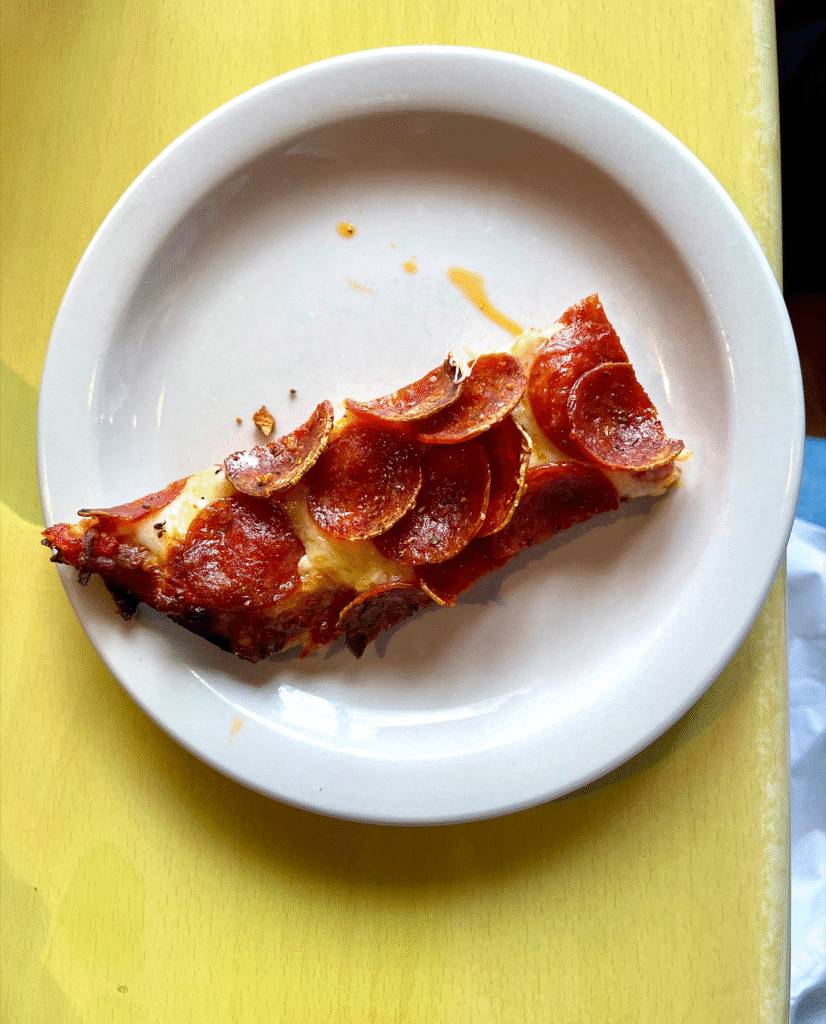
To most folks living in Columbus or anywhere in central Ohio, thin-crust, square-cut pizza is just pizza. The pies they grew up with don’t need to be defined or named, but for the sake of clarity, let’s call it “Columbus-style.” It may not be as well-known as pizzas from Chicago, New York, or even New Haven, but the local style has a fierce and loyal following. It routinely beats other cities on national top pizza lists, visitors can eat their way through a citywide pizza trail, and a long and storied history gives the city bona fides just as deep as its peers.
The local pizza is distinct in a few ways. Columbus pizza-makers roll their dough out thin and score it with a roller docker, which creates small holes that prevent the dough from bubbling in the oven. Most pies are dusted with cornmeal to keep from sticking to stone deck ovens; according to most pizza-makers in the city, the ovens’ stone bottoms are vital to evenly distribute heat, and the porous material absorbs moisture, delivering a crisp crust. The dough is topped with a sweet sauce and balanced by a provolone cheese mix that goes from edge to edge, along with, ideally, pepperoni. Pies arrive on the table cut into “squares,” though in reality they’re often closer to rectangles.
These factors combine into a look and feel that’s instantly recognizable. But Columbus-style pizza isn’t just popular because of its structure; it’s also relatively affordable. A pie is roughly $20, in contrast to pies that can easily start at $30 in cities like Los Angeles and New York. That makes Columbus pizza accessible to the city’s loyal student sports fans, who often cheer on nationally ranked and locally cherished teams like the Ohio State University’s Buckeyes with game day pizza sales. When the wildly popular team plays rival Michigan, it’s all hands on deck at pizzerias.
Pizza “is infused into the culture of this city,” says Jim Ellison, the author of Columbus Pizza: A Slice of History. “There’s three things that you can expect people will have a conversation with you about in Columbus: the weather, Ohio State — football in particular — and pizza.”
And the style is gaining traction beyond the city limits, popping up on menus across the Midwest. If you don’t know Columbus’s pizza already, you might soon.
Like so many American pizza styles, Columbus-style pizza got its start when Italian immigrants arrived in the region. Tat Ristorante Di Famiglia started the trend in 1929, opening in a neighborhood once referred to as Flytown for its proximity to the city’s airport (although Tat has jumped around a few times during its nearly 100-year run). The restaurant served pizza as a snack or appetizer, which was common at the time.
A few decades later, Jimmy Massey and Romeo Sirij opened Romeo’s, the first proper pizzeria in the city. Their inspiration was likely two-fold, says Ellison. Sirij was a wine salesman, and he may have seen how popular pizza pies were while making deliveries to Tat. Meanwhile, Massey had been a baker in Chicago, where tavern-style pizza, meticulously cut into easy-to-eat rectangles, was becoming popular. “I’ve got to think that at some point in time, he was at a bar in Chicago and he said, ‘Hey, I kind of like this square cut thing. It’s easier to share,’” Ellison says. “They’re slightly different styles, but they’re definitely in the same family.”
Whereas Chicago developed several styles of pizza, ranging from the square-cut tavern-style that Massey encountered to the thick deep-dish pies that tourists associate with the city, Columbus stuck with thin crust. When it comes to deep dish or thicker crust, “I don’t know if people really go for that. It’s so filling, and it’s kind of rich,” says Tom Iannarino, the second-generation owner of Terita’s Pizzeria. What people go for, at Terita’s at least, are thin-crust pies made with a recipe that hasn’t changed much since Iannarino’s father opened the shop in 1959.
Whether the slice is called tavern cut, party slice, or square, the shape is an important element of what makes a Columbus-style pizza, but the toppings are just as crucial.
Early pizzerias in Columbus mostly got their cheese (often provolone) and other toppings from DiPaolo Foods, an Italian grocery store-turned-food distributor (now run under the name RDP). The longtime vendor did more than sell goods, though; it influenced and standardized how pizza was made in the region and supported fledgling businesses. Richie DiPaolo started making and selling cardboard boxes to make pizzas easier to transport, and he worked with Vlasic to jar presliced peppers, a common addition to pies.
The most popular topping, though, is pepperoni, specifically, the amount thereof. Pizzerias pride themselves on how many slices they can fit on each pie. Massey’s, which Jimmy opened a few years after Romeo’s, boasts 155 pepperoni slices per large pie, while Donatos, a locally owned chain, fits 100. Old-world-style sausage casings, which curl in the heat of the oven, cause the pepperoni to shrink into perfect little cups of grease. Many local pizzerias’ menus note the name of their sausage provider — Ezzo Sausage Co. — another Columbus family business.
At every level, family businesses drive Columbus-style pizza. At Terita’s, Iannarino has his son, who represents the business’s third generation, run the pizzeria’s social media. At Minelli’s, Jeff Ferrelli inherited the shop his dad opened in 1967, and Jeff’s twin daughters, Kaci and Kelli, joined the family business after graduating from Ohio State. Massey’s, which has franchised and expanded to 15 locations, is still a family business, albeit run by a different family after Jimmy Massey sold the company to his long-time employee, Guido Casa.

Jim Grote, the man behind Donatos, didn’t invent the crispy-crusted, edge-to-edge topping pizzas that Columbus loves, but he “certainly made it popular, not just here, but elsewhere too,” says Bob Vitale, the dining reporter for the Columbus Dispatch. Today, the chain has more than 170 locations in 12 states.
The story of Donatos starts like many other pizzerias in Columbus. Grote bought a pizzeria in 1963 with a loan from his family. His parents made the sausages, his mom made the dough, and his kids all worked in the store. At one point, the pizzeria sat right in front of the family’s house, and customers would wait for their pizzas in the family’s home.
But Grote had larger ambitions. He was obsessed with consistency — he weighed each pie and looked for tools to help create efficiency in the pizzeria. Donatos later shifted from traditional deck ovens to conveyor belt ovens for greater consistency. One of his early inventions, the Peppamatic, sliced pepperoni to a consistent thickness and placed the slices evenly across a pie, edge to edge.
Grote even got a copyright on the marketing phrase “edge to edge” and took Pizza Hut to court in 1996 when it launched a campaign for a pizza called “the Edge.” Donatos won a $5 million settlement for copyright infringement. A few years later, Donatos had another run-in with a major fast-food chain. McDonald’s bought the chain in a bid to bring pizza to the masses. The arrangement didn’t work out quite as planned for either party, and the Grotes bought Donatos back in 2003. But eventually Grote found a compatible corporate partner, Red Robin, which serves Donatos pizza in more than 260 locations, helping Columbus-style pizza reach a larger audience. Donatos even recently partnered with restaurant robotics company Appetronix to open a fully automated pizza restaurant at John Glenn Columbus International Airport.
Ellison likens Donatos to the Bud Light of Columbus-style pizza. That’s not an insult. Any brewer knows “how hard it is to have a beer consistently come out exactly the same way every single time,” Ellison says. Same with pizza.
While Donatos is flourishing, Ellison worries that the traditional Columbus-style pizza is an “endangered species.” Many of the family pizzerias that opened in the ’50s and ’60s have shuttered locations or closed altogether. It’s tough to keep a family business going after the second or third generation.
But pizzerias are still opening up across the city, and Columbus is still a pizza city. It’s just evolving. Vitale points to new pizzerias that incorporate influences from around the world, echoing Columbus’s diverse population and growing culinary scene. There’s a paneer tikka masala pizza at Moon Pizza and a chicken shawarma pie at Auzy’s Pizza & Chicken. Their pies may be the ones feeding future generations of proud, Ohio State-cheering, Columbus-style pizza advocates.