A CGI image of what the complete microgrid-connected AVK and Pure DC facility will look like in Dublin, Ireland. (Photo: Pure Data Centres Group)
(Photo: Pure Data Centres Group)
Just outside Ireland’s capital, Dublin, a data center has become the first in Europe to turn to an independent, so-called “islanded,” microgrid to keep its servers running.
Europe is looking to cash in on the AI boom while tackling power connection delays that have persisted for decades. The European Commission estimates the bloc needs at least 1.2 trillion euros ($1.39 trillion) in investments by 2040. In some cases, companies can’t wait for bottlenecks to be eased and are turning to their own sources of power.
The Dublin facility, operated by power supply solutions provider AVK and digital infrastructure developer Pure Data Centre Group, could mark the continent’s first step toward a privately powered ecosystem.
Microgrids are localized energy systems that can generate, store, and distribute power. The systems are already being widely used in the U.S., where a boom in data centers in red-hot areas like Texas and Virginia has seen an increasing need for off-grid power.
AVK and Pure DC say their Dublin installation is the first data center in Europe to be operated by a live microgrid.
“As these data centers get bigger and we see AI workloads and that data becoming more of a feature in our day-to-day lives, that only puts more stress on the grid. So we have to drive to a different solution,” AVK CEO Ben Pritchard told CNBC.
The systems are not without their challenges. Regulatory hurdles could slow deployment, and the long-term success of microgrids likely depends on whether their power sources are both reliable and sustainable.
Overcoming an energy moratorium
Ireland is one of two European countries to have enforced a moratorium on new data center applications as the energy-intensive facilities put pressure on the nation’s grid. The facilities consumed a staggering 22% of the small country’s power in 2024.
Ireland’s national grid operator warned in late February that meeting power demand could be “challenging” as consumers use electricity in new ways. It identified data centers as a key driver of that demand growth.
But late last year, Irish authorities eased the moratorium, as the AI boom saw sentiment U-turn on their economic potential.
All new data centers connecting to the grid must now provide dispatchable power — electricity that can be turned on or off depending on the national grid’s needs — or have the capacity to store energy. They must also source at least 80% of annual demand from renewable electricity generated in Ireland, according to guidelines set by the country’s regulator CRU.
“The alternative in Ireland was to wait, literally wait for an unknown time to be able to get a grid connection, and still today you’re not able to get a grid connection. So creating a microgrid enabled us to move our project forward,” Pure DC President Dawn Childs told CNBC.
Childs, who was appointed a Dame in the U.K. for her services to engineering, added that the project is intended as both an immediate and a long-term solution. “If we have to stay as an islanded solution, we absolutely can … However, to get the most sustainable solution and to provide services back into the grid in Dublin, in the most constrained area of Ireland, it would be our desire to get a grid connection.”
The Dublin data center, which can run both cloud and AI workloads, has a total capacity of about 110 megawatts. Total projected investment in the site is about 1 billion euros ($1.2 billion).
The facility is currently powered by natural gas engines with the ability to switch to Hydrotreated Vegetable Oil (HVO). The site has also trialled biomethane as a power source.
If the Dublin data center does eventually secure a grid connection, it will be able to offer dispatchable power and provide up to 20 MW of battery storage, Childs said.
Islanded power
The global microgrid market was worth around $29 billion in 2025, with Europe’s market expected to grow by nearly 10% per year due to its aging infrastructure, according to estimates from Global Market Insights. While investments are made in modernizing the national grid, companies are expected to increasingly turn to more immediate solutions for power.
Microgrids are already being used to power industrial sites and plants in Europe, but there aren’t many instances of them powering data centers when compared to the U.S.
In addition to AVK, companies such as ABB and Siemens are racing to develop the technology, with Schneider Electric opening a microgrid testing lab in Massachusetts last year to test the systems in real-world conditions.
Siemens sees “potential opportunities” for implementing microgrids at data center locations and is currently in discussions with several customers, a company spokesperson told CNBC. The topic is particularly relevant for the U.S. market, but it is also having similar discussions in Europe, they said.
Siemens is also interested in the use of microgrids to support electric vehicle charging infrastructure and port decarbonization.
AVK, which is expected to reach at least a billion-dollar valuation by 2030, initially focused on standby and backup power generation before expanding to become a full power solutions provider.
According to the company’s CEO, discussions and plans for microgrids were underway in Europe, but the U.S. market quickly overtook the 27-nation bloc. “It’s just that the U.S. has such a high demand that we’ve seen the rollout a little bit quicker than we’ve seen here in Europe,” Pritchard told CNBC, adding that the company is now seeing a new type of investor who is specifically interested in microgrids and not necessarily the data center itself.
“They’re infrastructure funds who are looking to build, own and operate microgrids and supply power to the data centers,” Pritchard said. He expects this type of asset class to mature over the next three to five years.
Sustainability and reliability
One of the biggest challenges facing the market is how microgrids are deployed sustainably, as much of the discussion on the tech has revolved around the use of gas turbines or fuel cells, Diego Diaz Hernandez, a partner at McKinsey, told CNBC.
“Making these assets grid participants in theory and in practice are very different questions,” Diaz Hernandez said.
“Technically speaking, it’s very feasible to do so, and we’ve seen examples of that in the U.S. [where] grid operators are requiring 50 or even 100 hours of flexibility out of the entire year in order to ease the pressure on the grid. So they’re not asking for a lot, but actually having the regulation and policy in place to allow for that to happen is a big question.”
Ensuring the power supply is reliable, as well as overcoming regulation, will also be key, Hernandez said. He noted that in the U.S., around 30% of data centers are adopting microgrid or other behind-the-meter solutions, like fuel cells and gas turbines — power sources that don’t require a connection to the main grid. In Europe, the share was just 5–10% 18 months ago, but has since already risen to about 20%, he added.
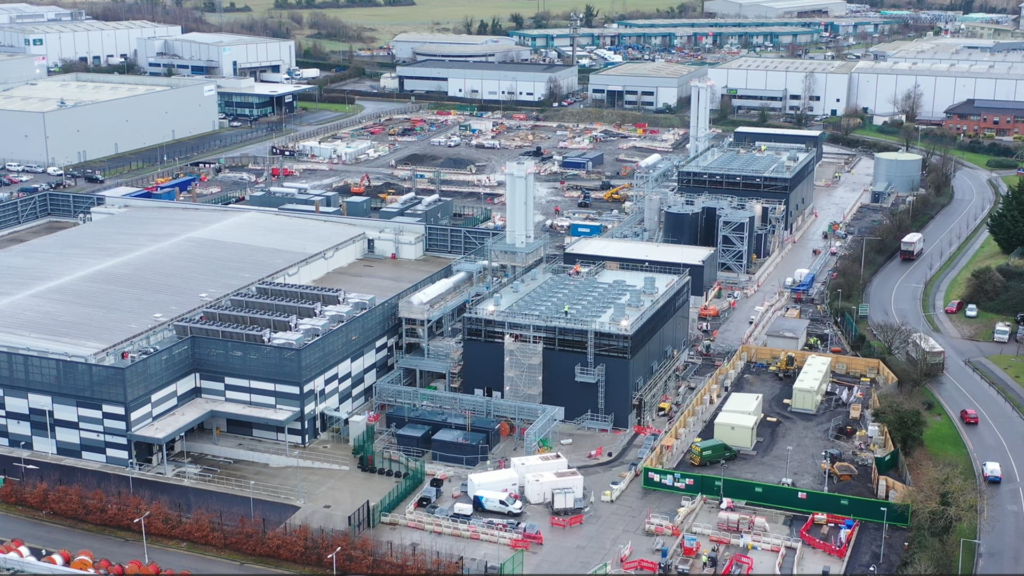
The energy center in construction at AVK and Pure DC’s microgrid connected data center in Dublin. (Photo: Pure Data Centres Group)
Pure Data Centres Group
Challenges aside, the burden on data centers to provide their own sources of power is clearly growing. Last week, U.S. President Donald Trump said data centers “need some PR help” amid concerns about their impact on electricity prices.
In his State of the Union speech, the president referenced America’s “old grid” and said major tech companies were obliged to provide for their own power needs.
“It’s clearly not in a data center’s core skill set to be developing and building microgrids,” Childs said, adding that Pure DC had to hire specialist engineers to build the microgrid in Dublin.
Governments are facing a tough balancing act when it comes to pleasing the needs of big Tech while also ensuring they meet their sustainability targets.
“We are a true enabling factor to allow big renewable projects to come online, to allow flexibility into the grid, and ultimately to allow power costs to come down for all consumers, both business and normal citizens, but the policy and regulation takes a while to allow and facilitate that,” Childs told CNBC.