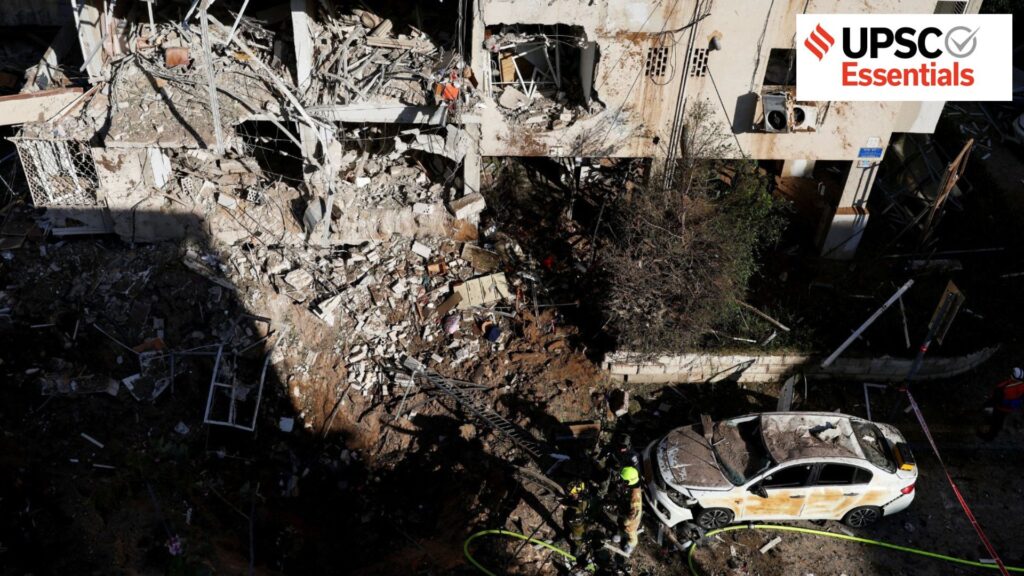
Amid the raging Iran war, Israel and the US bombed Iran’s Natanz nuclear installation used for the enrichment of uranium. Iran retaliated by attacking towns near Israel’s nuclear facility. Such developments have ignited concerns about the potential risks for accidents or radiological releases.
Iran’s nuclear programme, particularly its right to enrich uranium, lies at the heart of the ongoing crisis. Uranium, which serves as the primary fuel for nuclear power, is one of the most reliable and low-carbon energy sources. It is used extensively in most of the nuclear reactors across the world. However, the ongoing US-Israel war on Iran has brought the issue of uranium enrichment into sharp focus.
Alongside uranium, thorium and plutonium are other nuclear materials that are considered security resources due to their dual-use in both civilian energy generation and nuclear weapons development. Resultantly, their control, use, and regulation are critical to both global stability and the future of clean energy.
In this context, countries like India are shaping their nuclear strategies around the availability and long-term sustainability of these materials.
How India shifts from uranium to thorium
India’s nuclear energy programme has three stages. In the ongoing first stage, India is using the uranium fuelled Pressurized Heavy Water Reactor (PHWR). However, India has much less access to uranium than to thorium. Hence, the subsequent stages are designed to transition to using plutonium and thorium.
In the second stage, India will use plutonium-based mixed oxide as fuel for the Prototype Fast Breeder Reactor (PFBR). It will also utilise the spent fuel of Pressurised Heavy Water Reactors. In the third stage, it seeks to make use of thorium-based Advanced Heavy Water Reactors (AHWR), which utilise thorium to breed uranium. This stage is focused on attaining self-sufficiency. How do the three nuclear materials differ?
Uranium
Story continues below this ad
Uranium is a naturally occurring radioactive element. There are three natural isotopes of uranium — uranium-234 (U-234), uranium-235 (U-235) and uranium-238 (U-238). It is the fission of U-235 atoms, which produces nuclear energy. But natural uranium typically contains only 0.72 per cent of U-235 and most reactors need a higher concentration of this isotope in their fuel.
Therefore, before natural uranium is used for producing energy, it goes through a process called enrichment. This process increases the U-235 concentration, which is essential to sustain an efficient chain reaction in most nuclear reactors. The three main types of enrichment technologies include gaseous diffusion, gas centrifuge, and laser enrichment.
Low-enriched uranium (generally less than 20 per cent U-235) is largely used to create energy in commercial nuclear reactors. However, highly enriched uranium is largely used in the defense sector and nuclear weapons.
Thorium
Thorium is another naturally occurring nuclear substance and is more abundant than uranium. It exists in nature in a single isotopic form – 232TH. Thorium is not fissile and cannot sustain a nuclear chain reaction alone. It is considered ‘fertile’: upon absorbing a neutron, it gets converted into uranium-233, which is fissile and can produce energy through fission.
Plutonium
Story continues below this ad
In comparison to uranium and thorium, plutonium is mainly produced in nuclear reactors from uranium 238 by neutron capture. Plutonium has five “common” isotopes, Pu-238, Pu-239, Pu-240, Pu-241, and Pu-242, and all of these are “fissionable”.
However, Plutonium-239 contains the highest quantities of fissile material, and is notably one of the primary fuels used in nuclear fuel and weapons. Also, Pu-238 is used in deep-space missions as it emits steady heat from natural radioactive decay.
Geographical distribution of nuclear materials
The global distribution of nuclear fuels is highly uneven, with reserves concentrated in a few regions. According to current estimates, the world has a total of 5,925,700 tonnes of known reserves of uranium. Australia holds the largest share of 1,671,200 tonnes, which accounts for 28 per cent of total reserves. It is followed by Kazakhstan (8,13,900 tones), Canada (5,82,000 tonnes), Namibia (4,97,900 tonnes) and Russia (4,76,600 tonnes).
In 2024, Kazakhstan produced the largest share of uranium from mines (39 per cent of the world supply), followed by Canada (24 per cent) and Namibia (12 per cent). Together, these three countries contribute about three-quarters of the world’s uranium production.
Story continues below this ad
Thorium, by contrast, is estimated to be 3–4 times more abundant than uranium in nature. The most common source of thorium is the rare-earth phosphate mineral, monazite. Monazite usually has about 6-7 per cent thorium, though it can go up to 12 per cent. The richest deposits are in beach sands, where waves and ocean currents concentrate heavy minerals.
Notably, most of the world’s thorium reserves are in India, which are estimated at nearly 8.5 lakh tonnes (accounting for nearly 25–30 per cent of global thorium reserves). It is mainly concentrated in the coastal sand of Kerala, Tamil Nadu, and Odisha. India is followed by Brazil, which has a thorium reserve of 6,32,000 tonnes and Australia and the US each have around 5,95,000 tonnes of thorium reserves.
India’s nuclear fuel challenge
Although India has stepped into its second stage of nuclear programme, PHWRs still constitute the country’s main source of nuclear energy. India has uranium reserves of 4,25,570 tonnes. However, due to the low-grade quality of ore, the extraction cost remains high. It makes India highly reliant on uranium imports.
To ensure a long-term supply of uranium, India has recently entered into an agreement with a Canadian company, Cameco, which will provide around 10,000 tonnes of Uranium to India. Before this, India also signed a deal with Kazakhstan. India also imports uranium from Russia and France.
Story continues below this ad
But in view of the growing renewable energy demand and the supply chain vulnerabilities exposed by the ongoing Iran war, India needs to expand its nuclear fuel options and harness its large thorium reserves. Thorium provides a more sustainable, efficient and less wasteful option than uranium.
However, there are still major challenges associated with the use of thorium as nuclear fuel. Foremost, the nuclear infrastructure is largely designed for uranium. Secondly, thorium is non-fissile fuel and requires a driver fuel, which presents deployment challenges. Thirdly, despite its abundance, thorium is primarily obtained as a byproduct of monazite, which is mainly mined as a rare earth element. Without the demand for rare earth elements, extracting monazite for thorium only will be complex and costlier.
India’s path to self-reliance
In the coming decades, the demand for these nuclear materials is expected to rise significantly as countries expand nuclear power to meet climate and ensure energy security goals. However, the ongoing Iran war has not just exposed vulnerabilities in the nuclear supply chain but also brought renewed attention to uranium as a strategic resource.
These developments also bring India’s continued reliance on imported uranium into sharp relief. It underscores the need for India to harness its vast thorium reserves and enhance self-reliance and ensure long-term energy security. Strengthening research and development in thorium-based technologies, along with advancing closed fuel cycle systems, will be essential for this transition.
Story continues below this ad
Post read questions
India’s dependence on imported uranium poses strategic challenges. Analyse the need for transitioning towards thorium-based energy systems.
Explain India’s three-stage nuclear energy programme. How does it aim to transition to thorium from uranium and achieve long-term energy security?
What are the major challenges associated with thorium as a nuclear fuel in India?
In the context of the ongoing Iran war, analyse how geopolitical conflicts can impact nuclear fuel supply chains and energy security.
Story continues below this ad
(Renuka is a Doctoral researcher at Himachal Pradesh National Law University, Shimla.)
Share your thoughts and ideas on UPSC Special articles with ashiya.parveen@indianexpress.com.
Click Here to read the UPSC Essentials magazine for February 2026. Subscribe to our UPSC newsletter and stay updated with the news cues from the past week.
Stay updated with the latest UPSC articles by joining our Telegram channel – IndianExpress UPSC Hub, and follow us on Instagram and X.