Flavoring giant McCormick & Co. is racing to keep up with requests from food companies that are aggressively reformulating and innovating products amid rapidly changing consumer trends.
The company’s top executive said businesses want help removing artificial ingredients, reducing salt or adding trendy ingredients. On top of that, food makers are also asking for work to be done faster.
“We have seen acceleration in 2025 in terms of the number of projects that we get,” Brendan Foley, McCormick’s CEO, said on the sidelines of the Consumer Analyst Group of New York conference last week. “I think that will continue for some time.”
Food companies, impacted by shrinking volumes and margins, are eager to get products to market faster as inflation-weary consumers spend less. Manufacturers are also facing demands from consumers and regulators to remove artificial dyes and boost the nutritional content of their products with ingredients, such as protein and fiber.
PepsiCo CEO Ramon Laguarta said last year that the snacks maker will be “accelerating” its transition to natural ingredients due to increasing consumer demand and pressure from the White House to remove artificial colors.
The snack foods manufacturer plans to transition “all the portfolio into natural colors or at least provide the consumer with natural color options” in the next “couple years,” he said. In December, PepsiCo launched dye-free versions of Cheetos and Doritos under a new line called Simply NKD.
As other companies deploy a similar strategy, McCormick is working to solve problems earlier in the food development process. This includes finding reformulation solutions based on consumer demand rather than waiting for specific company requests.
So far, it’s focused on reducing sodium, fat and sugar, as well as moving away from artificial ingredients, colors and preservatives.
Foley stressed that many food makers have been reformulating products for years and consistently look for ways to add on-trend ingredients. Companies have recently become louder about their innovation changes, however, as consumers become more ingredient-conscious and the “Make America Healthy Again” movement targets the processed foods sector.
“What’s getting lost here is the food industry has been focused on this stuff for a long time,” he said.
Optional Caption
Christopher Doering/Food Dive
Flavor evolution
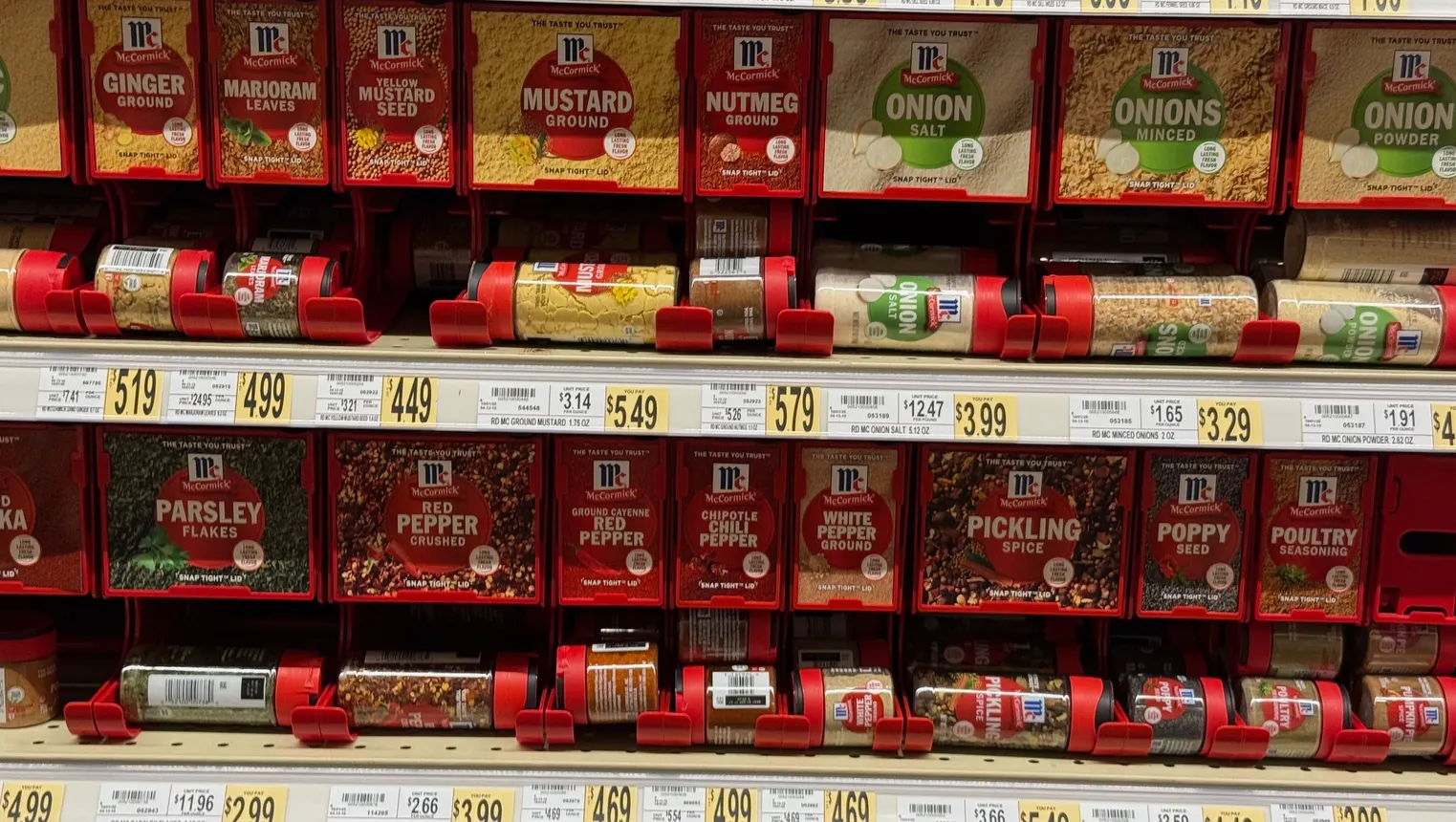
Companies are not just moving quickly on nutritional content, but also on flavor. With more consumers eating at home, many shoppers are gravitating toward unusual or premium spices and flavors to experiment with new tastes or to replicate the restaurant experience at home.
McCormick, which sources about 17,000 ingredients from more than 80 countries, remains dependent on black pepper, cinnamon, oregano and other “core” offerings, Foley said. But it will perpetually be looking for the next big flavor to satisfy ever-changing consumer tastes and preferences.
The flavor company is in a “constant trend identification and evolution on top of what is a very core set of products that we all need,” Foley said.
“You’re always going to see the core dominate,” he said. “But people also want excitement. They want new ideas. They want to explore it.”
The 137-year-old firm routinely scans social media, restaurant menus, Google and Amazon searches and other digital data to see if there is a spike in a trend that has matured enough where McCormick needs to launch its own flavor on the marketplace.
McCormick, for example, monitored dill pickle flavor for four years before launching its own French’s dill pickle mustard in early 2024.
Foley added that not every flavor or trend has to catch on a “massive scale” to be successful. “It just has to matter to a lot of people and you’re meeting their needs,” he said.
McCormick’s 2026 flavor of the year, black currant, underscores the delicate process of balancing core offerings with nascent ones as consumers seek out variety when they cook. One night, a person might want to create a family comfort meal in their kitchen, while the next night they might decide to experiment with a global trend like heat, Foley noted.
Flavors, such as black currant, can offer an exciting, yet approachable way for consumers to try new ingredients, especially as more globally inspired ingredients come to the forefront.
Experimentation is particularly notable among younger shoppers, who increasingly will make up a larger share of spending. More than 90% of Gen Z and Millennials say they actively seek out new food and beverage flavors, according to a study by Chicory, with most saying “the wilder the better.”
“We’ve spent a lot of time watching Gen Z and millennials and where they’re going, because that really defines the future,” Foley said.