Jammu and Kashmir and Ladakh High Court news: Opening the judgment with a poignant tribute to parental love, the Jammu and Kashmir and Ladakh High Court recently upheld the exclusive right of one daughter to a Rs 2 crore land acquisition compensation, dismissing a challenge by her sister’s heirs who were stated to have surfaced only after the land was acquired.
Justice Moksha Khajuria Kazmi observed that the father had bestowed his unmarried daughter with “roots” to ensure stability, while giving his married daughter “wings” to build her own life, noting that the dispute arose only after the death of one of the daughters, when her children sought a share in the compensation.

The high court opened its judgment with a literary and emotional reflection, framing the father’s distribution of property not as legal coldness but as a final act of love, and quoted, “There are two lasting bequests parents normally want to provide to their children—one is roots and the other is wings.”
The high court found that the sisters remained happily throughout their lives, but now the children of the elder sister, who is deceased, are claiming their right to compensation for the land which has been acquired by the national highway authority.
“In this case, the father’s final act of love depicts that he bestowed his minor, unmarried daughter with ‘roots’ so as to stand on her feet, and the elder married daughter with ‘wings’ to build her own kingdom,” the high court said in its March 30 order.
‘Silent for 70 years’
The high court noted that the petitioners have remained silent for 70 years after the mutation was recorded in 2011 in favour of their aunt, and the mother of the petitioner never objected to her right, title, or ownership during her lifetime.
The court also noted that the father ensured the future of the daughter who needed support the most at the relevant time. It further observed that the father provided stability to his unmarried daughter while trusting his married daughter to build her life with her husband and family.
Story continues below this ad
The high court found that the petitioners failed to produce any document establishing their interest in the property before the award. “Neither the petitioners nor their mother (deceased) had ever been recorded as owners or tenants in the available records,” it noted.
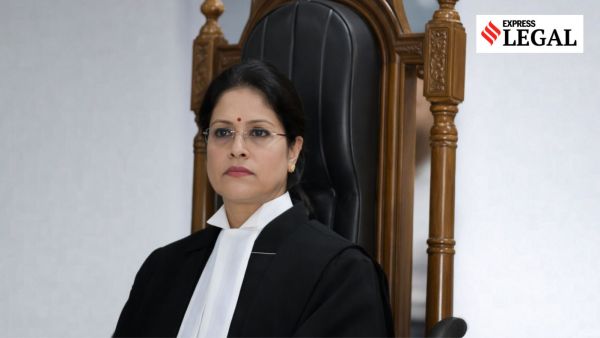 Justice Moksha Khajuria Kazmi found that the petitioner’s aunt was able to establish her right, title, and ownership over the acquired land.
On the other hand, the aunt was able to establish her right, title, and ownership over the acquired land, whereas the petitioners failed to demonstrate any entitlement to compensation.
The high court also noted that the date of death of the petitioners’ mother was not mentioned, and that the petitioners were over 50 years of age, making their claim of ignorance difficult to accept, especially as they resided near the disputed property.
The court also noted that the petitioners have already preferred a civil suit for declaration and consequential relief with respect to the said property. “This means that the petitioners/plaintiffs are yet to obtain a declaration in their favour on the basis of which they can be said to have a right, title or interest with respect to the suit property, including the property forming the subject matter of this petition,” Justice Kazmi said.
Story continues below this ad
Dismissing the petition, the high court pointed out that this dismissal should not come in the way of the petitioners in the civil suit and the revision petition pending before the competent courts. The court also directed the district collector to release the compensation to the aunt, while observing that if the petitioners succeed in the civil suit or revision, they may be compensated in accordance with their entitlement as determined by the competent court.
‘Land acquired, revenue record analysed’
- The petitioners are the legal heirs of Malla Begum, and, after the demise of the estate holder, Abdul Ahad Ganai, as per the law of inheritance under Muslim Personal Law, his whole estate had to be devolved upon his wife, Farzi Begum, and two daughters, Malla Begum and Sarah Begum.
- It is stated that the petitioners did not know that their aunt Sarah Begum, in league with the tehsildar, had illegally mutated the entire land of the then estate holder to the exclusion of the mother of the petitioners.
- They allegedly came to know about it only when the land in question was required by the authorities for the construction and strengthening of a two-lane project of the national highway.
- On further enquiry, it was found that the revenue record indicates the aunt as the exclusive owner of the land in question.
- The petitioners alleged that the mutation had been fraudulently obtained by their aunt, not their mother, nor were they ever associated with the mutation proceedings.
‘Petitioners stepped into shoes of mother’
Appearing for the petitioners, advocate Aswad Attar submitted that the property in question was a landed estate of the late Abdul Ahad Ganie, which, upon his demise, devolved upon his widow and two daughters in accordance with Muslim Personal Law (Sharia).
He further submitted that the petitioners, being the daughters of the late Malla Begum, stepped into her shoes and inherited her lawful share and pointed out that the competent authority transgressed its statutory limits by scrutinising the revenue entries, touching upon title and ownership.
Attar contended that mere revenue records cannot decide ownership, and since a civil suit on title is already pending in the matter, there clearly exists a genuine dispute over entitlement to the land and compensation.
Story continues below this ad
‘No challenge for 70 years’
Appearing for the aunt, advocate Jahangir Iqbal Ganai argued that the petitioners have not demonstrated any subsisting legal right of theirs over the property in question for more than seven decades, and it was never challenged by their mother during her lifetime.
Ganai added that the settled revenue record formed the basis of acquisition proceedings and the award, and the petitioners raised their claim only after the determination of compensation, a belated assertion lacking a prima facie foundation.
‘Petitioner’s aunt exclusive owner’
Deputy advocate general Hakim Aman Ali argued that the revenue assistant commissioner, while passing an order on an application filed by the petitioners regarding the release of compensation for the said land, had directed the office of the tehsildar to submit a report.
He further mentioned that a team was constituted to examine the available revenue records and submitted their report in December 2024, which strengthened the claim of the other daughter of the real estate holder as an exclusive owner in possession of the acquired land.