The foremost learning for the IAF is that indigenous weapons performed very well. The manner in which seamless integration of indigenous hi-tech systems into the national defence architecture was done was truly praiseworthy. Of particular note was the integration between the Army Air Defence network Akashteer and the IACCS of the IAF.
Newly brought in anti-drone systems of indigenous origin were integrated too. Some legacy systems like the SPYDER of Israeli origin and the S-400 operated in standalone mode. They are in the process of being integrated and this should happen quickly. The networking of the airborne element has faced delays and needs to be completed quickly in order to make the entire system more robust and avoid losses.

According to Air Marshal Anil Chopra, a leading expert on airpower, “Op Sindoor demonstrated the success of India’s ‘Atmanirbhar Bharat’ (Self-Reliant India) initiative, highlighting the country’s increasing self-reliance in defence. India’s indigenous counter-unmanned aerial systems, electronic warfare assets, and air defence weapons ensured multiple defensive layers from the international boundary to the hinterland. Indian multi-tier defence systems built over the last decade neutralised Pakistani attacks on our airfields and logistic installations”.
He goes on to add that much more needs to be done in this area and the pace of fielding indigenous solutions needs to increase.
The next issue pertains to the manner in which Chinese support to Pakistan emerged during the conflict. Nearly 80% of Pakistani military hardware is of Chinese origin. Over the years, China has supplied aircraft, ships, submarines, tanks, missiles, drones etc; however, the greatest cooperation is in the field of aviation. It is reliably learnt that for all newly supplied systems, Chinese technicians and operational teams were in Pakistan, and reportedly guiding and supporting combat engagements. With Pakistan being the leading recipient of Chinese armaments worth almost $20 billion, it was necessary for China to display the capabilities of these weapons. Hence, the “no holds barred” approach to the cooperation between the two sides.
While the ISR cooperation leading to good battlefield transparency was a given, the reported supply of the non-export version of the PL-15E in the period between the Pahalgam attack and 7 May was a new level of collusion not seen before. India, therefore, needs to study all Chinese weapons and their capabilities carefully and develop counter mechanisms to deal with this double threat.
In addition to catering for the difference in battlefield transparency that is likely to persist between India and its two principal adversaries for some time, there is a need to improve camouflage and concealment of critical assets that can deliver war-winning outcomes (like the S-400). Technologies to mask such assets already exist in the country and should be inducted expeditiously to retain the combat edge. Existing masking equipment is of vintage technology and needs to be upgraded at the earliest.
Story continues below this ad
India’s defence modernisation has chugged along steadily in the last few decades, albeit at a slow pace. This pace needs to accelerate. The number of fighter squadrons in the IAF has touched an all-time low. To enable effective targeting against a collusive threat the numbers have to increase. The defence spending in this geopolitical and neighbourhood environment needs to increase in order to be able to dominate the escalation ladder in such conflicts.
The Ukraine war has shown that uncontrolled escalation can lead to long drawn-out conflict. In such a scenario domestic armament capacity becomes a dominant factor. Therefore, to both stimulate domestic capacities and to make up for shortfalls, an increased defence spending is a must. Larger funds have been recently authorised for emergency purchases, though there is a large backlog. The IAF’s fighter fleet strength needs to be restored to the sanctioned 42 Squadrons at the very least, and acquisition of Flight Refuellers and AEW&C aircraft must be done on priority.
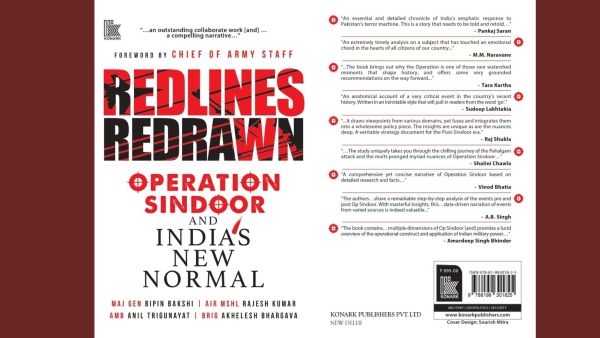 Redlines Redrawn brings together four distinguished experts who dissect the build-up, execution, and ramifications of Operation Sindoor.
Drone warfare has had an effect on all conflicts in the recent past and Op Sindoor was no exception. In this operation drones were used for two main roles, viz., ISR and strike. ISR drones were pivotal in real-time battlefield awareness; both India and Pakistan employed ISR drones extensively. These platforms provided real-time battlefield mapping, target identification, and tracking, and post-strike BDA. High-quality ISR was critical for identifying targets, planning strikes, and conducting post-strike assessment.
Hence, there is a need to improve fusion of airborne ISR (like Netra AEW&C, Heron TP drones) with space and HUMINT and harden and protect ISR assets against cyber/EW disruption. MALE UAVs due to their large size and slow speed are vulnerable in operations. However, till better solutions emerge they are invaluable in pre-conflict phases. India also needs to step up production of low-cost strike drones or loitering munitions to enable continued strike missions on vulnerable targets to keep up the pressure in a conflict situation.
Story continues below this ad
Counter-Drone Operations have also become critical – drones were successfully countered through kinetic and non-kinetic means and the IAF and AAD downed multiple Pakistani drones before they could engage targets. Therefore, drone defence is now a layered mission requiring integrated kinetic and electronic warfare assets. India must scale and harden its low-level air defence grid. Future developments in drone warfare point to use of drones for Electronic Warfare, Manned Unmanned teaming, use of AI/ML for drone swarming and drone interceptors. India must keep abreast of such developments and come up with indigenous solutions to develop these capabilities.
A factor in the multi domain operation that emerged was the narrative war that occurred during the conflict. Pakistan attempted to shape the global narrative, especially with videos, fake strike claims, and international lobbying. While the narrative war has been discussed elsewhere in the book, it is essential to understand that all future conflicts will be multi domain and there is a need to use open-source intelligence and independent verification to control narrative as well as deepen strategic communication planning across MEA, MOD, and PMO.
Finally technological self-reliance is now a strategic imperative. High-tech imported systems depend on spare parts, foreign data links, and political approvals. Therefore, fast-track development and integration of indigenous radar, missiles, avionics, and jammers is a pressing need. There is a need to incentivize private defence R&D, especially in drones, AI/ML for targeting, and hypersonic weapons; as well as, achieve supply-chain independence for long-duration conflict readiness.
(Excerpted from Redlines Redrawn: Operation Sindoor and India’s New Normal, authored by Major General Bipin Bakshi, Air Marshal Rajesh Kumar, Ambassador Anil Trigunayat, and Brigadier Akhelesh Bhargava, published by Konark Publishers, priced at ₹995/.)