In 2021, when Sikandar Singh, then 30, and Jaswinder Singh, 20, decided to start breeding sheep, they faced ridicule from neighbours and acquaintances. Many mocked the duo, asking if they had earned their degrees only to rear sheep. “Degree leike bhedan paal rahe ne (after securing degrees, now they are rearing sheep),” they would taunt.
Five years later, the same people now approach the duo from Dariapur village in Budhlada tehsil of Punjab’s Mansa district for advice and to learn about sheep rearing and breeding. Their venture, Punjab Sheep Farm, has grown into a enterprise with 200 sheep that, they say, generates Rs 20 lakh in annual net profit.

Sikandar, now 35 and a graduate, and his partner and relative Jaswinder, 25, a law graduate, began the venture in 2021 with an investment of about Rs 10–12 lakh. The idea emerged during their visits to Rajasthan, where their relatives were already engaged in sheep farming.
“Seeing how well sheep farming was doing there, I decided to try it in Punjab,” Sikandar said.
The duo began cautiously, first purchasing a single sheep to understand the basics of care and management. They later bought 20 Jamunapari ewes (female sheep) and two breeding rams. Soon after, they added another 20 ewes. Though 43 breeds are available in India, they opted for Jamunapari owing to its large size, good body weight and distinctive appearance.
Within four years, their flock expanded to nearly 200 sheep valued at around Rs 45–50 lakh. The farm currently includes about 100 adult ewes, 10–15 breeding rams and the remaining lambs. They maintain the herd size by selling about 150 to 200 animals annually.
According to the farmers, their initial investment was recovered within one and a half years, after which the venture started generating steady profits.
Story continues below this ad
An adult ewe typically sells for Rs 25,000–Rs 30,000, while breeding rams can fetch up to Rs 50,000. Lambs are sold for about Rs 10,500. With roughly 100 ewes producing nearly 300 lambs each year, the farm generates a significant income from animal sales.
“Sheep deliver their first lamb at about one year to 13 months of age and can reproduce twice a year, which leads to rapid growth in the flock,” explained Sikandar.
After accounting for expenses, the farmers estimate they earn Rs 10,000–Rs 12,000 per sheep annually. “With a herd of about 200 animals, this translates to over Rs 20 lakh in net yearly profit. The earnings have enabled us to purchase a tractor, expand farm infrastructure and invest in other agricultural activities,” says Sikandar, adding the farm primarily focuses on breeding rather than meat production.
“People come directly to our farm from across India and often make advance bookings for breeding animals. We rarely have to go to the market because buyers approach us,” adds Sikandar.
Story continues below this ad
The partners also compare the venture favourably with conventional farming. According to them, cultivating wheat or paddy on 50 acres of land on lease may appear lucrative, but after paying lease rent— often Rs 60,000–Rs 65,000 per acre — and other input costs, the actual profit may not exceed Rs 15 lakh.
Their sheep are housed in sheds measuring about 24×50 feet for every 100 animals. Around 200 sheep can be managed comfortably within approximately 3,000 square feet, which is about five per cent of an acre.
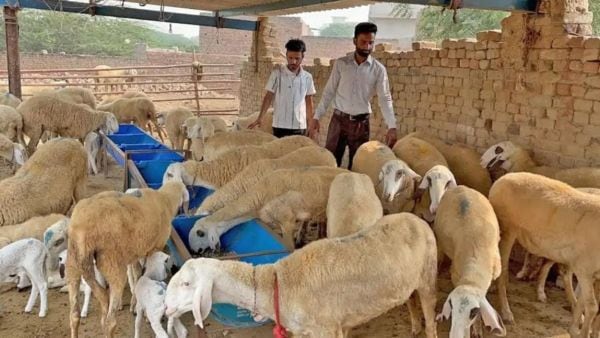 Mansa residents Sikandar and Jaswinder Singh leveraged their degrees to launch Punjab Sheep Farm in 2021, choosing the high-yield Jamunapari breed to build a thriving agricultural enterprise. (Express)
Jaswinder emphasised the importance of proper healthcare in sheep farming. “Our sheep are vaccinated against seven major diseases. Vaccination costs about Rs 100 per animal annually, and we carry out deworming every three months. Many people fail in sheep farming because they neglect vaccination, proper breeding practices and the selection of the right breed,” he said, adding that the feed cost per animal is around Rs 7,500 annually.
The animals are fed green grass, silage and dry fodder grown on about eight acres of agricultural land, including five acres owned by the farmers. Wool is sheared twice a year, in March and August, generating additional income, while the dung is used as manure.
Story continues below this ad
“Almost every part of the animal is useful,” Jaswinder said.
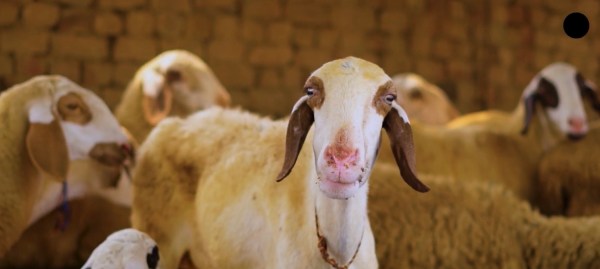 Mansa’s Sikandar and Jaswinder Singh have scaled their sheep farm to 200 animals valued at ₹50 lakh, recovering their initial investment in just 18 months through strategic breeding and sales. (Express)
They also see strong market potential. According to Sikandar, only about 28 per cent of the demand for sheep products in India is currently met, leaving a large gap in the market. Government support is also available through the National Livestock Mission, which offers subsidies of up to 50 per cent for sheep farming.
The farmer-duo now plan to expand their flock to around 500 sheep in the coming years.
They say that farmers, entrepreneurs and even government officials now visit their farm to learn about sheep breeding. What was once mocked is now viewed as a promising livelihood. “Anyone can start with 10–20 sheep and gradually expand because the animals reproduce quickly,” Jaswinder said.
Story continues below this ad
“Every profession has dignity. For us, sheep farming has become a sustainable and profitable profession,” added Sikandar.