

On June 25, 2025, while addressing an event to mark the 50th year since the Emergency, the RSS Sarkaryavah (General Secretary), Dattatreya Hosabale, said, “During Emergency, the country had no functioning Parliament, no rights, no judiciary. You put more than one lakh people in jail, kept more than 250 journalists in jail, violated fundamental rights, and forced 60 lakh Indians to undergo sterilisation. You ended the independence of judiciary. Have all the people who did this apologised to the country?”
Observing the day as ‘Samvidhan Hatya Diwas’ since 2024, the BJP and RSS held events across the nation this year, reminding the public of the atrocities they faced under the Emergency imposed by then Prime Minister Indira Gandhi, on June 25, 1975. Forced to go underground during the Emergency, RSS joined forces with the socialists to overthrow the Congress’ rule. In this piece, we look at how the RSS facilitated the formation of a coalition government, how it battled socialism with the Ram Mandir movement, which ended with the demolition of the Babri Masjid in Ayodhya.
Read | Rashtriya Swayamsevak Sangh: A look at its origins, ideology and rise (1925-1966)
Deoras’ rise and Emergency
During the Golwakar era, Madhukar Dattatraya Deoras, one of the RSS’ founding members, wielded considerable influence in shaping the organisation’s policies and expansion. However, having differed from Golwalkar on the RSS’ exclusion from politics, cow protectionism, and the organisation’s expansion, Deoras was briefly out of the Sangh. He rejoined in the RSS in 1957. Known to be an atheist, Deoras steered the RSS away from exclusionism by forming several community-based organisations such as a legal body, workers’ rights union, and education trusts. Under his tutelage, the RSS expanded its participation in social and service-based work in Indian society, reaping political dividends and building grassroot strength.
However, Jana Sangh and the RSS’ growing influence was halted with the imposition of a nationwide Emergency by the Indira Gandhi government on June 25, 1975. In his book, RSS: A Menace to India, Supreme Court lawyer A.G. Noorani, writes that the RSS initially did not join the Jayaprakash Narayan movement. Its four zonal chiefs were tasked with a five-point programme to survive the Emergency: (i) keep up morale by arranging congregations, (ii) establish an underground press, (iii) establish contact with significant members of minorities, (iv) solicit overseas Indian support for the RSS, and (v) prepare for a nationwide protest. Moreover, most RSS members went underground. As a result, only 186 of the 1,336 prachaks were detained in prison. But Deoras, along with the top leadership, were imprisoned. The RSS was banned as were public meetings and Indian media was severely censored.
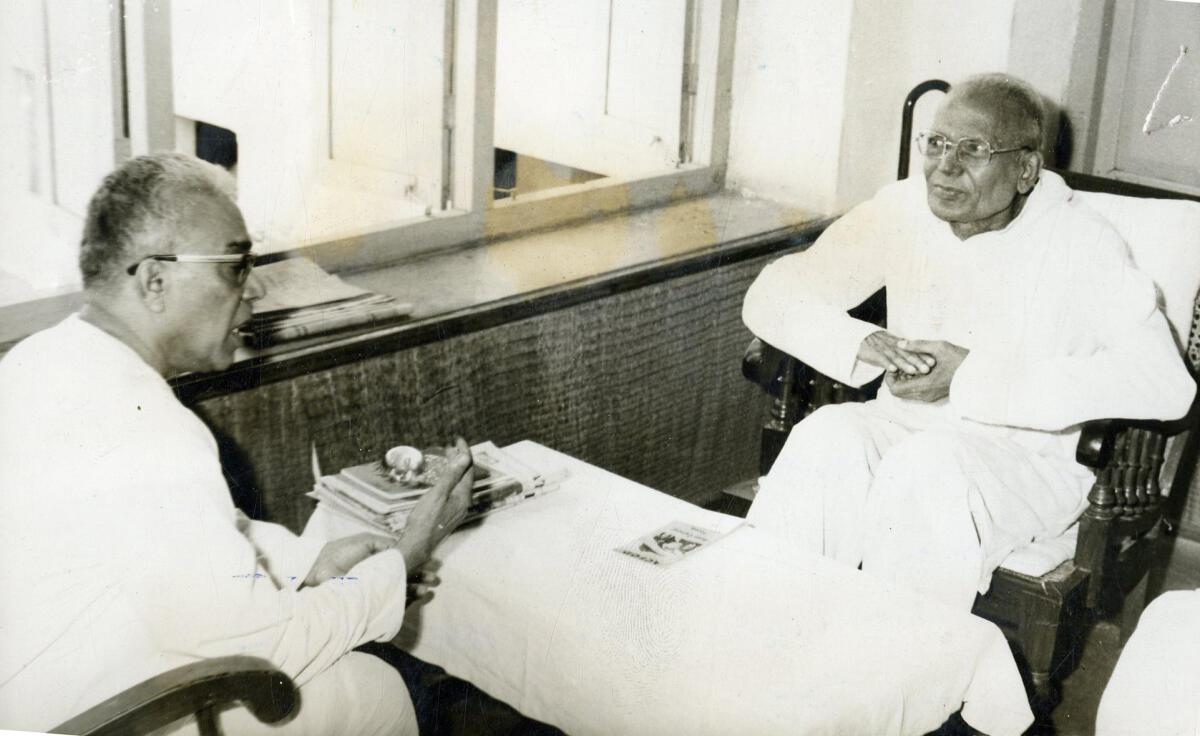
Bala Sahib Deoras, Sar Sanghchalak of RSS in conversation with Loknayak Sri Jayaprakash Narayan at the latter’s residence on November 01, 1977.
| Photo Credit:
The Hindu Archives
During Deoras’ imprisonment in Nagpur Central Jail, RSS workers sent him 60,000 postcards wishing him on his 60th birthday, carefully signing only first names to avoid detection. As most newspapers were censored, families wishing to communicate with jailed RSS workers, did it via hidden postcards in tiffin boxes, wrapped in plastic covers hidden in daal, stitching letters in jacket pockets of carry bags, writes BJP leader Vijay Chauthaiwale in The Print. “Grain merchants and farmers also contributed food grains to support the families of those in jail,” he writes, adding, “In spite of all the difficulties, no one from the RSS wrote a letter of forgiveness to the government. Baba and my uncles, like many others, walked out of jail only after Indira Gandhi was defeated.”
Noorani contradicts this. In a letter to Ms. Gandhi, dated August 22, 1975, Deoras writes,“I request you to please reconsider the case of the Sangh without any prejudice. In the light of the democratic right of freedom to organise, I beseech you to rescind the ban imposed upon the RSS.” There were no words about lifting the Emergency or releasing others from prisons.
Senior RSS functionary Sunil Ambekar justifies Deoras’ action. In an interview with the PTI, he says, “The purpose of the letters that Deoras ji wrote was to save people from the pain of the struggle that they were to face in the time to come. But he was clear that if correspondence does not work and the dictator considers this as a weakness, the next weapon is satyagraha (protest). This led to ending of the Emergency, and then elections were held again”.
However, former BJP MP Subramanian Swamy disagrees. In his article for The Hindu, he writes “Then RSS chief, Balasaheb Deoras, wrote several apology letters to Indira Gandhi from inside the Yerawada jail in Pune disassociating the RSS from the JP-led movement and offering to work for the infamous 20-point programme. She did not reply to any of his letters.” He claimed that Atal Behari Vajpayee too was out on parole after having given a written assurance that he would not participate in any programmes against the Government.
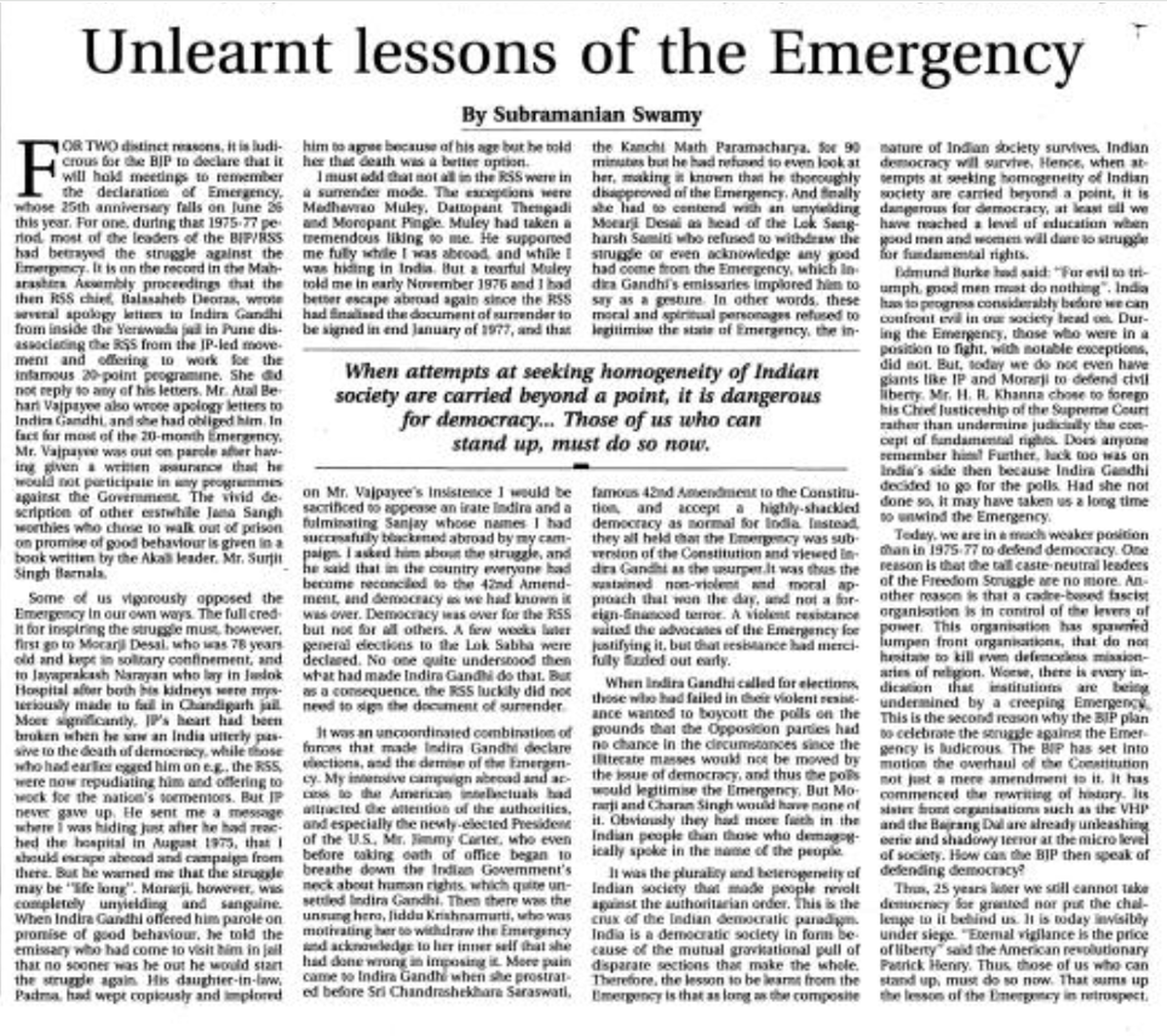
Mr. Swamy adds that Madhav Muley, Dattopant Thengadi and Moropant Pingle from the RSS refused to surrender. “RSS had finalised the document of surrender to be signed in end January of 1977, but a few weeks later general elections to the Lok Sabha were declared and RSS luckily did not need to sign the document,” he writes.
In the post-Emergency era, series of negotiations were held between RSS and the newly-founded Janata Party – an amalgam of Jana Sangh, Congress (O), Socialist Party and Bharatiya Lok Dal (BLD). Chaudhary Charan Singh, BLD chief, was adamant that no RSS volunteer could be part of Janata Party and no Janata Party member could join the RSS. Moreover, Socialist Party leader Madhu Limaye asserted that RSS would have to ‘refashion and conform with principles of Janata Party such as destruction of caste system and feudalism, social equality and progress’, writes Noorani. Limaye insisted that RSS must admit Muslims, Christians, Parsis into its fold. Then-Jan Sangh acting president O.P. Tyagi agreed to the socialists’ conditions, pointing out that the RSS stood dissolved at that time. However, he later took objection to this ‘no dual membership’ clause, writes Noorani.
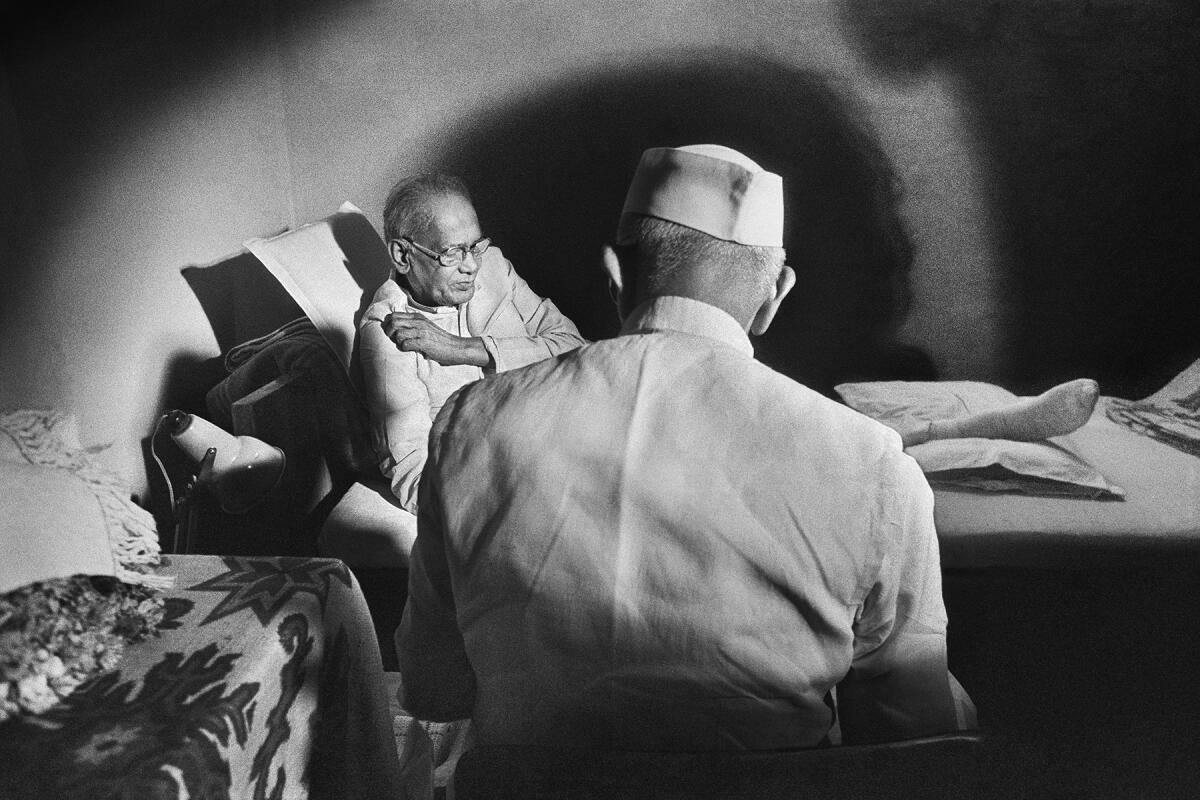
Jayaprakash Narayan nominated Morarji Desai to become the Prime Minister (Janta Dal) after defeating Indira Gandhi in 1977.
| Photo Credit:
The Hindu Archives
In response, Deoras met with Desai on April 10, 1977, offered RSS’ cooperation to the Janata government in the social, economic and cultural fields. However, he urged Desai to allow structural change in the RSS democratically in consultation with his cadres. “While there had been a sea change in the attitude of RSS workers, because of their sharing the jails with the Jamaat-e-Islami workers during the emergency, there should be eagerness on the part of Muslim friends too to join the RSS,” said Deoras, according to Noorani, adding, “The doors of the RSS will be thrown open for them but a decision is yet to be taken. Hinduism should not be forgotten.” An uneasy alliance was struck and the Janata government was formed in 1977.
However, the dual membership issue plagued the Janata government. Many Janata leaders pointed out that erstwhile Jana Sangh leaders still held RSS membership. Then Union Health Minister Raj Narain resigned from his post in July 1979, citing the same issue and floated the Janata Party (Secular) faction. Along with Charan Singh, the new faction attracted dissenters from Janata Party and Congress (Indira), reducing the Morarji Desai government to a minority. Desai resigned as Prime Minister.
Meanwhile, the RSS continued its outward religious expansion by conducting the second VHP sammelan in Allahabad in 1979, with prominent seers including the Dalai Lama in attendance. “If others submit grievances, they are accepted, but even the most well-founded demands of Hindus are ignored. This is because Muslims and other communities generally vote en bloc, while the Hindus are divided. As soon as the Hindus become united, the government will begin to be concerned with them also,” said Deoras at the event, adding, “The need of the hour is to awaken in Hindus the awareness that they are Hindus”. After the Janata Party’s defeat in the 1980 elections, its leaders held several negotiations with Deoras, urging changes to the RSS’s constitution, ideology, methods, and membership criteria. However, Deoras firmly refused to make any such changes to appease the Janata Party. As a result, the party split and on April 6, 1980, the Bharatiya Janata Party (BJP) was formed, with Atal Bihari Vajpayee chosen as its first president.
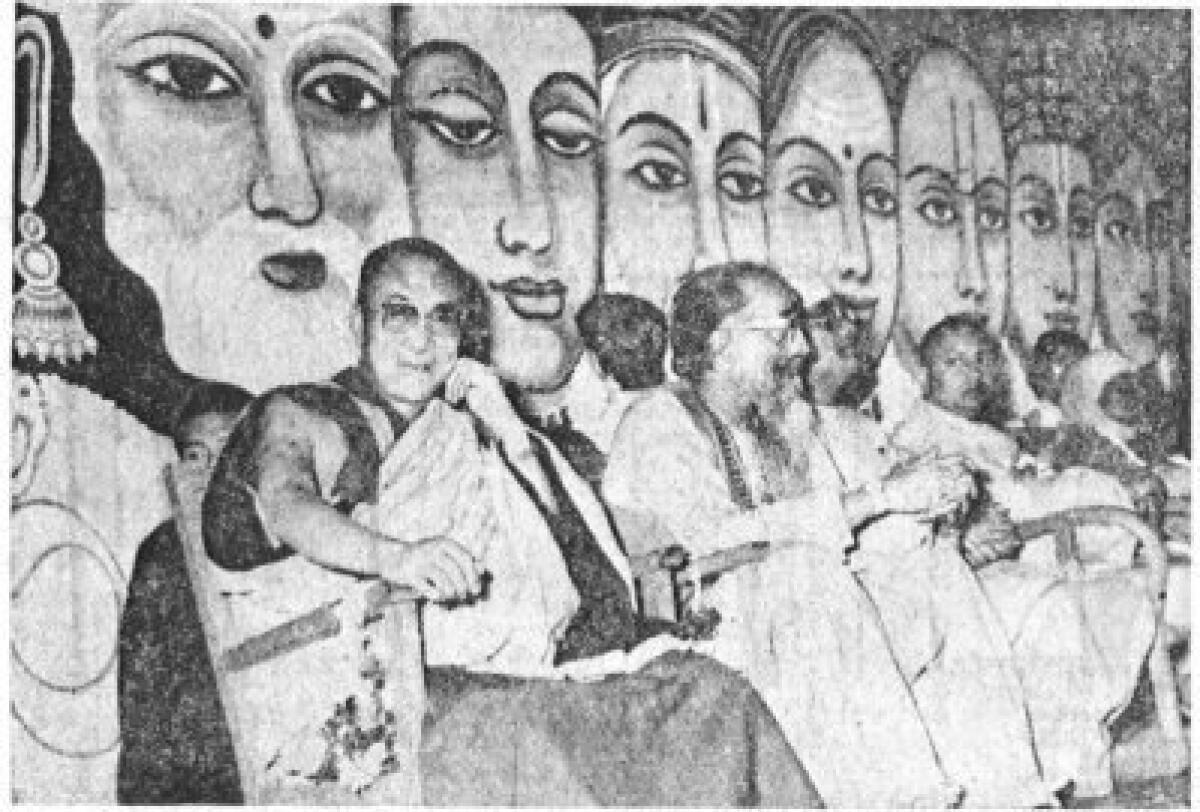
The Dalai Lama, Swami Chinmayananda (second from left) and other men on the dais in Allahabad in 1979.
| Photo Credit:
The Hindu archives
Rise of BJP and Babri Masjid demolition
Deoras’ mission to “unite all Hindus” received a major boost in 1981, following the mass conversions of Dalits to Islam in Meenakshipuram, Tamil Nadu. Leading the protests, the RSS along with other Hindu organisations opposed the ‘conversion of 800 Hindus’, seeking re-conversions of those people. According to reports, the Dalit families had converted due to social inequality and acute poverty. The incident spurred the VHP’s campaign against conversion.
A few years later, allegations of appeasing Muslims, especially orthodox Muslims, began to grow when the Rajiv Gandhi government passed an Act diluting the Supreme Court’s verdict in the Shah Bano case. Aware of the widespread anger, and in a bid to course correct, in February 1986, the Congress government ordered the reopening of the Babri Masjid site, allowing Hindus to worship the idols of Lord Ram that had been surreptitiously placed under the central dome of the mosque by a large group of Hindus on the night of December 22–23, 1949. In 2019, the Supreme Court ruled that the placement of the idols had ‘imperilled’ the Babri Masjid i.e. put it in risk of destruction.

When calls for establishing a Ram Mandir at the Janmabhoomi-Babri Masjid site were ramped up, senior RSS functionary Champat Rai was transferred to the VHP in 1985. As the Babri Masjid Action Committee was set up immediately after the locks were opened, the VHP organised the Ram Janmabhoomi Mahotsav, demanding the building of a temple at the site. This became an annual event and was soon picked up by BJP chief L.K. Advani in 1987. Deoras had reportedly met both Mr. Advani and Vajpayee that year and nudged them towards choosing the Ram Mandir cause. He predicted that the “Congress was trying to adopt a Hindutva line but it would not succeed under Rajiv Gandhi but would benefit the BJP in getting the Hindu society’s support.” At the Allahabad Kumbh Mela held in February 1989, the Sangh Parivar announced a ‘kar seva’ where volunteers were asked to donate bricks to begin construction of Ram Mandir in Ayodhya.
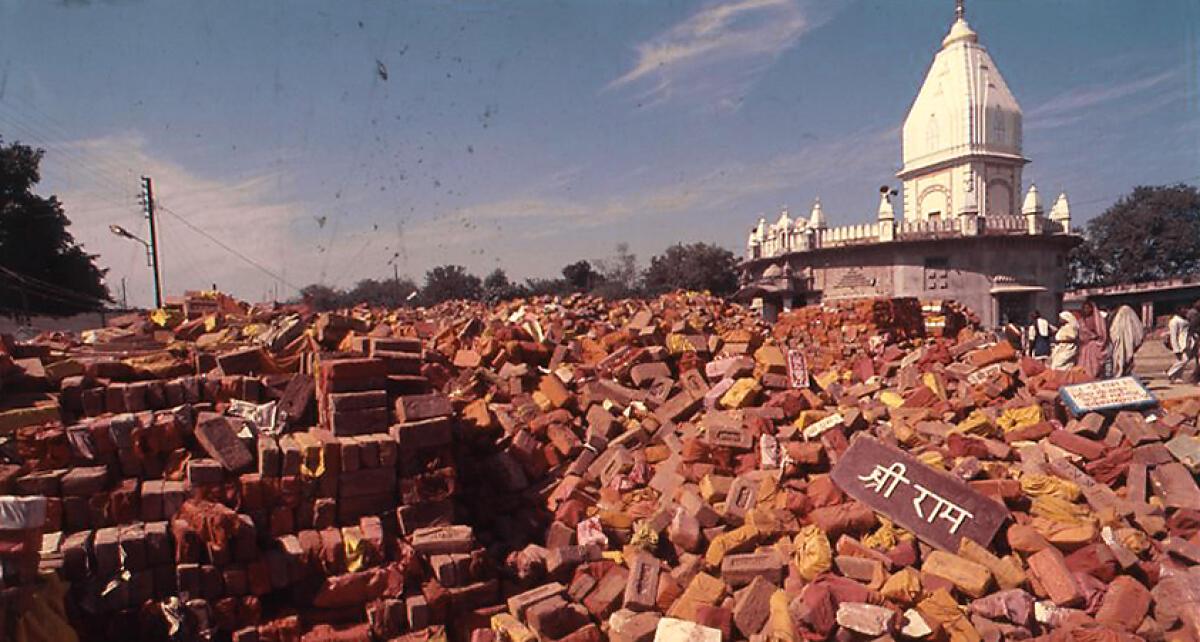
Consecrated bricks brought from various parts of the country as part of the Shilanyas exercise heaped in Ayodhya, in November 1989.
| Photo Credit:
The Hindu archives
On November 9, 1989, the VHP performed a shilanyas (foundation laying ceremony) at the site, setting a deadline of October 30, 1990, to build a Ram temple. Meanwhile, the United Front Government, which had the outside support of the BJP, implemented the Mandal Commission report, paving the way for 27% reservation for Other Backward Classes. Fuming at not being consulted on such a big move, Mr. Advani announced a 10,000-km Rath Yatra through 10 States from Somnath to Ayodhya. The journey which began on September 25, 1990 was scheduled to end on October 30, 1990 at the Babri Masjid, coinciding with the VHP’s deadline.
However, Mr. Advani was arrested by the Bihar police on October 22 before being flown out of the State and freed. Undeterred, the yatra proceeded to Uttar Pradesh, with 75,000 kar sevaks reaching Ayodhya. On the scheduled date, 40,000 kar sevaks gathered at the bridge leading to Ayodhya as the VHP prepared to hold a 14-kosi parikrama (procession) around the site and a ceremony at the grounds adjoining the mosque. While then Uttar Pradesh Chief Minister Mulayam Singh had received a promise from the VHP’s Ashok Singhal that the mosque would remain intact, kar sevaks scaled the domes of the Babri Masjid in an attempt to tear it down. In retaliation, Yadav ordered his 20,000-strong police force to fire at the crowds, killing 15 kar sevaks. The Babri Masjid remained intact.
In April 1991, Deoras instructed Singhal to keep the VHP away from the limelight, while keeping sadhus at the forefront at a massive Ram Mandir rally in Delhi. As a minority government led by P.V. Narasimha Rao was at the Centre and the BJP had formed a government in Uttar Pradesh led by Kalyan Singh, the State government acquired 2.77 acres around the disputed area to “promote tourism and provide amenities to pilgrims” and demolished all buildings in the area — levelling the ground. In May 1992, the death of Bhaurao Deoras — the elder brother of M.S. Deoras and a key strategist who was involved in bridging the disconnect between the RSS and its political arm — marked a key transition within the RSS. With his passing and with M.S. Deoras ailing, the RSS gave Sarkaryavah (General Secretary) Rajendra Singh a more prominent role in advancing the movement.
As the VHP and the BJP built momentum on the Ram Janmabhoomi temple demand, then Prime Minister Narasimha Rao reportedly spoke several times to Singh on the advice of Advani in an attempt to gauge intentions. In his book The RSS: And the Making of a Deep Nation, Dinesh Narayan writes that the RSS Sarsanghchalak told Rao that the Sangh would start building the temple gate first, away from the disputed area, and that it would take a few years. Rao was allegedly led to believe that this time gap may weaken the Muslim parties’ claim over the mosque and he was also assured by Kalyan Singh that the Babri Masjid would remain unharmed.
Demolition of Babri Masjid on December 6, 1992.
| Photo Credit:
The Hindu Archives
On December 6, 1992, a massive katha kunj (storytelling) event was organised by the VHP at the site adjoining the mosque, with more than 1,50,000 kar sevaks in attendance. Roused by the speeches given by BJP leaders including Advani, Murli Manohar Joshi, Uma Bharti, Nritya Gopal Das, and Sadhvi Ritambara, kar sevaks began throwing stones at the mosque. They went on to storm the disputed area and demolish the entire structure with the three domes within a few hours. Kalyan Singh had ordered the Uttar Pradesh police to stand down, allowing the demolition to occur — despite having assured the Supreme Court that the structure would be protected.
In the immediate aftermath, the RSS was banned for the third time by the government. The Librehan Commission, appointed to probe the sequence of events leading to the Babri demolition, stated, “Throughout the movement, the reins of the movement remained with the RSS who used to work out logistics and programmes. Ram, the incarnation of God, was exploited by a handful of men for their political power games.”
Despite this stinging indictment, the Bahri tribunal, set up to determine whether the ban on the RSS was justified and legally sustainable, held that it was unjustified. The tribunal lifted the ban on June 4, 1993. Almost a year later, Singh was appointed as the RSS chief after Deoras stepped down as Sarasanghchalak citing ‘health reasons’.
(With inputs from The Hindu archives)







hjx2bh
hyfywn
uz48ge