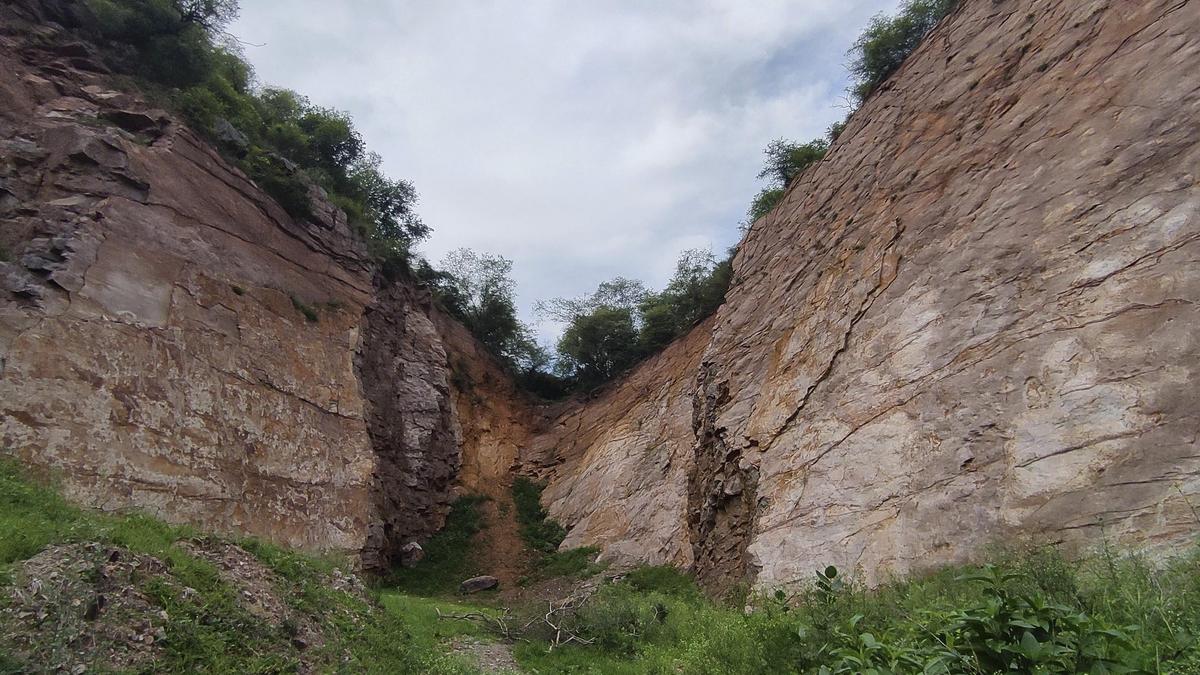
The Supreme Court is scheduled to take suo motu cognisance on Monday (December 29, 2025) of the public concern and furore over the recent definition of what constitutes the protected Aravali Hills and range, one of the world’s oldest mountain systems, amid fears that it would open the gates for unbridled mining and ecological harm.
A three-judge Special Vacation Bench headed by Chief Justice of India Surya Kant will hear the matter.
In a judgment in November, the Apex Court accepted the recommendations of a committee of the Ministry of Environment, Forest and Climate Change, defining the ‘Aravali Hills’ as any landform with an elevation of 100 metres or more above the local relief and an ‘Aravali Range’ as a collection of two or more such hills within 500 metres from each other.
“Any landform located in the Aravali districts, having an elevation of 100 metres or more from the local relief, shall be termed as Aravali Hills… The entire landform lying within the area enclosed by such lowest contour, whether actual or extended notionally, together with the hill, its supporting slopes and associated landforms irrespective of their gradient, shall be deemed to constitute part of the Aravali Hills,” the court had agreed with the Ministry panel.
The panel had also defined the Aravali Range, saying, “Two or more Aravali Hills, located within a proximity of 500 metres from each other, measured from the outermost point on the boundary of the lowest contour line on either side, shall constitute the Aravali Range”.
The court had also accepted the recommendations for sustainable mining and the steps to be taken to prevent illegal mining in Aravali Hills and Ranges.

It had directed the authorities to identify permissible areas for “mining and ecologically sensitive, conservation-critical and restoration priority areas within the Aravali landscape where mining shall be strictly prohibited or permitted only under exceptional and scientifically justified circumstances”.
“We further direct that till the MPSM (Management Plan for Sustainable Mining) is finalised by the MoEF&CC through ICFRE (Indian Council of Forestry Research and Education), no new mining leases should be granted,” it had directed.
The Apex Court had agreed with the Ministry panel’s recommendations despite recognising the Aravalis as a “green barrier” that prevents the eastward spread of the Thar desert.