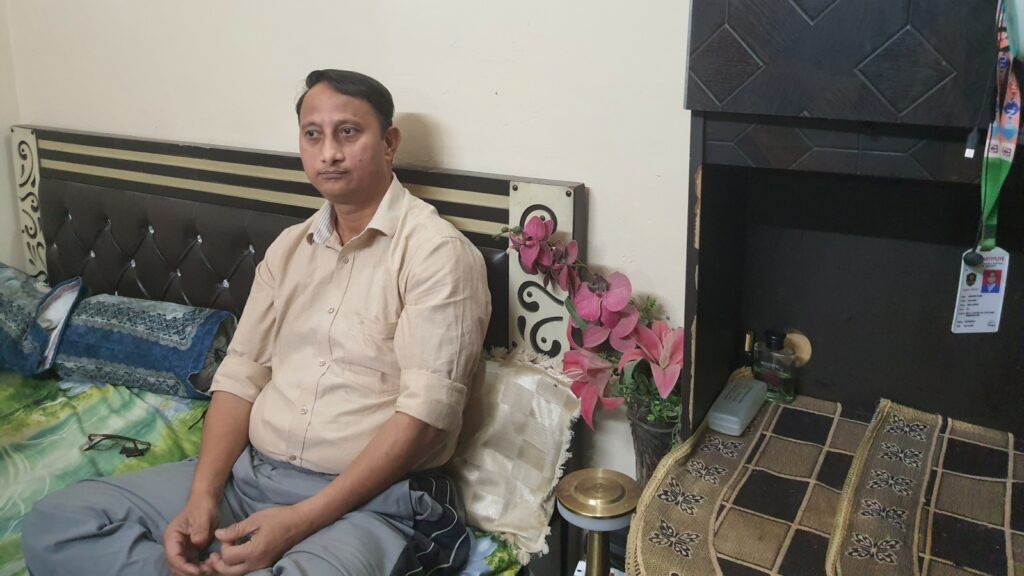
On a Tuesday evening in Ghaziabad, 41-year-old Mohammad Anish sat cross-legged on a narrow bed in his single-room apartment in Nandgram, staring at his phone as it kept lighting up. The messages were all the same.
The WhatsApp group had 55 members now — migrant workers scattered across India, bound by a shared problem. All of them were trying to recover passports they feared might never be returned.
Just days earlier, many of them had believed they were on their way to Europe.
That belief collapsed on March 8, when the Gautam Buddha Nagar Police announced they had busted a fake visa racket operating out of a mall in Greater Noida, arresting one of its key accused for allegedly cheating hundreds of job-seeking youths out of lakhs of rupees
The accused, Saksham Sharma, also known as Bittu Sharma, had been running a fraudulent visa consultancy, “SKY VISA VENTURE,” from an office inside Gaur City Mall along with an associate identified as Rajeev Sharma, who allegedly used the name Surendra, police said.
For Anish and dozens of others, the case was more than just another fraud investigation. It marked the collapse of a plan that had begun months earlier.
All of them had first met in Russia, according to Anish and other members of the group. They had arrived there in November 2023, drawn by the promise of a better future, and found work at a tailoring company that manufactured uniforms for the military. Over time, they formed a network — young men from Uttar Pradesh, Bihar, Rajasthan and Maharashtra.
Story continues below this ad
But conditions at the company began to deteriorate, the workers said. Wages and work arrangements became uncertain, and many had not seen their families for over a year. “In November, all of us returned to India as things in the company were not going accordingly and we had not seen our families for over a year,” Anish said.
A month later, conversations in the group resumed – this time about leaving again.
They began exploring opportunities not just in Russia, but also in Poland, Finland and Germany, according to multiple members of the group. Then, sometime in December, a new member appeared in their WhatsApp group. He introduced himself as Surendra. “Someone among us had added Surendra to our group and with the way he spoke we trusted him,” said Ali Waris, 24.
According to the group, Surendra claimed to have links to European employers and said he operated out of an office in Greater Noida. He told them he could arrange work visas at relatively low rates — Rs 1.5 lakh for Russia, and Rs 3.5 lakh for Poland and Finland.
Story continues below this ad
“All of us thought that it was not a bad deal,” Ali said. “We are not very educated people. Last time, all of us had gone through some agent. Since we were 55 people, we did not think that we would be duped.” Many agreed to pay.
Ali and Mannu Kumar, 23, decided to go to Poland and together paid Rs 6 lakh to the accused, they said. Mannu, a resident of Prayagraj, said he had borrowed the money from his elder brother.
“They are asking me, when is my flight. I have no passport and no money to return to my brother – what do I tell my family?” Mannu said.
Others paid varying amounts. Arvind Kumar, from Gorakhpur, said he paid Rs 2 lakh. Anish said he paid Rs 15,000 upfront and told the agents he would transfer the remaining Rs 80,000 after seeing his visa. At first, the process appeared legitimate. Passports were collected, and agreements were drafted promising overseas employment, the victims said. The agents remained in contact, offering reassurances.
But soon, inconsistencies began to emerge.
Story continues below this ad
It was an “invitation letter” sent to Anish that first raised doubts. “I told them, we first get a visa and then an invitation — how was it possible?” he said.
The next day, he received a visa document over WhatsApp.
“It did not look fake but did not look real either,” he said.
Around the same time, the accused continued to press for pending payments, frequently calling and asking clients to transfer the remaining amounts. Concerned, Anish and Arvind decided to verify the documents. On March 6, they visited an embassy official.
Story continues below this ad
There, they learned that the visa was fake and that no such company existed.
The following day, Anish filed a written complaint at the Bisrakh police station, alleging that the accused had taken passports from at least 26 people and collected money under the pretext of securing work visas, only to send forged documents over WhatsApp.
According to police officers, the accused allegedly targeted young people eager to work abroad through phone calls and other channels, promising jobs in countries like Finland, Poland and Russia. They collected passports, charged fees ranging from Rs 80,000 to Rs 1 lakh per person, and drafted written agreements to appear credible. When victims demanded updates or their documents back, they allegedly sent fabricated visa papers via WhatsApp.
It was only when some victims approached embassies for verification that the documents were confirmed to be fake, officials said.
Story continues below this ad
Back in Ghaziabad, Anish continued coordinating with others in the group, many of whom were now facing pressure from their families.
For most, the immediate concern was not recovering the money. “We have no hope to get our money back, but we need our passports,” Anish said.