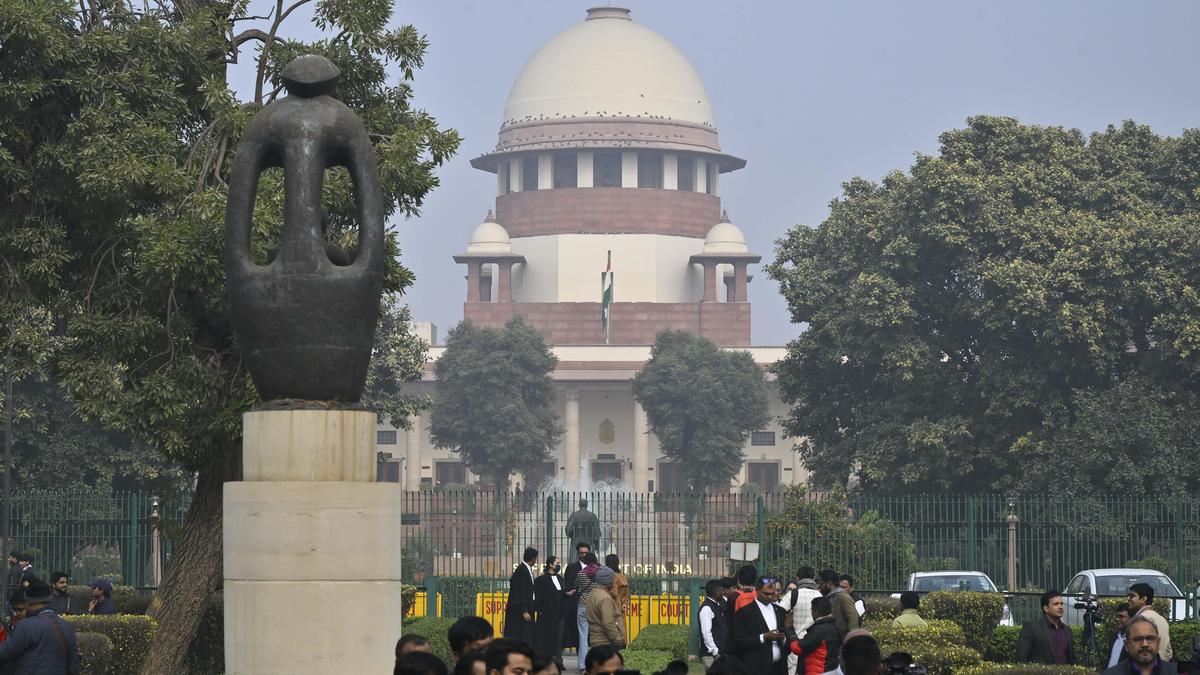
Over a year after a High Court judge used explicit language to narrate a sexual assault on a minor girl in his judicial order, the Supreme Court has assigned the Director of the National Judicial Academy, Justice (retired) Aniruddha Bose, a former apex court judge, to draw guidelines to infuse the qualities of sensitivity and compassion in judges, especially in the context of vulnerable cases.
A three-judge Bench headed by Chief Justice of India Surya Kant directed Justice Bose to include legal practitioners, academicians and social workers in the expert committee.
The court said the committee report should be comprehensive and written in simple language, without any legal jargon. The court said there was no point to such an exercise if the victims, whose rights the exercise seeks to protect, did not understand a word of the report. The Bench said the report should be translated into regional languages and submitted in the apex court.

The court highlighted that there were several offensive words and expressions in local dialects which are used casually in society. However, the use of these words also constitute an offence under the penal laws. The Bench said it was time to spread awareness about how such expressions were a violation of the rights of victims of sexual assault.
“It shall be highly appreciated if the committee, as a part of its report, is able to identify and compile such words/expressions, from different languages, so that they do not go unnoticed, and the complainants/victims are empowered to give a better and fuller narrative of the trauma undergone by them,” the judgment, authored by Chief Justice Kant, observed.
Comment | Judicial sensitivity to sentiments is a sign of regression
The judgment was triggered by a petition filed by an NGO ‘We the Women of India’, represented by senior advocate Shobha Gupta, and other members of the Supreme Court Bar, including senior advocate H.S. Phoolka about a March 17, 2025 order passed by a Single Judge Bench of the Allahabad High Court.
The Single Judge order used explicit expressions to detail the sexual assault on the minor girl by two men. It had set aside a summons order issued to the two accused under the Protection of Children from Sexual Offences (POCSO) Act and for charges of attempt to rape by a Special Judge in June 2023.
The Single Judge had concluded that the “pulling down of pyjama string” did not amount to an “attempt to rape” but only a lesser charge of assault or force on a woman with intent to disrobe under Section 354B of the erstwhile Indian Penal Code.
The Supreme Court had taken suo motu cognisance of the judgment as an example of how “judges and judicial officers have failed to imbibe compassion and empathy in the manner of handling matters involving sexual offences, especially when it comes to vulnerable and/or minor victims and witnesses”.
“No judge or judgment of any court can be expected to do complete justice when it is inconsiderate towards the factual realities of a litigant and the vulnerabilities which they may be facing in approaching a court of law… Our decisions, as participants in the legal process, from laying down the procedure that shall have to be faced by common citizens to the final judgment passed in any given case, must reflect the ethos of compassion, humanity, and understanding, which are essential for creating a fair and effective justice system,” Chief Justice Kant observed in the judgment.
Setting aside the High Court order of March 17, 2025, the Supreme Court restored the original June 2023 summons order of the Special Judge to the two accused men. Eom