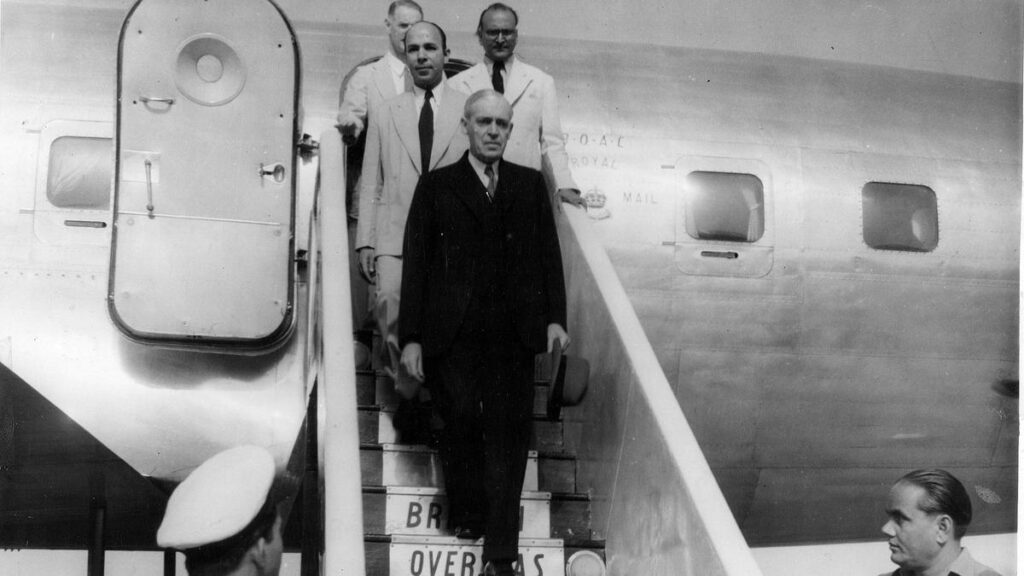
On September 15, 1950, at Lake Success, the temporary home of the United Nations between 1946 and 1951, the United Nations Security Council (UNSC) received a report on Jammu and Kashmir from Owen Dixon, former Chief Justice of Australia. Appointed by the UNSC to mediate between India and Pakistan, the 64-year-old jurist offered a set of categorical recommendations that, in effect, revived the logic of territorial partition.
Dixon had travelled extensively across Jammu and Kashmir on both sides of what later became the Line of Control, shuttled between New Delhi and Karachi, and even brokered a meeting between the Indian and Pakistani prime ministers on July 20, 1950. His proposal suggested that the Hindu-majority plains of Jammu should go to India, while the culturally and linguistically contiguous Muslim areas of Rajouri–Poonch, located close to the Line of Control, should go to Pakistan. Ladakh was to remain with India, while Gilgit-Baltistan and what came to be known as Pakistan-occupied Kashmir (PoK) were allotted to Pakistan. Dixon suggested that only the Kashmir Valley (predominantly Muslim, but with strong Kashmiri identity) should hold a plebiscite supervised by the United Nations.
Dixon report proved to be non-starter
The Dixon Report proved to be a non-starter. It was widely seen as a de facto invitation to Partition-type violence, mass displacement, and demographic upheaval within Jammu and Kashmir itself. In hindsight, the report lacked the analytical rigour required to capture the former princely state’s intricate religious, linguistic, and ethnic geography — one that resisted neat binary classifications of majority and minority. Moreover, it defeated the idea of inclusive India.
Yet, despite its failure, the idea of dividing Jammu and Kashmir did not disappear in a different context. It resurfaced periodically, though always framed within the context of Indian national sovereignty, and was presented not as secession but as administrative reorganisation. At different moments, this idea paradoxically brought together actors across regions and ideological lines who believed that territorial reconfiguration could offer relief from deep-seated political and structural grievances. Decades later, Inderjit Gupta, who served as India’s Union Home Minister from June 29, 1996 to March 19, 1998 in the United Front governments of H. D. Deve Gowda and I. K. Gujral, and was a senior leader of the Communist Party of India, also once proposed trifurcating Jammu and Kashmir into three distinct units namely Jammu, the Kashmir Valley, and Ladakh in the Parliament. After creating confusion, he had to retract his statement. The notion of division or trifurcation was also explicitly endorsed by the Rashtriya Swayamsevak Sangh, which advocated the reorganisation of Jammu and Kashmir in its Kurukshetra resolution of 2002. Ladakh, which was historically part of the former state of Jammu and Kashmir, was separated in 2019 under the Jammu and Kashmir Reorganisation Act, leaving behind two remaining administrative units within the reconstituted Union Territory: Jammu and the Kashmir Valley.
Strong chorus calling for separation of J&K returned
In the current context, a strong chorus calling for the separation of Jammu and Kashmir has returned. Recent statements across the political spectrum have been revealing. Much of this discourse, however, has the feel of a broken record spanning nearly eight-decades. Leaders in Jammu continue to articulate a narrative of discrimination and political neglect. The Kashmir Valley, in turn, contests the very framing of Jammu’s grievance. Valley-based leaders argue that Jammu is not the monolithic Hindu region it is often projected to be, pointing out that nearly 35% of Jammu’s population is Muslim. This is a reality they contend is routinely ignored in political mobilisation. Predictably, familiar patterns re-emerge. Muslim political leadership in Jammu opposes division, arguing that it would marginalise Muslim-majority hilly districts within the Hindu majority region. The debate circles back to hardened positions shaped by decades of mistrust. What is insufficiently recognised, however, is that 2026 is not the 1990s or early 2000s. The nature of India’s political landscape has changed profoundly.
Taken together, these developments underscore a central flaw in the assumption that the restoration of statehood alone will resolve Jammu and Kashmir’s problems grossly oversimplifies the former State’s political and social complexity. In fact, the current arrangement of divided political authority allows both the elected leadership, the National Conference (NC), and the Lieutenant Governor’s administration to exercise plausible deniability, each attributing policy failures to the other. This institutional ambiguity dampens accountability but also contains political fallout. However, once statehood is restored, that buffer disappears. Decisions perceived as discriminatory by either region would carry far greater political consequences and could quickly become explosive. This does not imply that the present arrangement is sustainable or desirable; rather, it highlights that statehood without structural reform may intensify, rather than resolve, existing fault lines.
At the same time, recent trend lines demand far greater attention to ground realities than is currently evident. Demands for the division of Jammu and Kashmir are now emerging from across the political spectrum and from both regions, and even from members of civil society. Notably, even Sham Lal Sharma, a sitting BJP legislator and a former minister, has publicly articulated this demand. He has been joined by former Congress MP and minister Lal Singh, who has been a strong votary of statehood and reorganisation. In the Kashmir Valley, Sajjad Lone, a former minister and legislator, has suggested that it may be time for an “amicable divorce,” effectively reviving the argument for dividing the former state. Often, the immediate triggers for such exchanges are symbolic rather than substantive. This time, the flashpoint has been the proposed establishment of a National Law School over whether it should be located in Kashmir valley or Jammu. Yet behind these symbols lie deeper political anxieties. Voices from the Valley, including Lone, increasingly argue that continued association with Jammu has become a constraint on Kashmir’s political and economic development. Thus, each region is now framing the other as an obstacle: Jammu views Kashmir as dominant and exclusionary, while Kashmir portrays Jammu as a drag on its aspirations. What emerges is not a new debate, but a deepening mutual exhaustion as one in which competing narratives cancel each other out, while the larger structural failures of governance, decentralisation, and internal federalism remain unaddressed.
Renewed narrative of division
The renewed narrative of division has, unsurprisingly, generated deep anxiety among Jammu’s Muslim population. Javed Ahmed Rana, a National Conference minister from Jammu’s Poonch district, was quick to oppose the demand. He argued that a minority cannot determine the fate of a majority. This implicitly invoked the fact that Jammu and Kashmir as a whole remains a Muslim-majority entity, and cautioning that political decisions driven by Jammu’s Hindu leadership could not be imposed unilaterally.
Jammu and Kashmir functions in ways characteristic of deeply diverse societies, particularly in the global south context. Those clamouring for the division of the former state and the creation of separate entities often insist that their demand is not religious in nature and that it includes Muslim constituencies as well. On paper, this claim carries some weight: many Muslims in Jammu are culturally and linguistically distinct from the Kashmiri-speaking population of the Valley.
Yet this distinction does not translate into support for division. Muslim communities such as the Gujjars and Paharis, despite their cultural and linguistic differences from Valley Muslims, largely oppose the breakup of Jammu and Kashmir. Their resistance is shaped not by cultural affinity but by political arithmetic. In a divided arrangement, these groups fear being reduced to religious and political minorities, with diminished voice, institutional protection, and access to power.
At face value, this inter-regional rivalry between the two regions started immediately after accession of J&K to the Indian union. Like the rest of the country, there was a transition from monarchy to democratic system in the princely states. But in the process what happened was that seat of power for all practical reason moved from monarch, who had Jammu origins, to Kashmir valley, political elite. With immense ethnic, religious, geographical and linguistic diversity within J&K and other uncertainties that clouded the post-independent history of J&K’s association with the Indian union, this marriage between the two region was far from harmonious in the absence of internal institutional federal structures.
Rebuttal to idea of division from Balraj Puri
In the post-Independent India, the most sustained and forceful intellectual rebuttal to the idea of division came from public intellectual and Padma Bhushan awardee late Balraj Puri, who for nearly six decades sensitised India and the world to the plural, layered mosaic of Jammu and Kashmir. Puri argued consistently that division would be a remedy worse than the disease that it would institutionalise political fissures rather than resolve them. His credibility across regions and political divides in and outside J&K, combined with deep empirical knowledge of the state, played a crucial role in persuading national leaders of all shades to resist simplistic solutions.
Both Jammu and the Kashmir Valley required tailored decentralisation within an overarching framework of asymmetrical federalism. And this was spelled out by Balraj Puri’s Jammu and Kashmir Regional Autonomy Report (1999) which remains the only serious and comprehensive proposal to address the J&K’s structural contradictions. Its central insight was straightforward: while political elites in Jammu and Kashmir demanded federalism within the Indian Union, they failed to apply the same principle internally. The failure to engage seriously with this report represents a lost opportunity whose consequences are now becoming visible today.
In the post-2019 scenario, the National Conference (NC), in particular, yet again had a historic opportunity to position itself as a genuinely pan–Jammu and Kashmir party. Instead, it has remained anchored to its core electoral base of 2024 assembly elections, which is Kashmir valley and Muslim areas of Jammu, and appears to have concluded, implicitly, if not explicitly, that Hindu-majority areas of Jammu will never be politically receptive to it. What this approach fails to recognise is how dangerous such a conclusion is in the broader national context.
A symbolic but telling illustration lies in the party’s recent Rajya Sabha nominations. It would have been politically prudent for the NC to nominate at least one Hindu representative from Jammu, reinforcing its claim of representing the entire J&K. This was particularly important keeping in the mind the national context.
Instead, all four candidates it fielded were drawn from the Kashmir Valley and Kishtwar, a Kashmiri-speaking hilly pocket of Jammu. The message, intended or otherwise, was unmistakable. An articulate voice from Jammu, with a nuanced understanding of both regional and national dynamics, could have contributed meaningfully to policy debates. That opportunity was missed.
Fundamentally different context now
A fundamentally different context has now emerged, both within Jammu and Kashmir and nationally. The generation that once acted as social and political glue between Jammu and the Valley is gone. Figures such as Sheikh Abdullah, despite their many contradictions, maintained relationships across regional and religious lines that are largely absent today. The problem, however, runs deeper than personalities. Political leaderships across parties tend to rediscover the virtues of internal federalism only when they are out of power. Once in office, the same ideas are treated as irritants. The same is true now. The prevailing belief is that governance and development alone can resolve political grievances. Governance may manage symptoms, but the underlying disease of over centralization of polity continues to deepen as current trends show.
The context of 2026 carries an additional warning. There was a time when the abrogation of Article 370 was widely considered politically and constitutionally impossible. Once policymakers in the national capital convinced themselves otherwise, it happened. The same logic applies here: if territorial reorganisation comes to be viewed as administratively and politically expedient by the national governance elite, there may be little to prevent it. This must be understood within the broader national context, where the union territory of Jammu and Kashmir occupies a central place in political imagination and party’s ideology.
That is why both supporters and opponents of division must therefore confront a harder question: do they have a credible answer to the present instability in Jammu and Kashmir? The current arrangement leaves everyone dissatisfied. In both Jammu and the Kashmir Valley, an entire generation is growing up with little understanding of each other’s histories, anxieties, or political journeys. That unfamiliarity, combined with centralised control and the absence of internal federalism, is steadily hollowing out the idea of a shared political future.
What also cannot be ignored is that a peripheral former state, now a Union Territory, punches far above its weight in India’s national security calculus, despite its relatively modest population, with half of Delhi’s population, and negligible economic contribution to the country. Over the past four-decades, a significant proportion of major terrorist incidents in India and have had direct or indirect linkages to Jammu and Kashmir. Beyond major attacks within Jammu and Kashmir itself, several of India’s most consequential terrorist incidents, including the 2001 Parliament attack in New Delhi, the 2008 Mumbai attacks, and even the 2024 Red Fort attack, have had direct or indirect operational linkages to networks rooted in or connected with Jammu and Kashmir.
Precisely for this reason, the region demands an understanding that is rooted, grounded, and empirically informed, rather than filtered through recycled binaries and inherited analytical frameworks. These outdated lenses have not only failed to capture the region’s complexities but have actively amplified internal instability, further eroding an already fragile social cohesion. Treating one of India’s most consequential regions as a mere managerial or administrative challenge is a profound misreading of the problem. What is required instead is a clinical and honest examination of the root causes of instability and anxiety in Jammu and Kashmir whose causes have a direct bearing on social cohesion, both within the region and across India as a whole.
Debate over J&K comes a full circle
Seventy-five years after Owen Dixon carried the logic of partition into the United Nations chamber at Lake Success, the debate over Jammu and Kashmir has come full circle. What was rejected in 1950 as analytically crude and morally dangerous is now resurfacing in a different context, not because it has acquired new wisdom, but because political imagination has withered and structural reform has been repeatedly postponed. The persistence of division talk is not evidence of its validity; it is a symptom of accumulated failure, particularly failure to decentralise power, to respect regional dignity, and to invest in genuine internal federalism. As in Dixon’s time, the temptation to redraw lines is being mistaken for a solution to political anxiety. But history offers a clear warning: when complexity is reduced to cartography, instability follows. Unless the Indian state and regional political elites move beyond managerial fixes and confront the deeper causes of alienation and mistrust, the idea of division will continue to return each time in a more dangerous form, with consequences that extend far beyond Jammu and Kashmir to the very political and security foundations of the Indian Union.
Luv Puri is the author of two books on Jammu and Kashmir, including Uncovered Face of Militancy and Across the Line of Control. He has worked on conflict and security issues for over two decades.