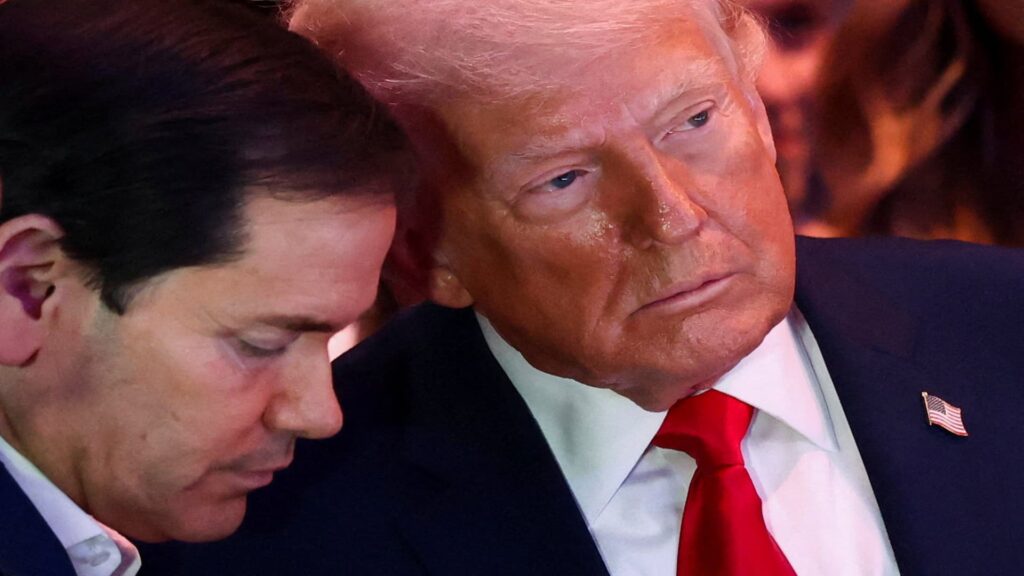
U.S. President Donald Trump speaks to reporters before boarding Air Force One on April 10, 2026 at Joint Base Andrews, Maryland.
Win McNamee | Getty Images
President Donald Trump on Sunday said the U.S. will blockade the Strait of Hormuz after talks held in Pakistan to end the Iran war hit the skids.
“Effective immediately, the United States Navy, the Finest in the World, will begin the process of BLOCKADING any and all Ships trying to enter, or leave, the Strait of Hormuz,” Trump said in a post to his social media platform Truth Social. “The Blockade will begin shortly. Other Countries will be involved with this Blockade. Iran will not be allowed to profit off this Illegal Act of EXTORTION.”
The announcement of a U.S. blockade of the strait likely scuttles any hopes that the war would end in the coming days following peace talks in Islamabad. It also threatens to exacerbate the economic crisis that has gripped global economies since the war broke out and Iran began restricting access to the strait, a chokepoint which carries about a fifth of the world’s oil.
Trump said the U.S. blockade is an effort to stop Iran from policing the strait and benefiting economically while the rest of the world suffers from its closure.
“At some point, we will reach an ‘ALL BEING ALLOWED TO GO IN, ALL BEING ALLOWED TO GO OUT’ basis, but Iran has not allowed that to happen by merely saying, ‘There may be a mine out there somewhere,’ that nobody knows about but them,” he said. “THIS IS WORLD EXTORTION, and Leaders of Countries, especially the United States of America, will never be extorted.”
Trump, speaking on Fox News’ “Sunday Morning Futures,” said the effort will be a “complete blockade” and “all or none,” meaning no ship will be allowed to pass until Iran relents.
Trump also announced in the post that the U.S. Navy will “seek and interdict every vessel in International Waters that has paid a toll to Iran.”
Iran was preparing to toll vessels seeking passage through the strait, a move that invoked Trump’s ire as Tehran tries to cement its grip on the passage amid a two-week ceasefire in the conflict.
“No one who pays an illegal toll will have safe passage on the high seas,” the president said.
Peace talks hosted by Pakistan broke down over what the U.S. described as Iran’s unwillingness to give up its efforts to obtain a nuclear weapon. Tehran’s demands include control of the Strait of Hormuz, payment of war reparations and a ceasefire across the region, including in Lebanon, according to Iranian state TV and officials. It is also seeking the release of its frozen assets abroad.
The U.S. delegation, led by Vice President JD Vance, met with Iranian and Pakistani negotiators for more than 21 hours during the rare face-to-face summit.
The war, and nearly complete closure of the strait, have put immense pressure on oil prices and the global economy. Markets have whipsawed throughout the campaign, and oil has at times rocketed to more than $100 per barrel.
Read more CNBC politics coverage
Trump on Fox said the U.S. needs to weather the storm to prevent Iran from obtaining a nuclear weapon, arguing that energy prices will fall when the war is over.
“It might not happen initially, but it’s going to go down,” he said.
The president also said that any country — potentially including China — that assists Iran will be slapped with a 50% tariff levied by the U.S.
“If we catch them doing that, they get a 50% tariff, which is a staggering, that’s a staggering amount,” Trump said.
Trump is set to meet with Chinese President Xi Jinping next month.
Iran responds
Iran said it will view the entry of military vessels near the strait as a breach of the two-week ceasefire and will respond accordingly, according to a Reuters report citing Iranian state media.
A statement issued by the Iranian Revolutionary Guard Corps said the strait is “open for the safe passage of non-military vessels in accordance with specific regulations,” Reuters reported.
U.S. military vessels entered the strait on Saturday to clear mines, according to The New York Times.
Help on the way?
Trump said that allies will assist in the blockade of the strait, but which American allies he was referring to remains unclear.
The president said on Fox that the United Kingdom and “a couple of other countries” are sending mine sweepers to help free the strait for safe passage. Trump also criticized the North Atlantic Treaty Organization for not offering assistance in policing the strait, which he has repeatedly done throughout the war.
“We’re very disappointed with NATO, we’re very, very disappointed they didn’t come,” Trump said. “Now they want to come and they want to help with the strait,” he added, without providing any evidence.
The BBC later reported that the U.K. would not be assisting with the blockade.
“We continue to support freedom of navigation and the opening of the Strait of Hormuz, which is urgently needed to support the global economy and the cost of living back home,” a spokesperson for the U.K. government told the BBC.
Trump also suggested that he expects U.S. allies in the Gulf to assist.
“They’ve already started,” he said, without providing details. “They’re much closer, so maybe they have to do it … but [Iran] made a big mistake when they started lobbing missiles at them.”
U.S. threatens to prosecute Iranian oil buyers
The U.S. Justice Department threatened to prosecute anyone who purchases sanctioned Iranian oil, according to a social media post from Acting Attorney General Todd Blanche.
“The Department of Justice will vigorously prosecute anyone who buys or sells sanctioned Iranian oil,” Blanche said in the post.
The Trump administration has recently waived sanctions on oil stranded at sea belonging to adversaries, including Iran and Russia. The sanctions relief was an apparent effort to lower oil prices, but was met with fierce resistance from Democratic lawmakers who said the president was giving a windfall to the enemy.