India and China, among the largest economies in Asia, are staring at a supply crunch for their energy needs as the Middle East conflict drags on. Asia’s biggest crude importers have so far managed to soften the blow of more than seven weeks of conflict which has disrupted trade via the Strait of Hormuz by relying on alternative arrangements, helping cushion not only their own economies but also those of other regional buyers competing for supplies.That buffer, however, is starting to fade! To navigate an unusually severe energy disruption, China and India have explored multiple options, including direct arrangements with Iran and drawing on shipments of Russian and Iranian crude already at sea. These floating reserves, though, are steadily reducing in numbers, according to a Bloomberg report. At the same time, movement through the Strait of Hormuz has effectively halted, with even vessels operating under sanctions for China’s independent refiners showing reluctance to challenge the US naval blockade.
India’s exposure greater than China
Among the two, India faces greater exposure. It depends heavily on the Gulf region not just for crude oil but also for liquefied petroleum gas used in households, where supply strains have been particularly evident. With limited reserves on hand, the world’s third-largest oil importer has increased purchases from Russia to bridge the gap, aided by US waivers. In fact, India’s purchase of Russian crude is now near the highs seen around June 2023.
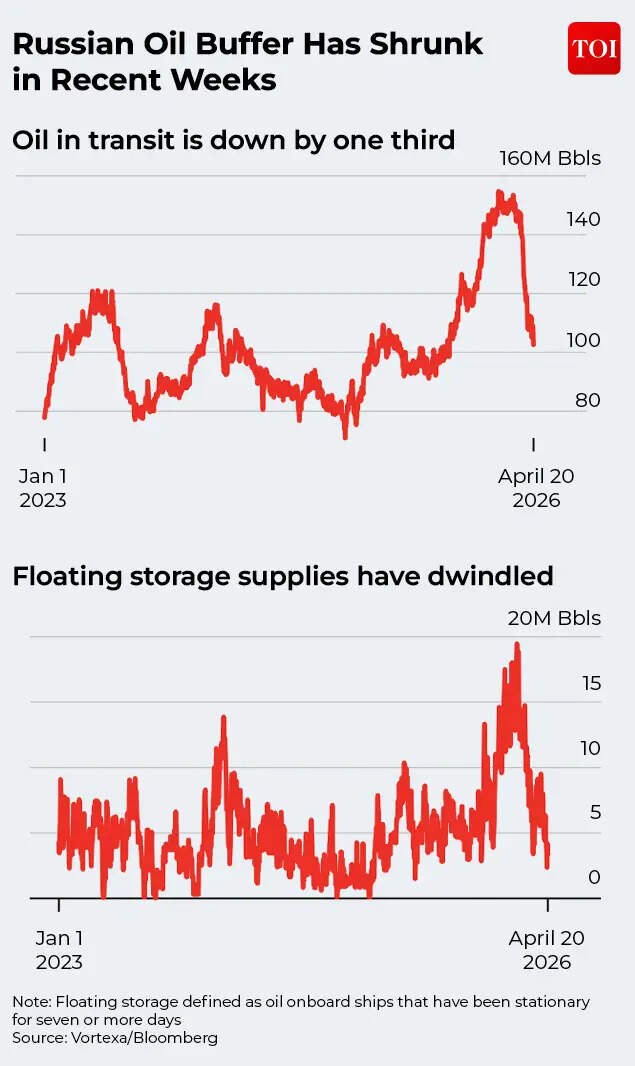
Refining companies indicate they have sufficient supplies for the next month, but prices no longer reflect the discounted levels seen in the years following the Ukraine conflict. At the same time, the volume of crude available in transit is shrinking quickly.In mid-February, floating storage held around 20 million barrels of Russian oil available for purchase. That figure has since fallen sharply to under 5 million barrels, according to Anoop Singh of Oil Brokerage Ltd. Estimates from Vortexa Ltd suggest the volume is now closer to 3 million barrels, the Bloomberg report said.India had earlier ensured uninterrupted movement of LPG and other shipments through the Strait of Hormuz following a bilateral understanding with Iran. However, after a turbulent weekend in which two Indian vessels were targeted while attempting to pass through the route, New Delhi summoned Tehran’s envoy and has temporarily halted plans to dispatch empty ships to the Gulf for loading.The issue has been raised with Iran in strong terms, Randhir Jaiswal, spokesperson for the Ministry of External Affairs, said on Monday.The government may take measures to tighten exports, according to Anoop Singh of Oil Brokerage Ltd. Such steps have already been seen in China and other markets, even as India works to maintain refinery operations and meet domestic demand.
China better placed, but facing issues
China, however, is relatively better placed due to its long-standing focus on energy security, substantial reserves exceeding 1 billion barrels, and its position as the world’s largest consumer. Smaller economies risk being edged out by bigger buyers, although even Beijing is beginning to feel the strain of rising prices as supply tightens. According to the International Energy Agency, the absence of flows through the Strait of Hormuz led to a 10% drop in global supply last month. State-run refiners have already begun scaling back operations.With Iranian shipments no longer benefiting from exemptions tied to the Strait of Hormuz due to a blockade by the United States, pressure is also mounting on China’s independent refiners, often referred to as “teapots.” These players, which account for nearly one-fifth of China’s refining capacity, are now grappling with both tighter supplies and rising costs.Xavier Tang, a senior market analyst at Vortexa Ltd, said volumes of Iranian crude in transit are likely to decline as the US blockade disrupts a previously steady flow, even during the conflict, “although not at a fast pace.” According to Vortexa, Iran currently has around 160 million barrels of oil “on water,” referring to shipments already loaded and en route, only slightly below levels seen in February before the war began.While this volume remains relatively strong compared to historical trends, higher prices for Russian crude have also lifted Iranian grades. Discounts that once applied to barrels such as Russia’s ESPO or Iranian oil have turned into premiums, as buyers scramble for alternatives to Middle Eastern supplies. At the same time, risks have intensified with Washington stepping up secondary sanctions, adding further strain on independent refiners tasked with maintaining output.“All of Asia is looking at very constrained oil supplies,” Anoop Singh of Oil Brokerage Ltd said. “With every passing day the war is hurting more nations, sparing no one.”