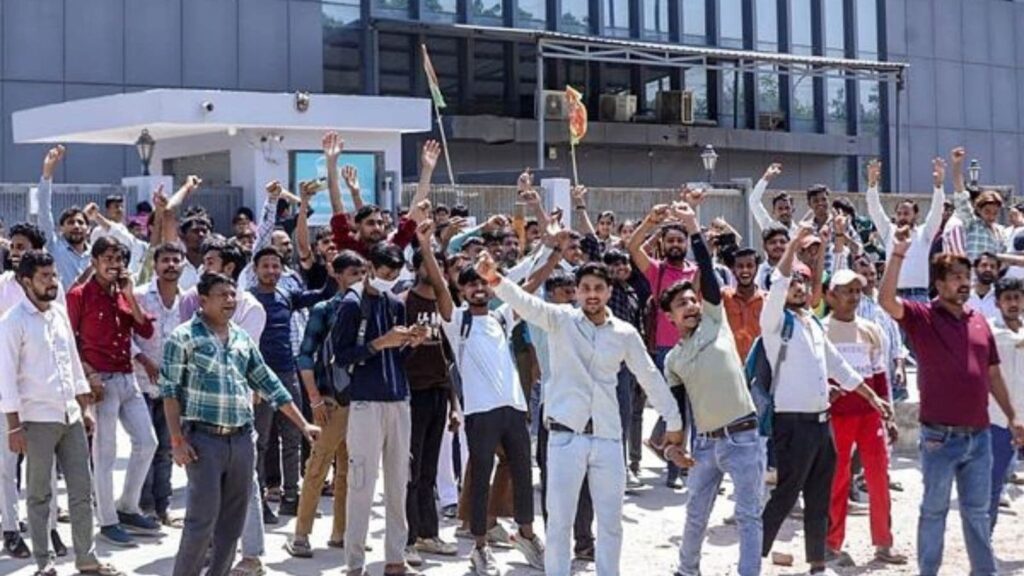
The violence marked a sharp escalation of tensions that had been simmering in the factories since Friday, and the latest in a series of labour protests that have broken out in at least four other cities across North India over the past couple of months.
Following two days of dharnas by contractual labour outside factories, the Uttar Pradesh government had announced a series of measures for workers’ welfare, including mandatory double overtime pay and timely wages on Saturday.
On Sunday, Gautam Buddha Nagar district magistrate Medha Roopam met with representatives of industrial units and directed them to take steps to safeguard the rights of workers.
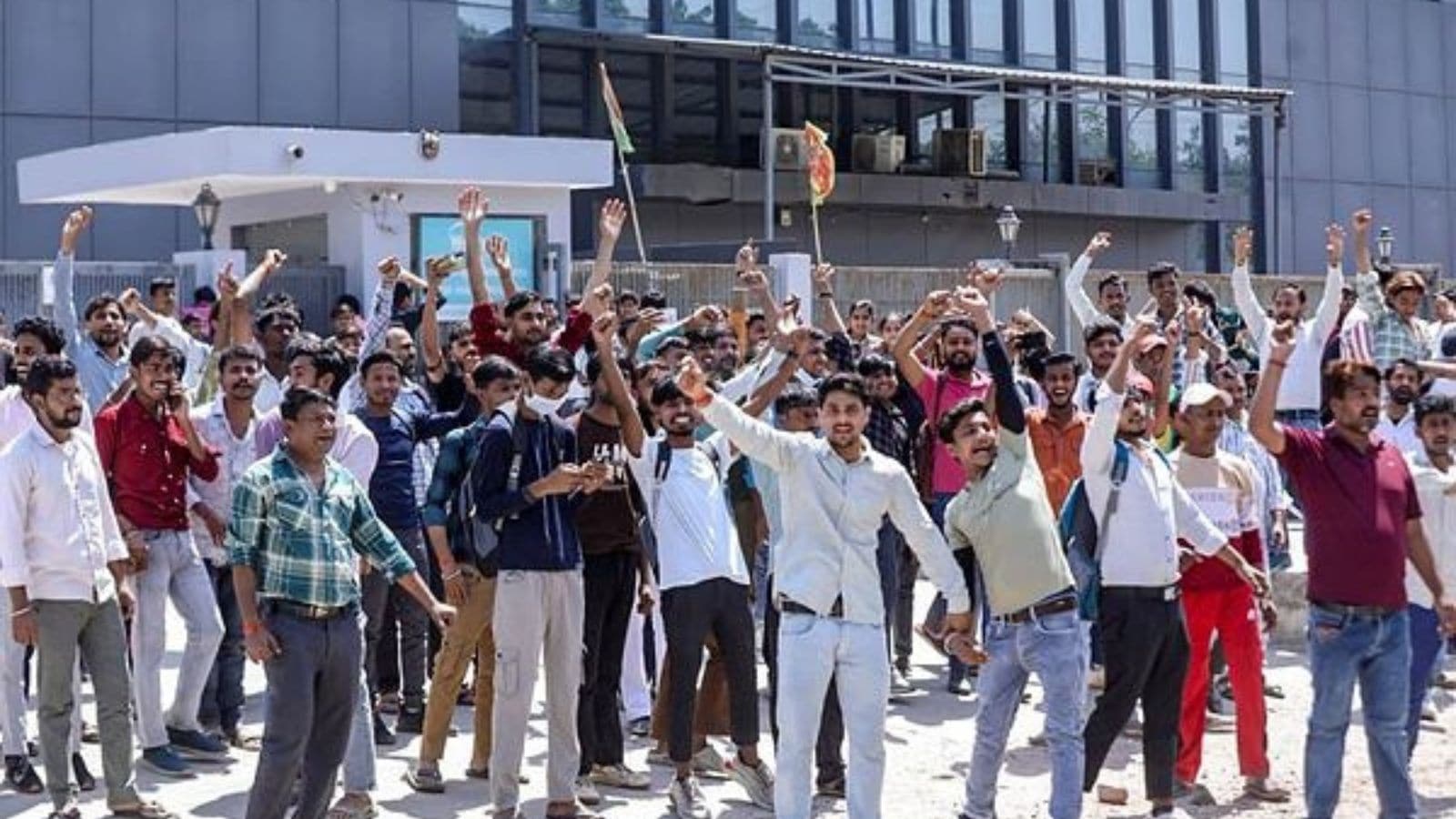 Factory workers during a protest demanding a hike in wages, in Noida, Gautam Buddh Nagar district, Uttar Pradesh, Monday. (PTI)
Police said it was unclear why the workers suddenly became violent on Monday. UP Director General of Police Rajeev Krishna said the “provocative elements” and “external elements” involved in the violence were being traced, and “firm legal action will follow once their identities are established”.
Speaking in Muzaffarnagar, Chief Minister Yogi Adityanath expressed solidarity with the workers, and asked them to be “wary of those who incite unrest”. The CM also asked factory owners to open talks with the protesting workers.
“When the state is progressing towards development and peace, some people are conspiring to spread unrest,” the Chief Minister said. “Be cautious of those trying to create industrial unrest and do not let them succeed.”
Story continues below this ad
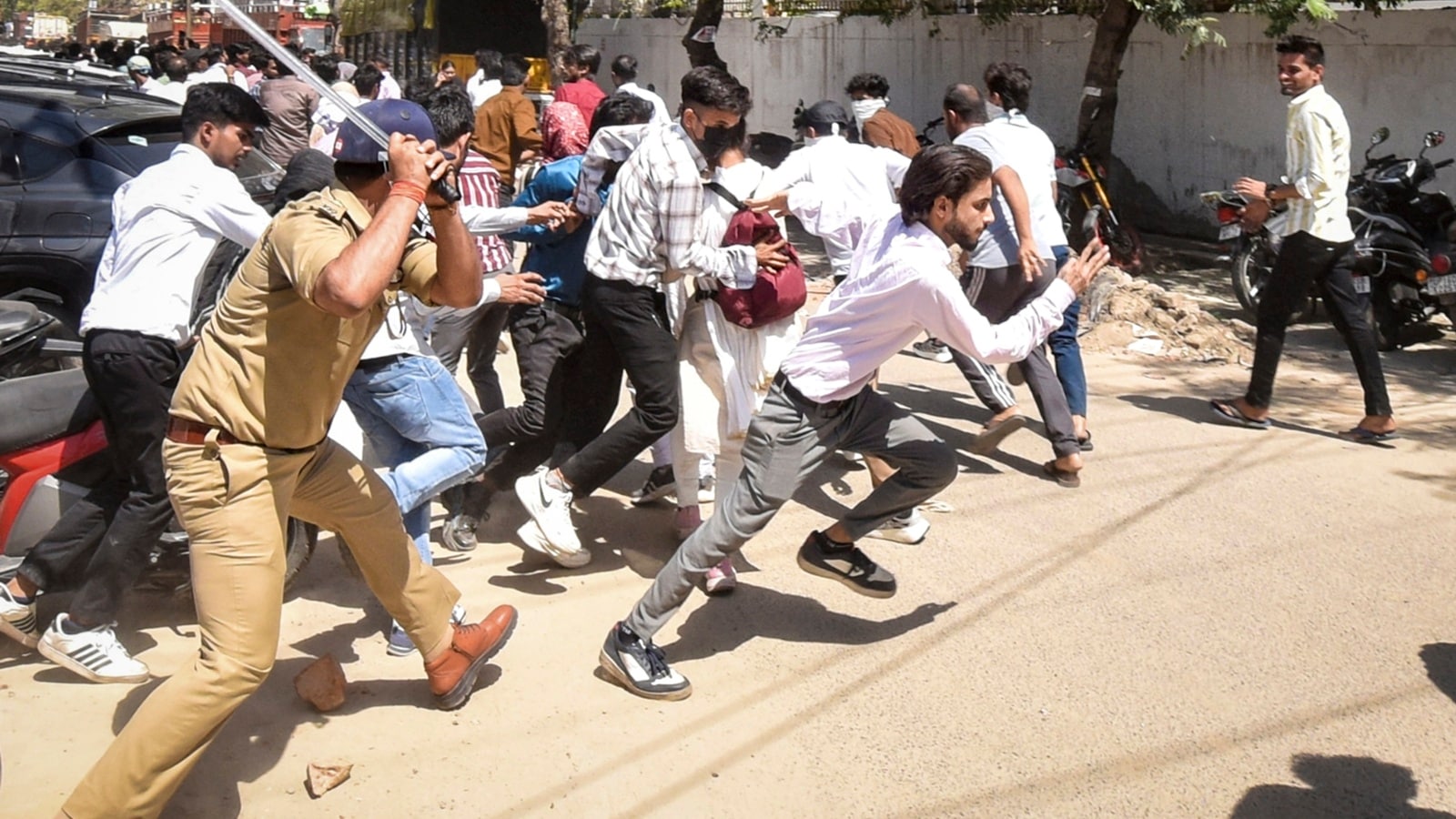 Police personnel resort to a lathi charge on protesters demanding a salary hike, in Noida. (Source: PTI Photo)
Calling for better industrial relations, he said, “I appeal to all entrepreneurs to maintain direct dialogue with workers.” He added, “Our government stands with workers; it will provide security to entrepreneurs and protection to labourers, while ensuring fair wages.”
A high-level committee set up by the UP Labour Department to resolve the dispute between workers and industries has begun discussions with all stakeholders, a government spokesperson said in the evening. The committee will look into the reasons for the unrest and violence and submit its recommendations on priority to the government, the spokesperson said.
The committee headed by the Industrial Development Commissioner includes top government officials, and representatives of both labour organisations and industry associations.
A senior police officer told The Indian Express on Monday evening that between 40,000 and 45,000 workers flooded the streets at more than 80 locations in the industrial areas of Noida’s Phase 2 and Sectors 60, 62, and 84. More than 60 people had been detained, the officer said.
Story continues below this ad
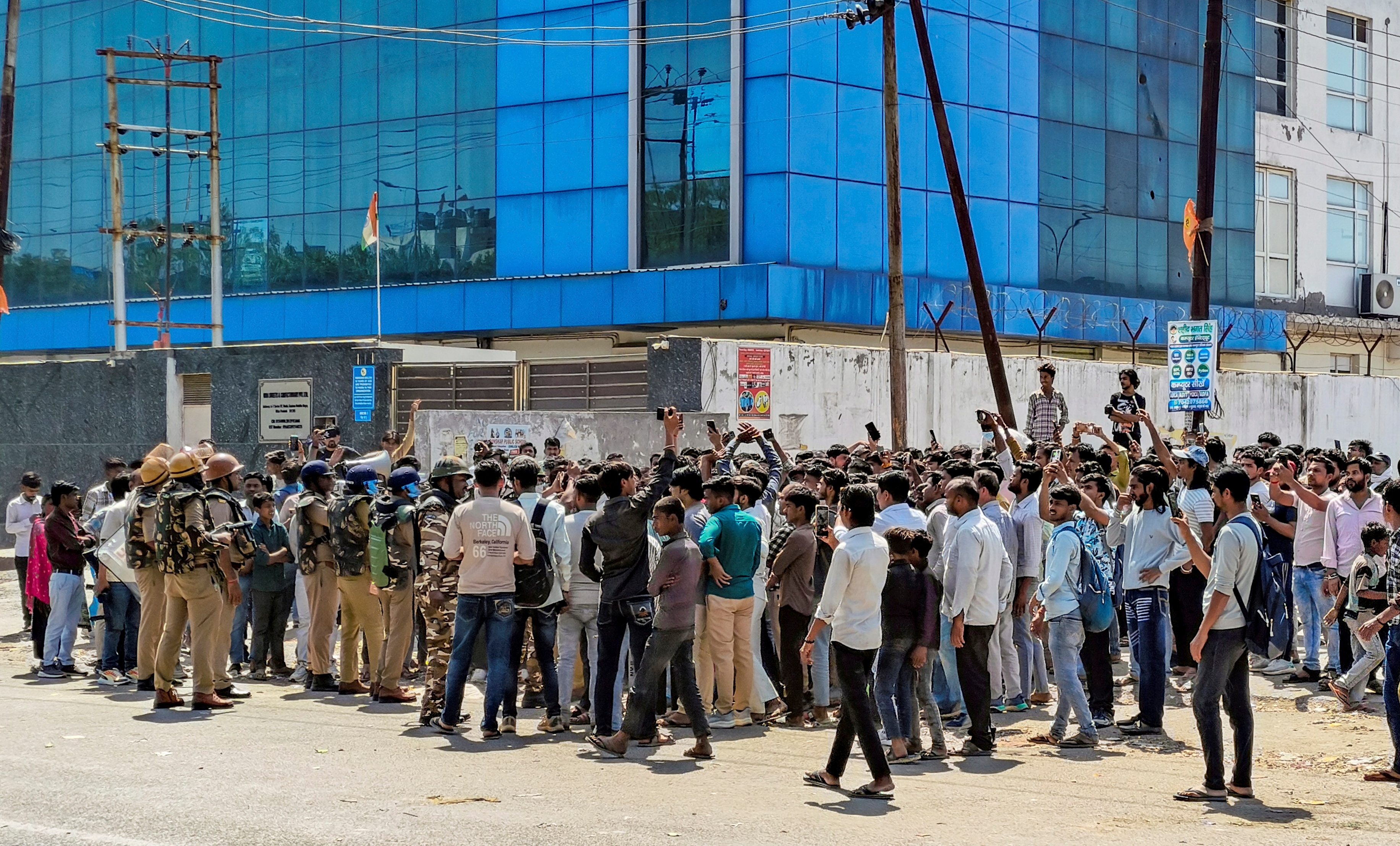 Noida: Factory workers during a protest demanding a hike in wages. (PTI Photo)
Police said seven FIRs had been registered at various police stations, and several “anti-social elements” had been taken into custody. FIRs had also been registered against two handles on X, police said. More than 50 bot accounts had been created in the past 24 hours to push “misleading narratives”, police said.
The vandalism and stone-throwing that began during the morning rush hour led to several major roads being blocked in Noida. The cascading traffic jams across the city and parts of Delhi continued until the evening.
The first protests by industrial workers took place on February 2 in Barauni in Bihar’s Begusarai district, home to an IOCL refinery and an HURL fertiliser unit. Protests in Surat, Gujarat, India’s diamond-cutting and polishing hub; Manesar, Haryana, an important centre for the automobile and electronics industries; and Panipat, also in Haryana, a hub for textiles and recycling, followed. Noida is home to footwear, textiles, and auto parts manufacturing units.
The common demand in these protests, led mainly by contractual workers, has been for better working conditions similar to those for regular employees, higher minimum wages, better overtime payments, and clearance of dues.
Story continues below this ad
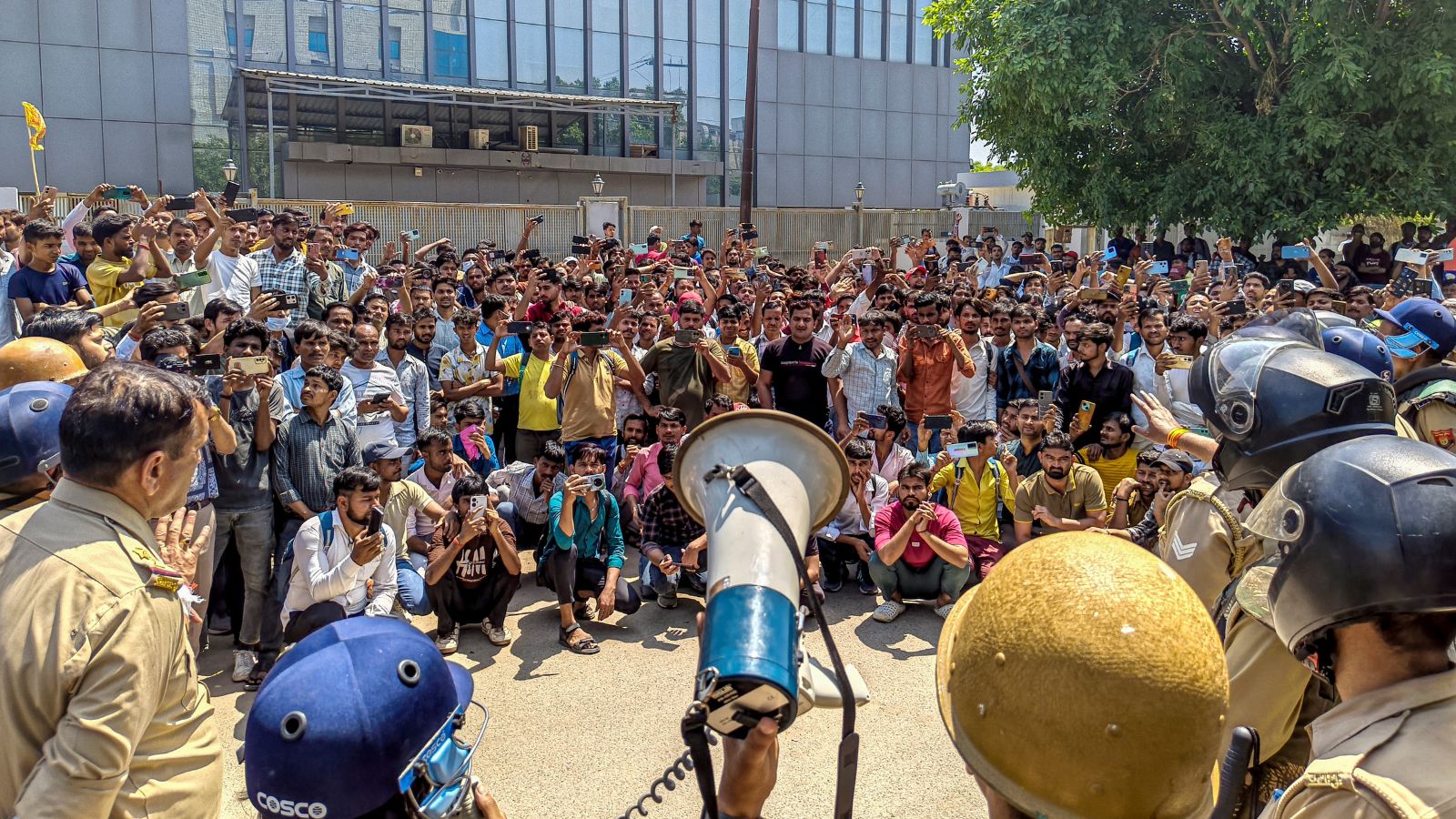 Factory workers during a protest demanding a hike in wages, in Noida, Gautam Buddh Nagar district, Uttar Pradesh, Monday. (PTI)
Sources in several workers’ unions told The Indian Express that workers were expecting an increase in wages after the implementation of the Labour Codes in November 2025. However, the wage revisions did not happen as expected, and the outbreak of the war in the Middle East and the shortage of cooking gas and the distress it has triggered in some sectors have deepened frustrations.
The Codes on Wages, Social Security, Industrial Relations, and Occupational Safety, Health and Working Conditions, which went into effect on November 21 last year, are intended to ease regulations and compliance norms for employers, as well as ensure uniformity in wage structure and social security protection for workers.
As the energy crisis has become worse over the past month, some migrant workers facing the brunt of the higher cost of living due to the shortage of LPG, have opted to temporarily return to their home towns.
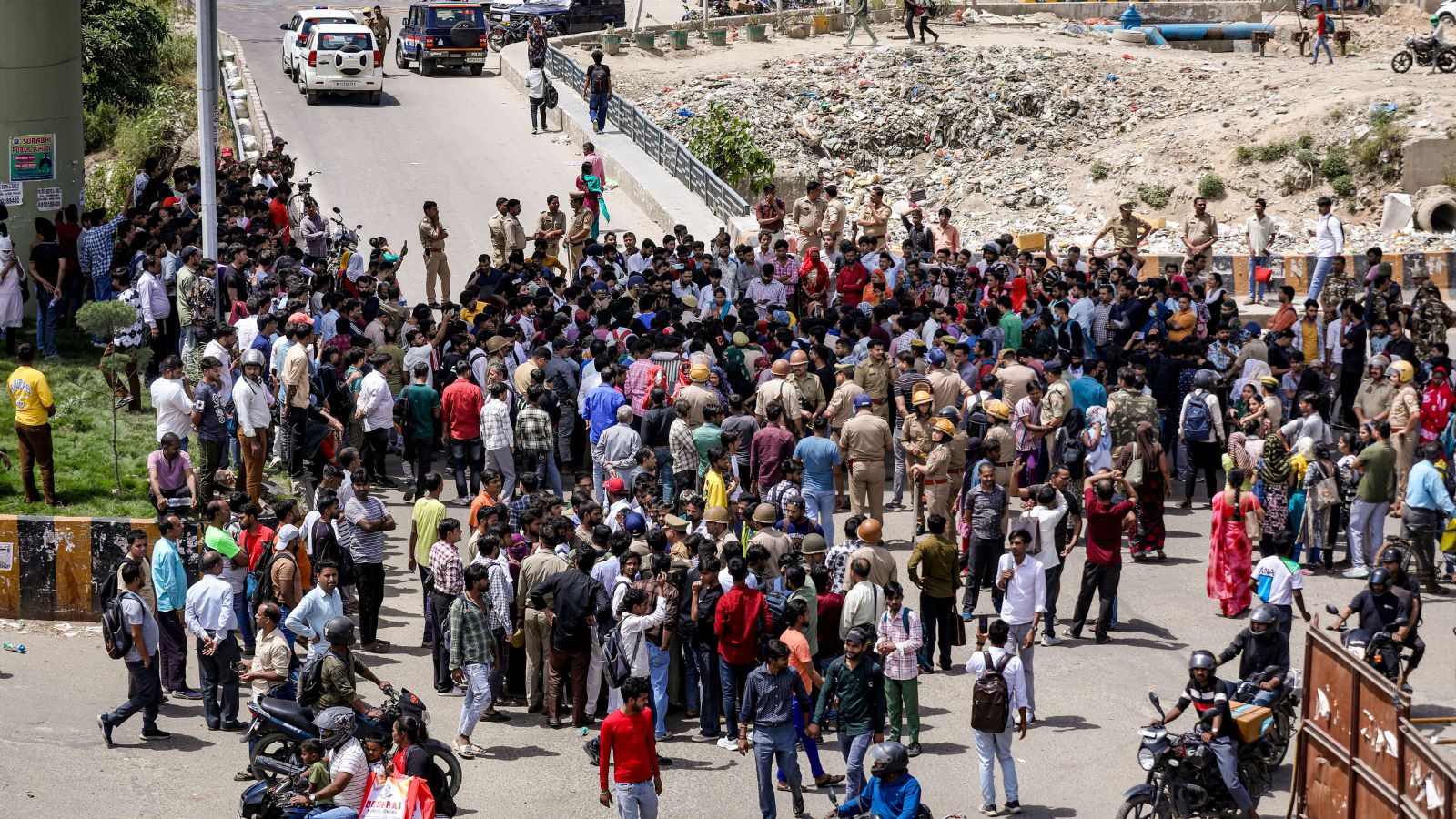 Factory workers during a protest demanding a hike in wages, in Noida, Gautam Buddh Nagar district, Uttar Pradesh, Monday. (PTI)
Monday’s protest in Noida comes after the Haryana government on April 9 revised minimum wages with effect from April 1, 2026. This was the first revision of wages after October 21, 2015. The basic monthly minimum wage for unskilled workers in Haryana is now Rs 15,220.71, and that for highly skilled workers is Rs 19,42.85. The corresponding per-day wage, which applies to contractual workers, is Rs 582.40 and Rs 747.14 respectively.
Story continues below this ad
The Haryana government notified the increases after large-scale protests by workers in key industrial centres including Manesar and Faridabad.
With Pratyush Deep, Ravi Dutta Mishra, Aanchal Magazine, Asad Rehman & Maulshree Seth